Introduction: Managing Dense Vegetation With the Right Mowing Equipment
Dense vegetation can create significant challenges for commercial landscaping contractors, agricultural operators, roadside maintenance teams, municipalities, and vegetation management companies. Thick grass, tall weeds, tangled plant growth, and mixed vegetation can increase mowing time, place greater demands on cutting equipment, and make site maintenance more difficult.
Traditional mowing equipment may be unsuitable for certain rough or overgrown areas, particularly where terrain is uneven, access is restricted, or operators need to maintain a safe distance from the cutting equipment.
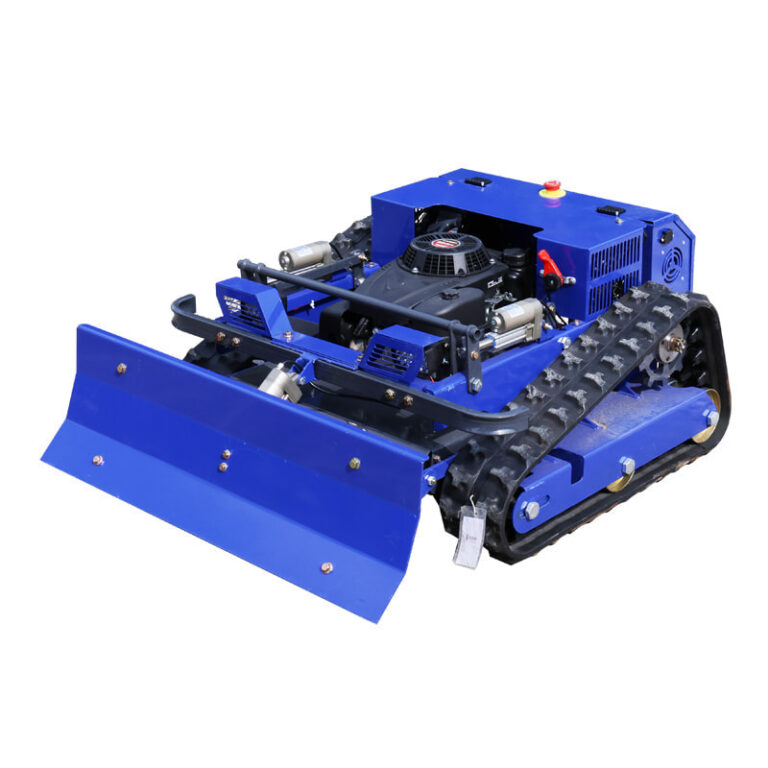
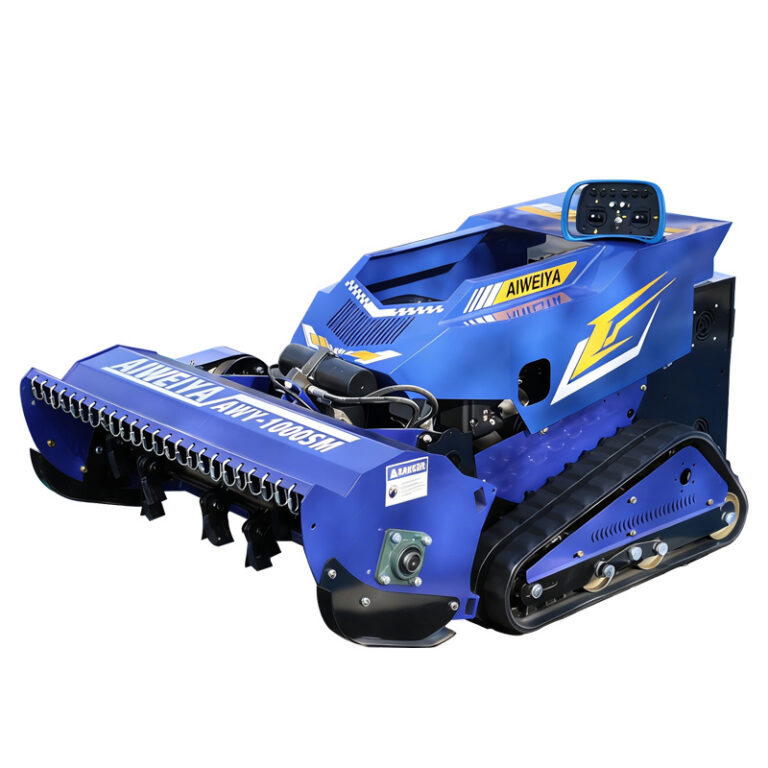
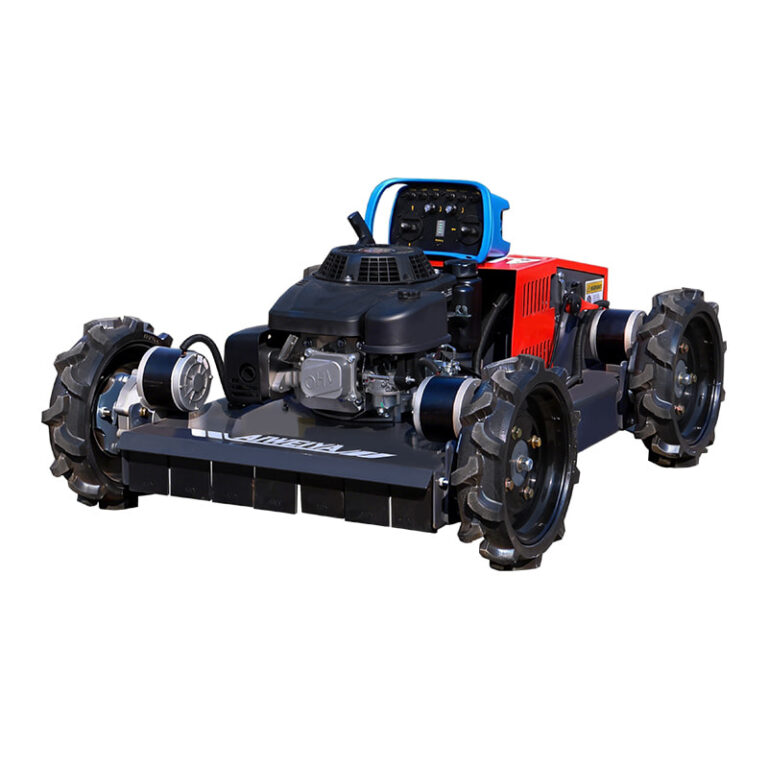
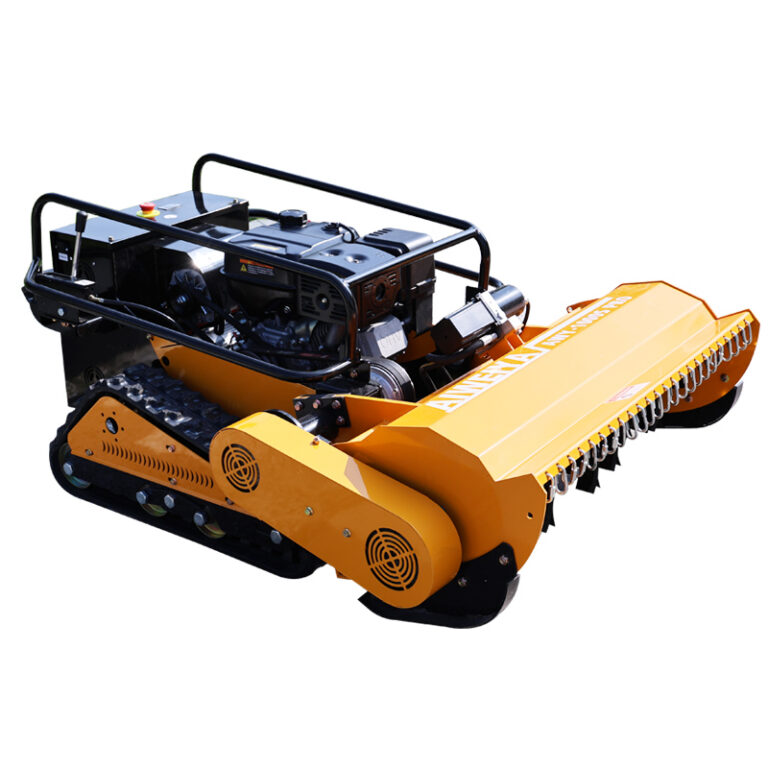
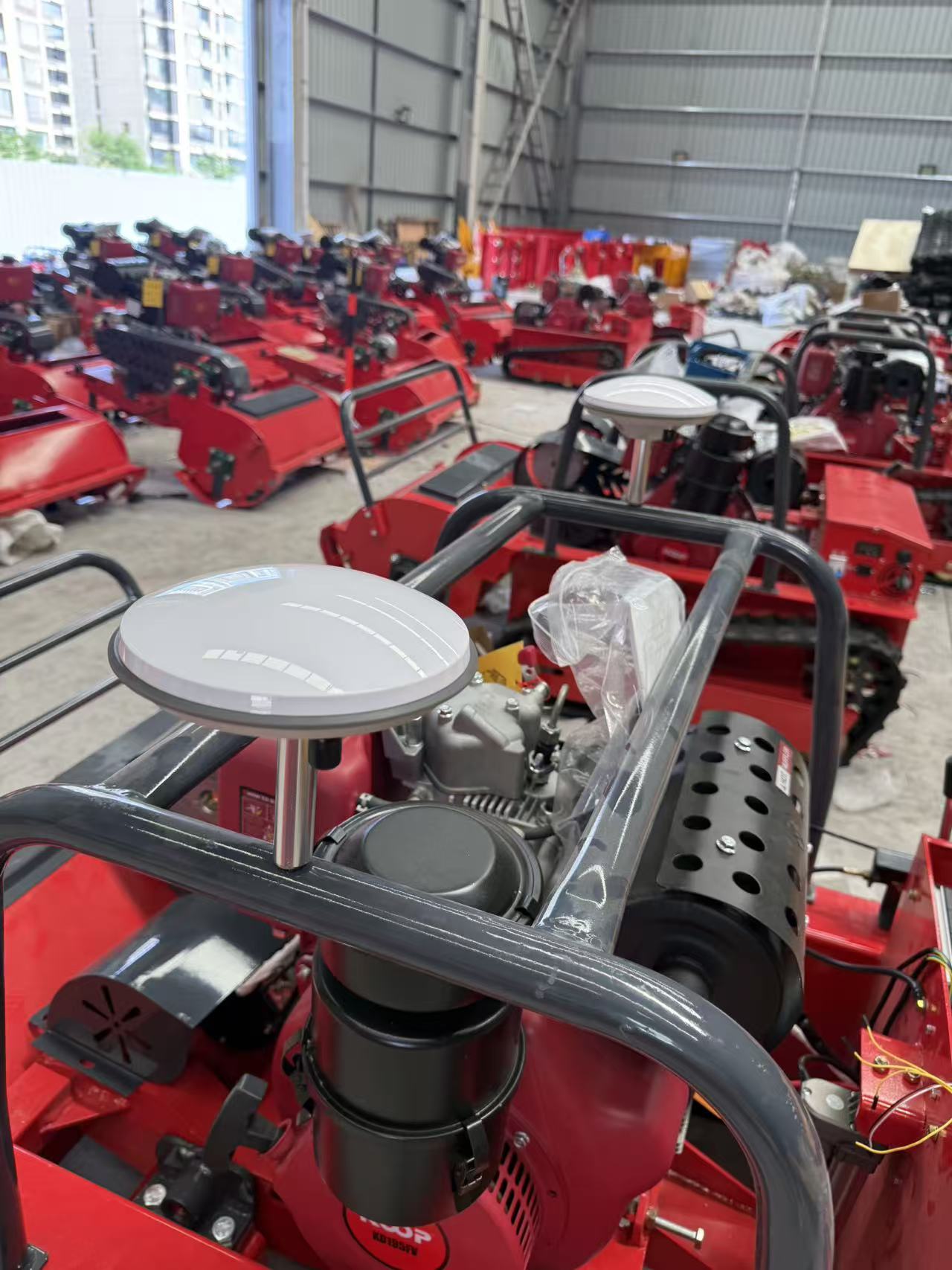
A remote control flail mower for dense vegetation offers an alternative for suitable applications. By combining remote operation with a flail cutting system, the machine can help professional users manage overgrown areas while allowing the operator to control the mower from a suitable position outside the immediate cutting zone.
However, not every remote control mower is designed for the same vegetation density. Engine power, rotor design, cutting width, ground conditions, machine stability, and operating speed all influence performance.
This guide explains how to evaluate a remote control flail mower for demanding vegetation management projects and what commercial buyers should consider before purchasing.
1. What Is a Remote Control Flail Mower for Dense Vegetation?
A remote control flail mower is a mowing machine that uses a rotating rotor fitted with multiple flail blades or hammer-style cutting tools. Depending on its design, the rotor cuts and processes vegetation as the machine moves across the ground.
When configured for appropriate working conditions, a flail mower can be used for vegetation such as:
- Tall grass and overgrown lawn areas
- Thick weeds and seasonal plant growth
- Mixed grass and soft-stemmed vegetation
- Certain types of light brush within the machine’s rated capability
- Vegetation along field margins, access roads, and commercial properties
The remote control system allows the operator to steer the mower and control its functions from a distance, subject to the machine’s operating range and configuration.
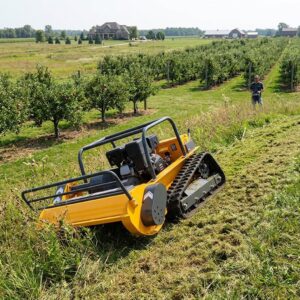
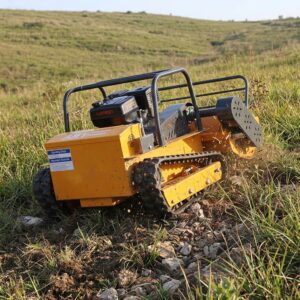
Tracked models can be particularly useful when ground conditions require additional traction or when the work area includes uneven terrain. Actual suitability depends on the machine design, ground conditions, slope limits, and vegetation being cut.
For commercial buyers, the key question is not simply whether a mower has a flail cutting system. It is whether the complete machine is appropriately matched to the intended workload.
2. Why Dense Vegetation Requires Different Mowing Considerations
Mowing thick vegetation is different from maintaining a regularly cut lawn.
When vegetation becomes tall, tangled, or densely packed, the cutting system may encounter greater resistance. Material can accumulate around the cutting area, and the engine may experience increased load.
Dense vegetation can also hide stones, branches, wire, uneven ground, and other obstacles. These conditions make equipment selection and operating procedures especially important.
Commercial buyers should assess four factors before choosing a mower.
Vegetation height: Tall growth may require a slower working speed or more than one pass, depending on the machine’s capabilities.
Vegetation thickness: Thick stems and tangled plant material can place greater demands on the rotor and cutting tools than ordinary grass.
Ground conditions: Wet soil, loose ground, ruts, and uneven surfaces can affect traction and maneuverability.
Maintenance frequency: Sites maintained regularly may present a different workload from land that has remained unmanaged for an entire growing season.
A suitable mower should be selected according to the most demanding normal working conditions expected at the site—not only the easiest mowing task.
3. How the Flail Cutting System Handles Heavy Vegetation
The cutting system is one of the most important components when selecting a mower for dense vegetation.
A flail rotor carries multiple cutting tools that rotate as the machine operates. The exact cutting action depends on the rotor speed, blade or hammer design, deck configuration, and material being processed.
For commercial applications, buyers should examine the following specifications.
Rotor and Flail Design
Different flail configurations are intended for different types of vegetation and working conditions. Lighter cutting tools may suit routine grass and weed management, while heavier configurations may be designed for more demanding vegetation within the manufacturer’s stated limits.
Ask the supplier which flail configuration is fitted as standard and whether alternative cutting tools are available.
Cutting Deck Construction
The deck protects and houses the cutting assembly. Its construction, internal clearance, and ability to manage cut material can affect performance in thick growth.
A robust appearance alone does not prove that a machine can handle heavy vegetation. Request technical information and, where possible, a demonstration using vegetation similar to your intended application.
Cutting Height and Material Flow
Dense vegetation may require adjustments to cutting height and travel speed. Trying to cut too much material in a single pass can reduce productivity or increase the risk of blockage and excessive load.
The correct operating method should follow the manufacturer’s instructions and the conditions on site.
4. Engine Power and Performance Under Load
Engine power is an important specification for a commercial remote control flail mower, especially when the machine is expected to work in dense vegetation.
However, higher engine power does not automatically guarantee better mowing results. Performance also depends on rotor design, power transmission, cutting width, working speed, cooling, and the type of vegetation.
When comparing machines, consider these points:
- Rated engine output: Check the manufacturer’s published power rating and how it relates to the complete cutting system.
- Power transmission: Understand how power is transferred to the cutting rotor and drive system.
- Cooling and ventilation: Dense vegetation and dusty environments may make proper maintenance of cooling components especially important.
- Working speed: A machine may need to move more slowly through heavy growth to maintain consistent cutting performance.
- Service requirements: Ask about engine servicing, filters, belts, and other wear or maintenance items.
If your business regularly handles thick weeds or overgrown land, request guidance on the recommended vegetation conditions and working method for the exact machine configuration.
Do not compare engine power figures in isolation. Compare the full specification and the intended duty cycle.
5. Why Crawler Tracks Matter on Rough and Overgrown Ground
Dense vegetation is often found on land that is not perfectly flat or regularly maintained. Examples include field margins, roadside banks, industrial land, and overgrown commercial properties.
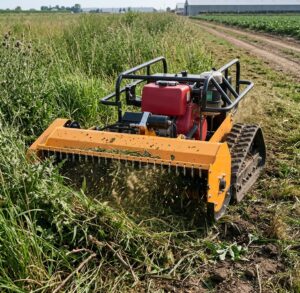
Crawler tracks can provide a continuous contact area with the ground, helping a suitably designed machine travel across certain uneven surfaces. Actual traction depends on track width, tread design, machine weight, weight distribution, and soil conditions.
A tracked remote control flail mower may be worth considering when the project includes:
- Uneven or rutted ground
- Rough grassland and unmanaged field margins
- Sloped areas within the machine’s approved operating limits
- Sites where ordinary wheeled equipment has difficulty maintaining traction
- Mixed vegetation across changing ground conditions
Tracks are not a guarantee of safe operation on every slope or in every soil condition. Wet grass, loose soil, hidden holes, and lateral slopes can still present serious challenges.
Before purchase, confirm the manufacturer’s slope limits and operating restrictions. Do not assume that a machine suitable for dense vegetation is automatically suitable for steep slopes.
Related article: Crawler vs Wheel Remote Control Mower
6. Choose the Right Cutting Width for the Work Area
Cutting width affects the amount of vegetation covered in each pass. A wider mower may cover more ground per pass in open areas, but it may not be the best choice for sites with narrow access or obstacles.
Commercial buyers should balance productivity with access requirements.
Open land: Wider cutting equipment may reduce the number of passes when ground conditions and vegetation allow.
Restricted access: A compact machine may be easier to maneuver between structures, along narrow paths, or through confined working areas.
Mixed terrain: If a project combines open ground with narrow sections, overall productivity may depend more on maneuverability than on maximum cutting width.
Transport requirements: Machine width and overall dimensions also affect loading, trailer selection, storage, and transport between job sites.
When comparing models, ask for the cutting width and overall machine width as separate measurements. Confirm whether the machine can pass through the narrowest access point at your intended worksite.
Related article: Remote Control Mower Cutting Width Explained
7. Adjust Working Speed to Vegetation Density
A mower’s rated travel speed is not necessarily the speed at which it will achieve its best results in dense vegetation.
Thick grass and weeds may require slower movement so the cutting rotor can process the material effectively. Faster travel through heavy growth can result in uneven cutting or excessive machine load.
For professional operations, productivity should be evaluated using the entire work cycle:
- Inspect the work area and identify hidden obstacles.
- Establish an appropriate cutting height and operating approach.
- Begin at a conservative speed suited to the vegetation.
- Monitor the cutting result and machine behavior.
- Adjust speed or make additional passes when needed.
- Inspect the machine and cutting tools according to the maintenance schedule.
For buyers comparing suppliers, ask about expected performance under clearly defined conditions. A useful comparison identifies vegetation type, approximate height and density, ground conditions, cutting width, and the required finish.
Avoid relying solely on a headline figure for maximum travel speed or theoretical area coverage.
8. Remote Operation and Operator Positioning
Remote operation can help an operator control a mower from a position selected according to the site’s layout and safety requirements.
This can be useful in overgrown areas where visibility, access, or proximity to the cutting equipment is a concern. However, remote control does not remove all operational hazards.
Before operating, the team should:
- Inspect the work area for stones, wire, branches, holes, and other hazards.
- Keep people and animals outside the designated exclusion zone.
- Maintain a suitable view of the mower and its direction of travel.
- Follow the manufacturer’s guidance for slopes and uneven terrain.
- Understand the emergency-stop and loss-of-signal procedures.
- Stop work if visibility, traction, or machine behavior becomes unsafe.
When evaluating a remote control system, check control responsiveness, operating range, emergency-stop functions, battery arrangements, and the procedures required if communication is interrupted.
For contractors managing multiple crews, operator training and consistent work procedures are just as important as the machine specification.
9. Commercial Applications for Dense Vegetation Mowing
A remote control flail mower may be suitable for a range of commercial vegetation management projects when its capabilities match the site’s conditions.
Landscaping and Property Maintenance
Landscaping contractors may use suitable machines to manage overgrown sections of large properties, vacant lots, and commercial grounds. The machine should be selected according to access, vegetation type, and the required finish.
Roadside and Embankment Maintenance
Road maintenance contractors often encounter thick grass and weeds along road shoulders, drainage areas, and embankments. Site access, traffic management, ground conditions, and slope limits should be assessed before work begins.
Related article: Remote Control Mower for Roadside Vegetation Control
Farms and Orchards
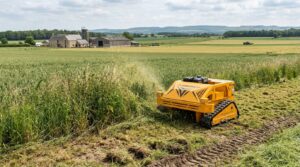
Agricultural operators may need to control weeds and grass along field margins, farm access routes, orchard areas, and other land that is not regularly maintained. Machine dimensions and clearance are particularly important where trees, crops, or other obstacles are present.
Related article: Remote Control Mower for Farm Vegetation Management
Solar Farms and Industrial Properties
Solar sites and industrial properties may have recurring vegetation control requirements. Buyers should consider narrow access routes, fixed infrastructure, drainage, maintenance schedules, and the need to avoid damaging surrounding equipment.
Related article: Remote Control Mower for Solar Farm Vegetation Management
For all these applications, the mower must be matched to the actual vegetation and ground conditions. Very woody growth, large branches, stumps, and other materials may exceed the machine’s rated capability and require different equipment.
10. Maintenance for Frequent Heavy-Duty Mowing
Regular maintenance is essential when a mower is used frequently in dense vegetation. Heavy workloads can increase wear on cutting tools and place additional demands on the engine, transmission, tracks, and other components.
A commercial maintenance plan should address the following areas.
Flail blades and fasteners: Inspect cutting tools for wear, damage, and secure attachment according to the manufacturer’s instructions.
Cutting deck: Remove accumulated vegetation safely, following the required shutdown and isolation procedures.
Tracks and undercarriage: Check track condition, tension where applicable, rollers, and accumulated debris.
Engine and cooling system: Follow the prescribed service intervals and keep air intakes and cooling components clean.
Hydraulic or drive components: Inspect relevant hoses, connections, belts, and drive components according to the machine design.
Remote control system: Check controller condition, batteries, communication functions, and emergency-stop operation.
Replacement parts: Identify the components likely to require regular replacement and confirm their availability before ordering a machine for commercial use.
Always shut down and isolate the machine as specified before inspection or cleaning. Never approach a cutting rotor while it is operating or before all required shutdown procedures have been completed.
For fleet operators, maintenance records can help identify recurring wear, plan servicing, and reduce unexpected downtime.
Related article: Remote Control Mower Maintenance Guide for Commercial Users
11. What B2B Buyers Should Check Before Ordering
For importers, distributors, rental businesses, and professional contractors, purchasing a remote control flail mower is also a supplier-evaluation decision.
A useful supplier assessment should include the following questions.
Machine Configuration
- Which engine and cutting system are included in the quoted configuration?
- What vegetation types and working conditions does the manufacturer recommend?
- What are the cutting width, machine width, weight, and rated travel speed?
- What are the documented slope limits and operating restrictions?
Parts and Technical Support
- Which spare parts are recommended for routine maintenance?
- Are parts lists, operation manuals, and maintenance instructions available?
- What technical support is available for overseas buyers?
- What warranty terms apply, and which items are excluded?
Wholesale and Customization
- Are sample orders and bulk orders available?
- Can the supplier discuss OEM or private-label requirements?
- What are the minimum order quantities for customized configurations?
- What packaging, shipping, and documentation options are available?
Demonstration and Verification
Where possible, request a demonstration or recorded test that represents your intended working conditions. Clarify the vegetation type, ground conditions, machine configuration, and operating method so that the results are meaningful.
Do not assume that a general product video proves performance in every type of dense vegetation.
12. How to Compare Quotations From Different Manufacturers
The lowest initial quotation may not represent the best commercial value. Buyers should compare equivalent configurations and calculate the expected cost of ownership.
| Comparison item | What to verify |
|---|---|
| Engine | Brand, model, rated output, service requirements |
| Cutting system | Rotor configuration, cutting tools, deck design |
| Drive system | Crawler tracks or wheels, traction characteristics |
| Dimensions | Cutting width, overall width, machine weight |
| Remote control | Functions, range, emergency-stop features |
| Spare parts | Availability, pricing, delivery arrangements |
| Warranty | Coverage, exclusions, claim procedures |
| Customization | OEM options, labeling, packaging, minimum quantities |
| Logistics | Packaging, shipping terms, delivery arrangements |
| Documentation | Manuals, parts lists, technical specifications |
For distributors and dealers, it is also useful to assess whether the supplier can maintain consistent product configurations, provide product information for local marketing, and support repeat orders.
For contractors, the priorities may instead be uptime, ease of maintenance, suitability for the worksite, and service costs over the expected service life.
13. Why Work With NUOYU for Remote Control Mower Solutions?
NUOYU offers remote control mower products and application-oriented solutions for professional and commercial buyers.
When evaluating NUOYU equipment for dense vegetation management, buyers can discuss the intended application and request information about the available machine configurations, cutting systems, track options, dimensions, and technical requirements.
Before selecting a model, provide details about:
- The main vegetation types and approximate density
- The terrain and ground conditions
- The required cutting width and access limitations
- The expected operating frequency
- The intended market and purchasing quantity
- Any OEM, private-label, or distributor requirements
This information helps establish whether a particular configuration is appropriate for the intended workload.
Explore the relevant options:
- NUOYU Remote Control Flail Mower Products
- NUOYU Vegetation Management Solutions
- Contact NUOYU for a Commercial Quotation

14. Frequently Asked Questions
Can a remote control flail mower cut dense grass?
Yes, a suitably configured remote control flail mower can be used for dense grass, provided the vegetation and working conditions fall within the manufacturer’s recommended operating limits. Cutting performance depends on the machine’s power, rotor design, cutting width, and operating speed.
Is a flail mower suitable for tall weeds?
Many flail mower configurations are designed for grass and weed management, including certain types of tall growth. However, vegetation height, stem thickness, moisture, and density affect performance. Confirm the recommended working conditions for the exact model.
Can a remote control flail mower cut brush?
Some models can handle light brush or woody vegetation within their rated capability. Larger woody plants, thick branches, and stumps may require specialized equipment. Ask the manufacturer to confirm the machine’s limitations before use.
Are crawler flail mowers better for rough ground?
Crawler tracks can offer useful ground contact and traction on certain uneven surfaces. Actual performance depends on track design, machine weight, soil conditions, and terrain. Tracks do not eliminate the risks associated with unstable or excessively steep ground.
Does a wider cutting width always improve productivity?
No. A wider cutting width can increase coverage in open areas, but restricted access, obstacles, dense vegetation, and slower operating speeds may reduce the advantage. Select a cutting width that matches the site’s layout and working conditions.
What should commercial buyers ask a manufacturer?
Buyers should ask about engine power, cutting system, approved vegetation types, machine dimensions, slope limits, safety functions, maintenance schedules, spare parts, warranty terms, and technical support. Dealers should also confirm wholesale, OEM, and private-label conditions where relevant.
How can I obtain a quotation for a remote control flail mower?
Contact the supplier with your intended application, vegetation conditions, terrain, preferred configuration, estimated order quantity, and destination market. This helps the supplier prepare a more relevant quotation and identify any technical details that need clarification.
Conclusion
A remote control flail mower for dense vegetation can be a valuable option for professional land maintenance when the machine is properly matched to the workload.
The most important considerations are the cutting system, engine performance under load, crawler traction where needed, cutting width, working speed, operator safety, and long-term maintenance requirements.
For contractors, importers, distributors, and other B2B buyers, the best purchasing decision comes from comparing complete machine configurations and supplier support—not from relying on a single specification or the lowest initial price.
If your business manages thick grass, heavy weeds, or frequently overgrown commercial sites, define the working conditions first and then request a configuration suited to your application.
Looking for a remote control flail mower for your commercial vegetation management business? Contact NUOYU to discuss your application, product options, and wholesale requirements.