Mowing a flat lawn is relatively straightforward.
Maintaining vegetation on a slope is a completely different challenge.
Hillsides, roadside embankments, drainage banks, commercial landscaping slopes, and agricultural terrain can make conventional mowing difficult because the operator and machine must deal with changing ground angles, traction conditions, visibility, and access.
For professional landscaping companies, municipal maintenance teams, agricultural contractors, roadside maintenance businesses, and vegetation-management companies, a remote control mower for slope mowing can provide an alternative approach for suitable applications.
Instead of sitting directly on the machine, the operator can control the mower remotely while maintaining an appropriate observation position.
When combined with crawler tracks and a suitable cutting system, a remote mower can be useful for certain slope-maintenance projects.
However, slope mowing requires careful equipment selection.
The machine should be evaluated according to:
- Slope angle
- Ground condition
- Traction
- Machine stability
- Center of gravity
- Cutting system
- Vegetation density
- Weather conditions
- Operator visibility
- Manufacturer operating limits
This guide explains what commercial buyers should know before purchasing a remote control mower for slope mowing.
1. What Is a Remote Control Slope Mower?
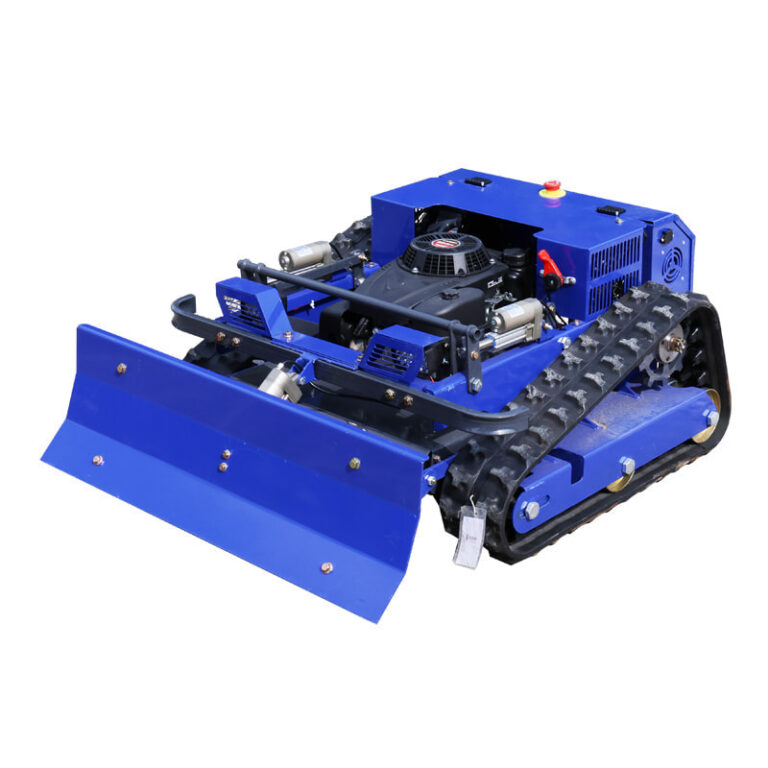
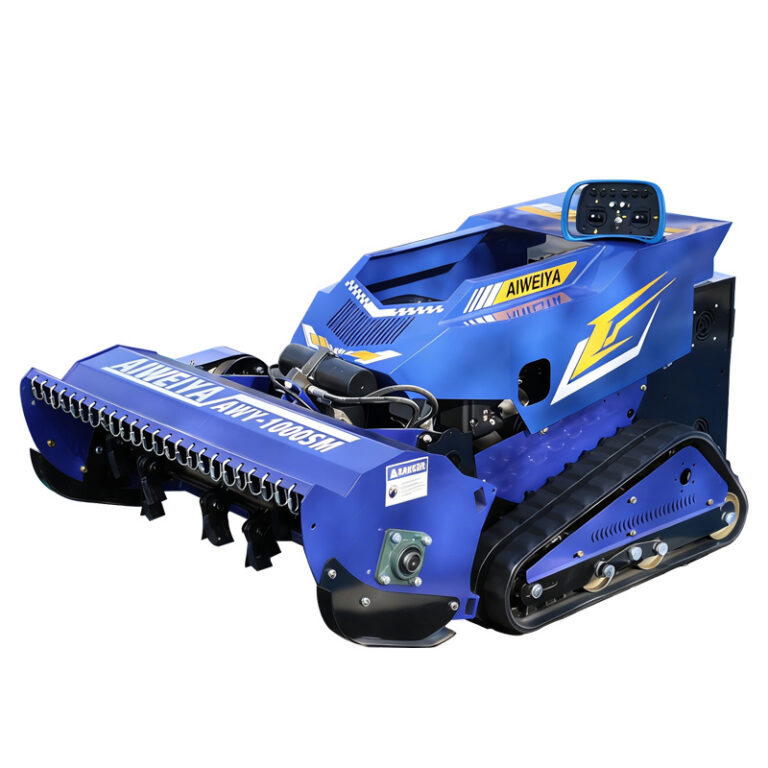
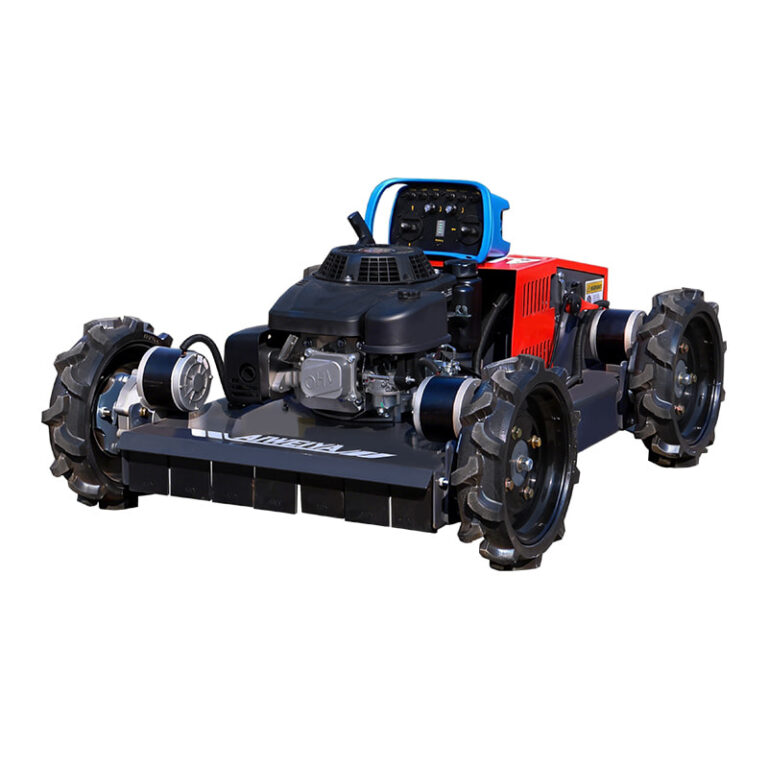
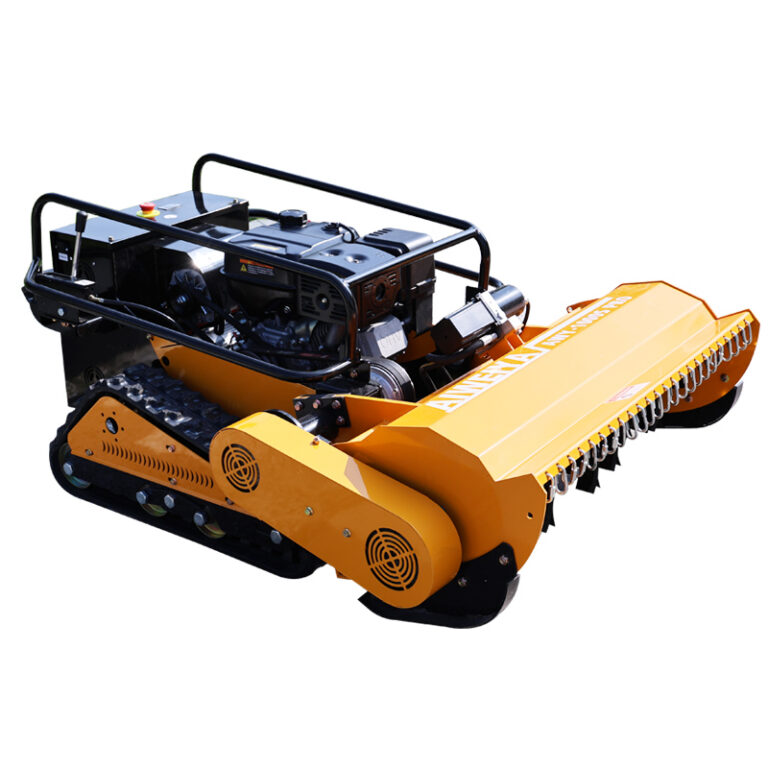
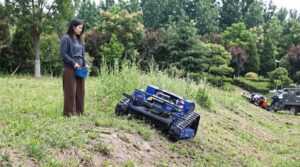
A remote control slope mower is a remotely operated mowing machine designed for vegetation-management applications that may involve sloped or uneven terrain.
The machine typically combines:
- Remote-control operation
- Motorized drive system
- Mowing deck
- Traction system
- Safety controls
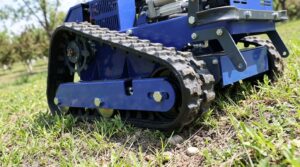
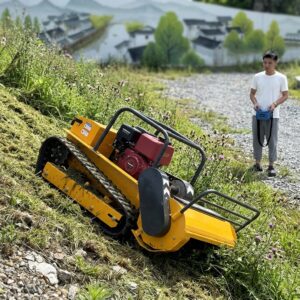
Some models use crawler tracks rather than conventional wheels.
Crawler tracks can provide a larger ground-contact area, which may help the machine maintain traction on certain uneven surfaces.
However, a tracked mower is not automatically suitable for every slope.
The manufacturer’s specifications should always define the approved operating conditions.
2. Why Is Slope Mowing More Difficult Than Flat-Ground Mowing?
Several factors make hillside mowing more demanding.
Gravity
The machine must work against gravity when traveling uphill or across a slope.
Traction
Grass, soil, moisture, and loose materials can affect traction.
Stability
The machine’s center of gravity and weight distribution influence stability.
Visibility
The operator needs a clear view of the mower and its working area.
Ground Conditions
A slope may contain:
- Holes
- Rocks
- Ruts
- Loose soil
- Wet grass
- Drainage channels
These conditions can change the way a machine behaves.
For this reason, slope mowing should never be evaluated only by looking at the advertised maximum slope angle.
3. Why Crawler Tracks Are Important for Slope Mowing
Crawler tracks are one of the most noticeable features of many remote control slope mowers.
Compared with a conventional wheel configuration, a crawler system can distribute the machine’s weight over a larger contact area.
Potential advantages include:
- Strong ground contact
- Traction on certain uneven surfaces
- Reduced wheel-slip in suitable conditions
- Ability to work across rough grassland
- Stable movement when properly operated
However, track design varies between machines.
Commercial buyers should evaluate:
- Track width
- Track tread design
- Ground contact length
- Machine weight
- Weight distribution
- Ground clearance
- Drive torque
The actual performance should be assessed under conditions similar to the intended application.
4. What Slope Angle Can a Remote Mower Handle?
This is one of the most important questions from commercial buyers.
There is no single slope angle that applies to every remote control mower.
Maximum operating angle depends on:
- Machine design
- Center of gravity
- Track configuration
- Surface conditions
- Direction of travel
- Vegetation
- Moisture
- Machine weight
- Manufacturer testing
A slope that appears manageable under dry conditions may become significantly more difficult after rain.
Therefore, buyers should ask the manufacturer for:
- Maximum recommended operating slope
- Maximum lateral slope
- Maximum uphill/downhill angle
- Recommended direction of travel
- Surface limitations
- Weather restrictions
Never select a mower simply because a product listing shows a large numerical slope angle.
The real working conditions are more important.
5. Why Surface Conditions Matter
A slope is not simply an angle.
Two hillsides with the same angle can behave very differently.
Dry Grass
Dry, firm grass may provide better traction.
Wet Grass
Wet vegetation can become slippery and may significantly affect traction.
Loose Soil
Loose soil can reduce stability and increase the possibility of track slip.
Mud
Mud can make both traction and steering more difficult.
Gravel or Stones
Loose stones can affect track contact and machine movement.
Hidden Holes
Vegetation can hide depressions that are difficult to see from a distance.
For professional operators, weather and ground conditions should be evaluated before beginning work.
6. Remote Operation on Slopes
Remote operation is particularly useful when the operator needs to maintain a suitable position away from the mower.
Instead of sitting on the machine, the operator can stand at a location that provides a clear view of:
- The mower
- The slope
- The cutting area
- Potential obstacles
- The machine’s direction of movement
This allows the operator to continuously monitor the machine.
However, remote control should not be considered a replacement for operator training.
Operators should understand:
- Machine controls
- Emergency-stop functions
- Communication range
- Terrain limitations
- Safe operating procedures

7. Slope Mowing for Roadside Embankments
Roadside embankments are common applications for professional slope mowing equipment.
Vegetation may grow along:
- Highway embankments
- Road shoulders
- Drainage banks
- Access roads
- Bridge approaches
- Industrial roads
These areas can be difficult to access with conventional mowing equipment.
A remote control mower may be considered where:
- The machine can safely access the slope
- The terrain falls within the manufacturer’s limits
- The vegetation is appropriate for the cutting system
- Traffic and work-zone requirements are properly managed
For roadside contractors, machine width can also be important.
A mower that is easy to transport and maneuver can be more practical for teams working across multiple sites.
8. Slope Mowing for Municipalities
Municipalities are responsible for maintaining many types of public land.
Potential applications include:
- Public parks
- Drainage channels
- Roadside slopes
- Retention areas
- Green spaces
- Public embankments
Municipal buyers typically need equipment that can provide:
- Reliable operation
- Consistent maintenance
- Easy servicing
- Operator training
- Spare-parts availability
- Long-term supplier support
Procurement teams should evaluate the total cost of ownership rather than only the initial equipment price.
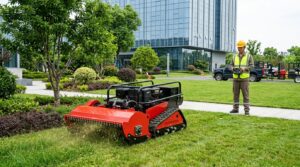
9. Slope Maintenance for Landscaping Contractors
Professional landscaping contractors may encounter slopes on:
- Residential developments
- Commercial properties
- Hotels
- Resorts
- Golf-related landscapes
- Industrial sites
- Large estates
In these projects, appearance is often important.
The cutting system should therefore be selected according to the desired finish.
For regular grass maintenance, a configuration optimized for lawn or grass cutting may be appropriate.
For rougher vegetation, a flail mowing system may provide greater versatility within its rated application.
The contractor should match the machine to the customer’s actual requirements.
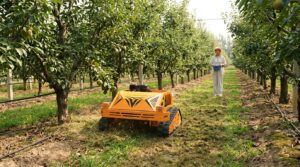
10. Remote Mowers for Agricultural Slopes
Agricultural properties can include:
- Hillside fields
- Orchard slopes
- Grass banks
- Farm access roads
- Field boundaries
Remote mowing equipment may help manage vegetation in suitable areas.
However, agricultural applications require additional attention to:
- Crops
- Irrigation
- Fences
- Trees
- Drainage
- Livestock
Operators should establish clear boundaries before starting work.
11. Choosing the Right Cutting System for Slopes
Slope mowing is not only about mobility.
The cutting system must also match the vegetation.
Grass
For regularly maintained grass, a standard mowing deck may be appropriate.
Tall Grass
Tall grass may require more cutting capacity and careful speed management.
Weeds
Dense weeds can increase the load on the cutting system.
Mixed Vegetation
A flail mower may be considered for suitable mixed vegetation applications.
Brush
Some configurations may handle light brush within their specified limits.
Large woody vegetation, stumps, and heavy forestry material generally require specialized equipment.
Always confirm the manufacturer’s application range.
12. Cutting Width and Hillside Access
A wider mower can cover more ground per pass.
However, wider machines may not always be ideal for slope applications.
Consider:
- Slope width
- Access roads
- Obstacles
- Trees
- Fences
- Drainage channels
- Machine transport
For narrow embankments, a compact mower may be easier to maneuver.
For large open slopes, a wider cutting deck may improve productivity.
The ideal configuration depends on the complete project.
13. How Weather Affects Slope Mowing
Weather can significantly affect mowing conditions.
Rain
Rain can make slopes slippery.
Strong Wind
Wind can affect visibility and operator comfort.
Extreme Heat
High temperatures can increase stress on engines and hydraulic or electrical systems depending on machine design.
Wet Vegetation
Wet grass can increase cutting resistance and may create additional traction challenges.
For this reason, commercial teams should consider weather conditions as part of daily work planning.
If ground conditions are unsuitable, postponing the job may be safer than attempting to operate beyond the machine’s recommended conditions.
14. Safety Considerations for Slope Mowing
Safety should be a primary consideration when using any powered equipment on slopes.
Before operating, inspect the site for:
- Holes
- Rocks
- Loose soil
- Drainage channels
- Fences
- Utility infrastructure
- Fallen branches
- People
- Animals
The operator should:
- Inspect the terrain.
- Confirm that the slope is within the machine’s operating limits.
- Establish an appropriate operating area.
- Maintain a clear line of sight.
- Keep unauthorized people away from the working zone.
- Follow the manufacturer’s operating procedures.
- Stop the machine if conditions become unsafe.
Do not operate beyond the manufacturer’s specified limits.
15. Why Machine Stability Matters More Than Maximum Speed
Commercial buyers sometimes focus on maximum travel speed.
For slope mowing, stability and controllability are generally more important than maximum speed.
A machine that moves efficiently but becomes difficult to control on challenging terrain may not be appropriate for the application.
Evaluate:
- Track design
- Machine weight
- Center of gravity
- Steering behavior
- Remote-control responsiveness
- Braking
- Emergency-stop system
For slope projects, predictable machine behavior is a key consideration.
16. Maintenance After Slope Mowing
Slope mowing can expose the machine to:
- Dust
- Grass
- Soil
- Moisture
- Debris
After operation, inspect the machine according to the manufacturer’s maintenance schedule.
Pay particular attention to:
Tracks
Check for damage, debris, and abnormal wear.
Cutting Deck
Remove accumulated vegetation safely.
Cutting Tools
Inspect for wear or damage.
Engine
Check air filters, cooling areas, and other service points.
Fasteners
Inspect components that may experience vibration during operation.
Remote Control
Check batteries, controls, and emergency functions.
Regular maintenance helps commercial operators reduce unexpected downtime.
17. Transporting a Remote Control Slope Mower
Many contractors work across multiple properties.
Transportation therefore becomes an important purchasing consideration.
Before purchasing, check:
- Machine dimensions
- Machine weight
- Loading method
- Trailer compatibility
- Tie-down points
- Storage requirements
A compact machine that can be transported easily between projects may offer greater operational flexibility.
For contractors with multiple crews, transportation efficiency can have a significant effect on daily productivity.

18. Buying a Remote Control Slope Mower for Your Business
Before requesting a quotation, prepare information about your typical projects.
Property Information
Provide:
- Approximate area
- Slope conditions
- Access limitations
- Ground type
Vegetation Information
Describe:
- Grass height
- Weed density
- Brush presence
- Cutting frequency
Business Information
Tell the supplier whether you are:
- Landscaping contractor
- Agricultural contractor
- Municipal buyer
- Equipment dealer
- Rental company
- Property maintenance company
Purchasing Information
Include:
- Required quantity
- Destination market
- OEM requirements
- Spare-parts requirements
This information allows manufacturers to recommend a more appropriate configuration.
19. What B2B Buyers Should Ask the Manufacturer
Before placing an order, ask:
Technical Questions
- What is the recommended slope range?
- What cutting system is installed?
- What vegetation can the machine process?
- What is the cutting width?
- What is the machine weight?
- What are the machine dimensions?
Remote-Control Questions
- What is the operating range?
- What functions can be controlled remotely?
- What happens if communication is interrupted?
- Is an emergency-stop function included?
Service Questions
- What spare parts are available?
- What is the warranty?
- Are operation manuals provided?
- Is technical support available?
Commercial Questions
- What is the MOQ?
- What is the lead time?
- Is OEM/ODM available?
- What packaging options are available?
A detailed quotation should include enough information to compare equivalent configurations from different suppliers.
20. Remote Control Mower vs Traditional Slope Mowing Equipment
Different businesses may use different equipment depending on the property.
| Feature | Remote Control Mower | Traditional Ride-On Mower |
|---|---|---|
| Operator position | Remote | On machine |
| Difficult terrain | Depends on model | Depends on model |
| Slope applications | Suitable models available | More limited depending on machine |
| Large open areas | Suitable | Suitable |
| Operator exposure | Remote position | Directly on machine |
| Transportation | Model dependent | Model dependent |
| Vegetation management | Configuration dependent | Configuration dependent |
| Commercial use | Yes | Yes |
The best choice depends on the site, vegetation, operating requirements, and budget.
21. Total Cost of Ownership
Commercial buyers should look beyond the purchase price.
Total cost can include:
Machine Price + Shipping + Fuel + Maintenance + Wear Parts + Spare Parts + Labor + Downtime
For contractors, downtime can directly affect project schedules.
For dealers, spare-parts availability and warranty support can influence customer satisfaction.
A supplier offering comprehensive technical support may provide greater long-term value than a supplier competing only on initial price.
22. Why Choose NUOYU for Remote Control Slope Mowing Solutions?
NUOYU provides remote control mower solutions for professional and commercial vegetation-management applications.
Potential applications include:
- Slope mowing
- Embankment maintenance
- Landscaping
- Farm vegetation management
- Roadside vegetation control
- Industrial property maintenance
- Commercial landscaping
- Large-area vegetation management
For B2B customers, machine selection can be discussed according to:
- Terrain
- Vegetation
- Cutting requirements
- Machine dimensions
- Quantity
- Spare-parts requirements
- OEM/ODM requirements
If you are a distributor, contractor, rental company, or commercial property maintenance business, provide your typical application details when requesting a quotation.
FAQ: Remote Control Mower for Slope Mowing
1. Can a remote control mower cut grass on slopes?
Some remote control mowers are designed for suitable slope applications. The actual capability depends on machine design, terrain, surface conditions, vegetation, and the manufacturer’s operating limits.
2. Are tracked remote mowers good for hillsides?
Crawler tracks can provide strong ground contact and traction on certain uneven surfaces. However, the machine must still be operated within its specified limits.
3. What is the maximum slope a remote mower can handle?
There is no universal maximum. The allowable slope depends on the specific machine and operating conditions. Buyers should obtain the manufacturer’s rated slope specifications before purchase.
4. Can remote mowers be used on roadside embankments?
They may be suitable for certain roadside embankment applications. Contractors must evaluate terrain, traffic, vegetation, access, and local work-zone requirements.
5. Can a remote mower work on wet grass?
Wet grass can reduce traction and make slope mowing more difficult. Operators should evaluate actual site conditions and follow the manufacturer’s recommendations.
6. Are remote control slope mowers suitable for landscaping contractors?
Yes. They can be considered for commercial landscaping projects involving suitable slopes, large properties, embankments, and difficult-to-access vegetation.
7. Can a remote control mower cut brush on a slope?
Some configurations can handle certain types of light brush. However, buyers should confirm the permitted vegetation type and maximum material size with the manufacturer.
8. What should I provide when requesting a quotation?
Provide information about slope conditions, vegetation type, property size, access, expected working frequency, required cutting width, purchase quantity, and destination market.
Conclusion
Slope mowing requires a different approach from conventional flat-ground lawn maintenance.
For suitable applications, a remote control mower for slope mowing can provide commercial landscaping contractors, agricultural operators, municipalities, roadside maintenance companies, and property managers with a flexible vegetation-management solution.
The most important factors to evaluate include:
- Slope angle
- Ground conditions
- Crawler-track design
- Machine stability
- Cutting system
- Engine performance
- Cutting width
- Remote-control functions
- Safety systems
- Maintenance requirements
- Spare-parts support
Most importantly, buyers should select equipment according to the actual job site rather than relying on a single specification such as maximum slope angle or engine power.
For businesses managing hillsides, embankments, roadside vegetation, or commercial landscapes, the right remote mower can become a valuable addition to a professional vegetation-management fleet.
Looking for a remote control mower for slope mowing? Contact NUOYU to discuss your terrain, vegetation, machine configuration, and commercial purchasing requirements.