Vegetation management is an important part of maintaining many agricultural properties.
Farm operators may need to control grass, weeds, brush, and unwanted vegetation around fields, access roads, drainage areas, boundaries, livestock facilities, orchards, and other working zones.
Unlike conventional lawns, agricultural properties often contain uneven ground, rough vegetation, slopes, muddy areas, stones, ditches, and obstacles. Large farms may also have extensive areas that require regular maintenance.
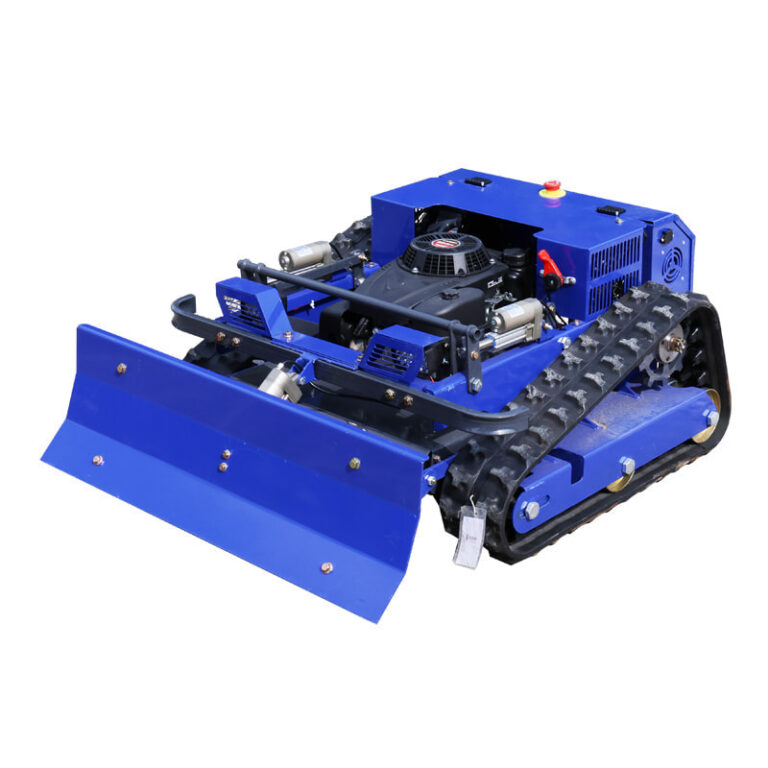
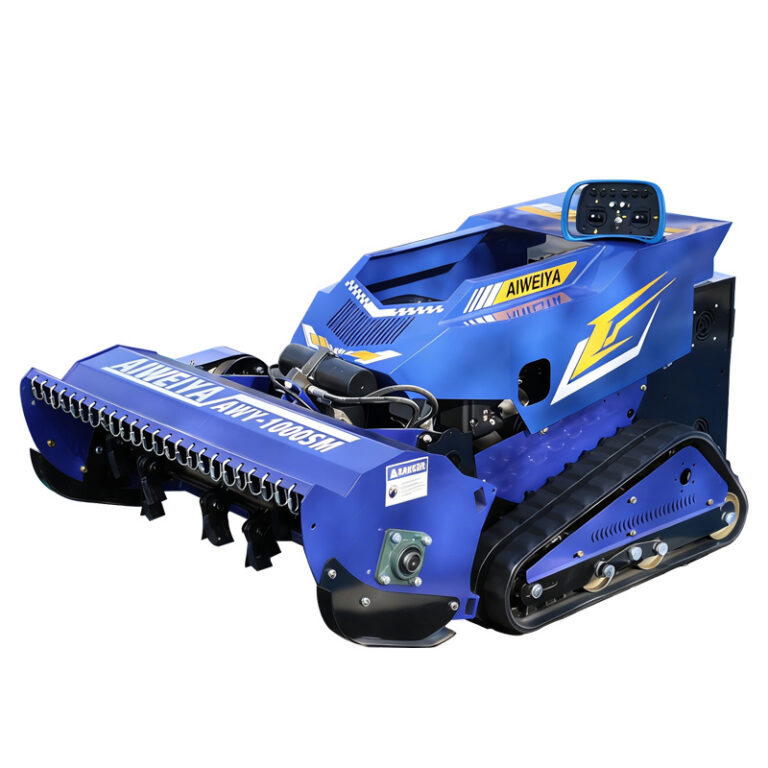
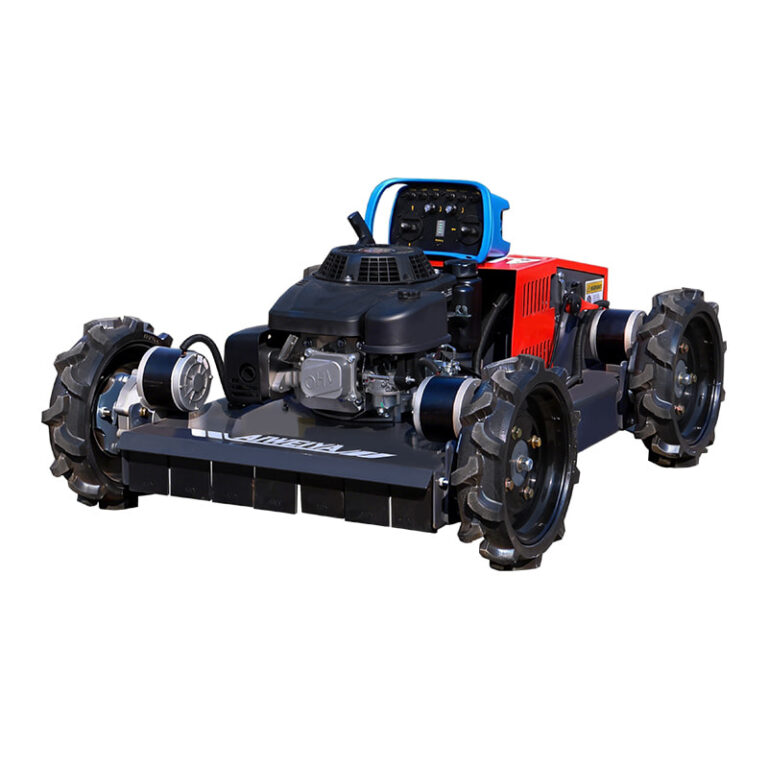
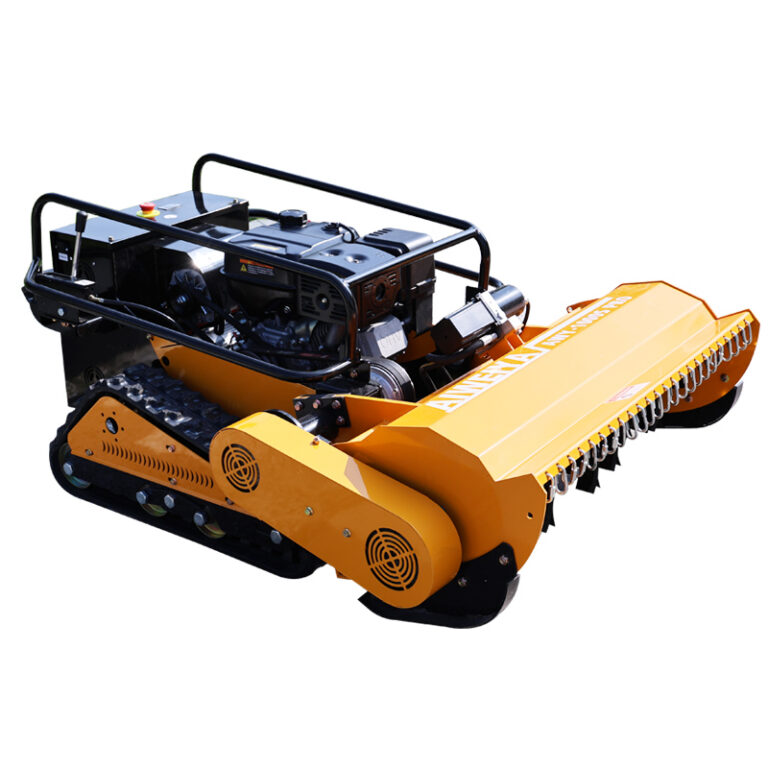
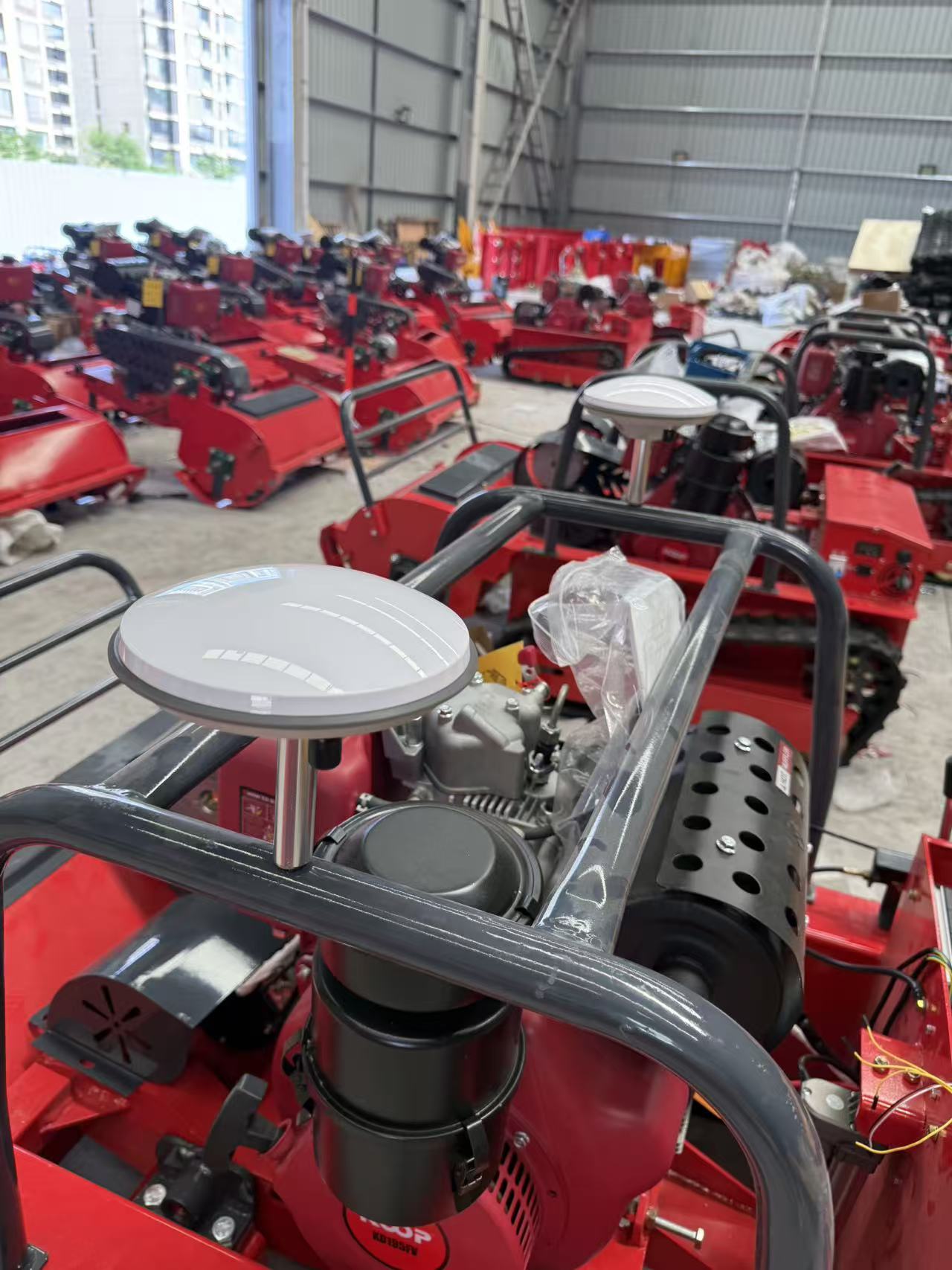
A remote control mower for farm vegetation management can provide an additional equipment option for agricultural operators and professional contractors.
Instead of requiring an operator to sit directly on the mower, a remote-control system allows the machine to be controlled from a suitable position, depending on the equipment configuration and operating instructions.
For commercial buyers, the important question is not simply whether a mower can cut grass. The equipment should match the farm’s terrain, vegetation, operating area, cutting requirements, transport arrangements, and maintenance capabilities.
This guide explains what agricultural businesses should consider when choosing a remote control mower for farm vegetation management.
1. What Does Farm Vegetation Management Include?
Farm vegetation management can involve many different areas of agricultural land.
Typical tasks include:
- Grass cutting
- Weed control
- Tall vegetation management
- Field-edge maintenance
- Farm-road vegetation control
- Drainage-area mowing
- Boundary maintenance
- Vegetation around farm buildings
- Sloped-area mowing
- Brush management
- Pasture-edge maintenance
- General non-crop vegetation control
The required equipment can vary considerably depending on the application.
For example, maintaining grass along a relatively flat farm road is different from managing dense vegetation on an uneven embankment.
This is why agricultural buyers should identify the specific work areas before selecting a machine.
2. Identify the Farm Areas That Need Mowing
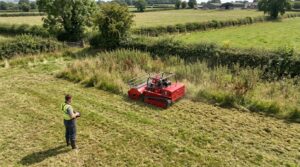
Before purchasing equipment, divide the farm into different mowing zones.
For example:
Open Field Edges
Large field boundaries may require relatively high productivity and a suitable cutting width.
Farm Roads
Roadside vegetation may require maneuverability and the ability to work around drainage areas or uneven shoulders.
Drainage Areas
Ditches and drainage channels can create difficult operating conditions and may require equipment designed for uneven terrain.
Sloped Land
Hillsides and inclined agricultural areas require careful consideration of traction, stability, and manufacturer-rated gradeability.
Around Agricultural Buildings
Areas around barns, storage facilities, machinery buildings, and other structures may require more precise maneuvering.
Property Boundaries
Farm boundaries may contain weeds, grass, and brush that require periodic maintenance.
Mapping these areas gives buyers a clearer idea of what machine configuration is actually required.
3. Terrain Is One of the First Specifications to Evaluate
Agricultural land can have highly variable terrain.
A farm may contain:
- Flat fields
- Rolling terrain
- Hills
- Uneven soil
- Grass-covered slopes
- Loose ground
- Muddy sections
- Rough access roads
- Ditches
- Small depressions
The machine should be selected according to the most demanding terrain where it is expected to operate.
A machine suitable for flat grass may not necessarily be appropriate for steep or irregular ground.
For slope applications, buyers should review:
- Gradeability
- Track or wheel configuration
- Ground contact
- Machine weight
- Center of gravity
- Ground clearance
- Traction
- Working direction
Actual operating limits should always follow the manufacturer’s specifications and site conditions.
For more information, see Remote Control Mower for Steep Slopes.
4. Crawler Tracks for Rough Agricultural Ground
Crawler tracks are commonly considered when a mower needs to work across uneven terrain.
Compared with wheels, tracks can provide a larger area of ground contact depending on their design.
Potential advantages for agricultural applications include:
- Ground contact across uneven terrain
- Traction on certain soft surfaces
- Stable movement across irregular ground
- Suitability for some sloped applications
However, tracks do not eliminate terrain limitations.
Farm operators should still consider soil moisture, slope angle, surface conditions, machine weight, and the manufacturer’s operating limits.
For a detailed comparison, see Crawler vs Wheel Remote Mower.
5. Match the Cutting System to the Vegetation
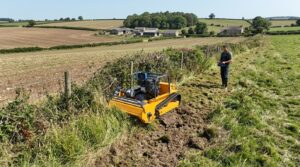
Farm vegetation can range from short grass to tall weeds and heavier brush.
The cutting system should therefore be selected according to the vegetation profile.
Grass Management
For regular grass maintenance, a suitable rotary or flail configuration may be considered depending on the machine design.
Tall Weeds
Tall weeds may require a cutting system capable of handling greater vegetation density.
Mixed Vegetation
Where grass, weeds, and heavier plant material occur together, a flail mower may be worth considering.
Brush and Rough Growth
Heavier vegetation requires particular attention to the manufacturer’s rated cutting conditions.
Buyers should ask suppliers what vegetation types the machine is designed to process rather than assuming that every mower can handle the same material.
See What Is a Remote Control Flail Mower? for more information.
6. Cutting Width Should Match the Farm’s Working Areas
Cutting width affects potential productivity.
A wider cutting width can cover more ground in a single pass, but it may also increase machine dimensions.
For farms with large open areas, a wider machine may be practical.
For farms containing:
- Narrow access roads
- Buildings
- Fences
- Trees
- Irrigation equipment
- Tight field entrances
a more compact configuration may be easier to operate.
Commercial buyers should therefore compare cutting width with the actual working environment rather than choosing the largest available cutting system.
Read Remote Control Mower Cutting Width Explained for a detailed comparison framework.
7. Farm Vegetation Is Often Seasonal
Agricultural vegetation management changes throughout the year.
During periods of rapid growth, farms may require more frequent mowing.
During slower-growth periods, maintenance requirements may decrease.
Factors include:
- Rainfall
- Temperature
- Irrigation
- Crop cycles
- Weed species
- Local climate
- Land-use patterns
For commercial operators, this means equipment utilization should be evaluated across the full year rather than based on a single mowing season.
A contractor may also use the same remote mower for several different applications throughout the year.
8. Remote Operation for Difficult Farm Areas
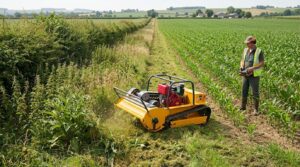
Remote operation can change how operators approach certain mowing tasks.
Instead of riding directly on the machine, the operator can control it from a suitable position with a clear view of the working area.
This may be useful for areas such as:
- Slopes
- Ditches
- Rough field edges
- Tall vegetation
- Uneven terrain
- Areas containing obstacles
The operator should always maintain appropriate visibility and follow the manufacturer’s safety procedures.
Remote operation should not be interpreted as automatic operation. The operator remains responsible for controlling the machine and monitoring its surroundings.
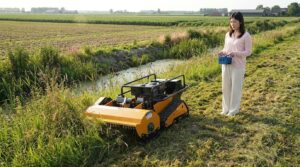
9. Managing Farm Drainage Areas
Drainage systems are important on many farms.
Ditches and drainage channels may accumulate grass and weeds that can interfere with maintenance.
However, drainage areas can also contain:
- Slopes
- Wet soil
- Soft ground
- Uneven surfaces
- Water
- Deep channels
Before using a remote mower in such areas, the operator should assess the terrain carefully.
The machine’s rated operating conditions should be checked against the actual site.
For commercial drainage maintenance, machine stability, traction, ground clearance, and operator visibility may all be important.
10. Farm Roads and Access Routes
Farm roads require regular maintenance because vegetation can grow along road shoulders and access routes.
A remote mower can potentially be used for:
- Grass along road edges
- Weed growth
- Vegetation near drainage channels
- Rough roadside areas
- Unmanaged access routes
When evaluating equipment for farm roads, consider:
- Machine width
- Turning radius
- Cutting width
- Transport requirements
- Ground clearance
- Traction
- Visibility
- Remote-control range
For larger commercial projects, these factors can influence how many machines are required and how operators organize daily work.
11. Mowing Around Farm Buildings
Agricultural properties often include barns, warehouses, workshops, storage buildings, livestock facilities, and equipment yards.
These areas can contain obstacles such as:
- Fences
- Posts
- Buildings
- Machinery
- Feed equipment
- Utility infrastructure
- Stored materials
A compact and maneuverable mower may be useful for these environments, depending on the machine dimensions.
Operators should identify obstacles before beginning work and maintain appropriate clearance.
12. Engine Power and Working Load
Engine power is an important specification, but it should not be evaluated independently.
A commercial buyer should consider:
Engine power + cutting width + vegetation density + working speed + terrain
A mower operating through dense vegetation on uneven terrain may have different power requirements from a mower maintaining short grass on flat ground.
The supplier should be able to explain the intended application range of each model.
See Remote Control Mower Engine Power Explained for a more detailed explanation.
13. Ground Clearance and Machine Dimensions
Ground clearance can matter when working across rough farm terrain.
Low obstacles, soil irregularities, vegetation buildup, and small changes in elevation can affect machine movement.
At the same time, overall machine dimensions determine where the mower can physically operate.
Before purchasing, record:
- Machine length
- Machine width
- Machine height
- Ground clearance
- Weight
- Minimum access width
- Transport dimensions
These measurements are especially important for dealers and contractors who intend to operate the machine across different customer sites.
14. Productivity for Commercial Farm Contractors
Agricultural contractors often need to complete work across multiple farms.
For these businesses, productivity should include more than mowing speed.
A useful evaluation can include:
Working productivity = mowing capacity + maneuverability + setup time + transport + maintenance
For example, a machine that can mow quickly but requires significant transport preparation may have a different practical productivity level from a machine that is easy to move between locations.
Contractors should therefore evaluate the entire workflow.
15. Maintenance for Agricultural Working Conditions
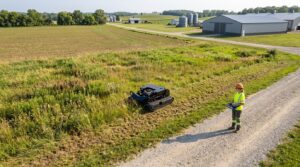
Farm environments can expose machinery to substantial amounts of:
- Soil
- Dust
- Grass
- Mud
- Moisture
- Plant residue
- Small stones
Regular inspection is therefore important.
A maintenance program may include checking:
- Cutting components
- Engine
- Belts
- Tracks
- Drive components
- Fasteners
- Lubrication points
- Remote controller
- Electrical components
- Safety systems
After working in wet or muddy conditions, appropriate cleaning and inspection procedures should be followed according to the manufacturer’s instructions.
16. Spare Parts Are Important for Commercial Farms
For a private homeowner, equipment downtime may be inconvenient.
For a commercial farm or contractor, downtime can affect scheduled work.
Before ordering, ask the supplier for a recommended spare-parts list.
Commonly discussed categories may include:
- Cutting components
- Belts
- Filters
- Track components
- Bearings
- Remote-control batteries
- Electrical components
- Wear parts
Dealers may also want to purchase spare-parts packages together with their initial machine order.
17. Remote Mowers for Agricultural Contractors
Contractors may use remote mowers across different agricultural environments.
Potential service applications include:
- Farm field edges
- Orchards
- Pastures
- Roadside areas
- Drainage zones
- Slopes
- Industrial properties
- Rural land
This broader application range can be important when building a commercial equipment fleet.
If your business provides agricultural vegetation-management services, compare the machine’s capabilities against your actual customer projects.
18. Choosing a Farm Mower for Dealers and Distributors
Agricultural equipment dealers may need products suitable for multiple customer groups.
A potential product portfolio could include:
- Compact remote mowers
- Tracked flail mowers
- Higher-power models
- Slope-oriented machines
- Multi-purpose vegetation-management equipment
The ideal range depends on local market demand.
Dealers should evaluate:
- Target applications
- Machine specifications
- Wholesale pricing
- MOQ
- Spare parts
- Warranty
- Technical support
- Packaging
- Delivery time
- Branding
- OEM/ODM capability
See How to Choose a Remote Control Mower Supplier for Your Market for more information.
19. OEM and ODM for Agricultural Equipment Businesses
Some agricultural machinery companies may want customized remote-control mower products.
Depending on the manufacturer’s capabilities, OEM/ODM cooperation may involve:
- Brand labeling
- Product colors
- Packaging
- Documentation
- Configuration adjustments
- Spare-parts packages
- Dealer support materials
Before starting an OEM project, buyers should confirm:
- MOQ
- Development requirements
- Production lead time
- Certification requirements
- Branding specifications
- Packaging requirements
- Quality-control process
For a complete overview, see Remote Control Mower OEM and ODM Guide.
20. How to Compare Farm Mower Quotations
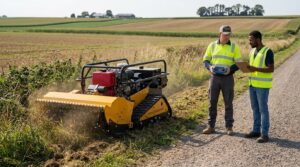
When comparing suppliers, request a detailed specification sheet.
A useful comparison can include:
| Specification | Supplier A | Supplier B | Supplier C |
|---|---|---|---|
| Engine | — | — | — |
| Engine power | — | — | — |
| Cutting width | — | — | — |
| Cutting system | — | — | — |
| Drive system | — | — | — |
| Machine dimensions | — | — | — |
| Machine weight | — | — | — |
| Gradeability | — | — | — |
| Remote-control range | — | — | — |
| Fuel capacity | — | — | — |
| Spare parts | — | — | — |
| Warranty | — | — | — |
| Lead time | — | — | — |
| OEM/ODM | — | — | — |
This makes it easier to distinguish between different configurations rather than comparing only the advertised price.
21. Total Cost of Ownership
The purchase price is only one part of the commercial equipment investment.
Farm operators should consider:
Total Cost of Ownership = Purchase + Transport + Maintenance + Spare Parts + Operation + Downtime
For example, a lower-priced machine may not necessarily provide lower long-term costs if replacement parts are difficult to obtain or maintenance requirements are higher.
For dealers and contractors, after-sales support can also affect the cost of maintaining a fleet.
Read Remote Control Mower Price: What Affects the Cost? for more information.
22. Common Mistakes When Buying a Farm Remote Mower
Mistake 1: Choosing Only by Horsepower
Power should be matched with the cutting system, vegetation, and terrain.
Mistake 2: Ignoring Farm Access Width
The mower must fit through gates, roads, and working areas.
Mistake 3: Using One Configuration for Every Farm
Different farms can have very different terrain and vegetation.
Mistake 4: Ignoring Seasonal Utilization
Consider how often the machine will actually be used throughout the year.
Mistake 5: Not Planning Transportation
Large farms and contractors may need to move equipment frequently.
Mistake 6: Buying Without a Spare-Parts Plan
Commercial operations should understand how replacement parts will be supplied.
Mistake 7: Comparing Only Unit Prices
Specifications, warranty, support, and operating costs also matter.
23. Farm Vegetation Management Buying Checklist
Before purchasing a remote control mower, confirm:
- Main mowing areas identified
- Vegetation types identified
- Terrain evaluated
- Slopes measured or assessed
- Narrowest access point measured
- Cutting width selected
- Cutting system selected
- Engine power matched to workload
- Machine dimensions checked
- Ground clearance checked
- Track or wheel configuration evaluated
- Remote-control specifications reviewed
- Safety functions confirmed
- Transport method planned
- Storage requirements confirmed
- Spare-parts availability checked
- Maintenance schedule reviewed
- Warranty confirmed
- OEM/ODM requirements discussed
- Supplier production capacity evaluated
24. Why Consider NUOYU for Farm Vegetation Management?
For agricultural equipment buyers, NUOYU provides remote-control mowing solutions intended for a range of commercial vegetation-management applications.
Potential applications include:
- Farm vegetation management
- Orchard maintenance
- Slope mowing
- Roadside vegetation control
- Embankment maintenance
- Solar-site vegetation management
- Brush and weed cutting
- Landscaping
- Commercial land maintenance
For a farm project, buyers can provide the supplier with:
- Farm size
- Terrain information
- Vegetation type
- Access width
- Required cutting width
- Expected operating hours
- Quantity
- Target market
- OEM/ODM requirements
This information allows suppliers to recommend a machine configuration based on the application rather than simply quoting a generic model.
Explore NUOYU Farm & Orchard Mowing Solutions or browse the NUOYU Remote Control Mower Products.
FAQ: Remote Control Mower for Farm Vegetation Management
1. Can a remote control mower be used on a farm?
Yes. Depending on its configuration, a remote control mower can be used for grass, weeds, field edges, slopes, drainage areas, farm roads, and other non-crop vegetation-management applications.
2. Are tracked remote control mowers suitable for rough farm terrain?
Tracked models can be considered for uneven agricultural terrain because crawler tracks provide substantial ground contact. Actual suitability depends on soil, slope, machine configuration, and manufacturer operating limits.
3. What type of cutting system is suitable for farm vegetation?
The choice depends on vegetation type. Grass may require a different configuration from tall weeds, mixed vegetation, or heavier brush.
4. Can one remote mower be used for different farm applications?
Potentially, depending on the mower configuration. Some commercial models may be suitable for multiple vegetation-management tasks, but buyers should confirm the rated application range with the manufacturer.
5. What should a farm contractor consider when purchasing?
Contractors should evaluate productivity, transport, machine versatility, maintenance, spare parts, remote-control operation, terrain capability, and total operating costs.
6. Can agricultural equipment dealers order remote mowers in bulk?
Yes, commercial suppliers may offer wholesale purchasing arrangements. Buyers should confirm MOQ, pricing, lead time, warranty, spare parts, and dealer support.
7. Can farm remote control mowers be customized?
Depending on the manufacturer, OEM/ODM customization may be available. Customization requirements should be discussed before ordering because they can affect MOQ, production time, packaging, and certification.
Final Thoughts
A remote control mower for farm vegetation management can be an important option for agricultural businesses that need to maintain grass, weeds, field edges, slopes, drainage areas, and other non-crop vegetation.
The right equipment should be selected according to the actual farm environment.
Key factors include:
- Terrain
- Vegetation
- Cutting system
- Cutting width
- Engine power
- Machine dimensions
- Ground clearance
- Track configuration
- Remote-control system
- Transport
- Maintenance
- Spare parts
- Supplier support
For commercial farms, contractors, dealers, and distributors, it is useful to provide the supplier with detailed application information before requesting a quotation.
A good purchasing process starts with the working environment, then matches the machine configuration to that environment.
Looking for a remote control mower for commercial farm vegetation management?