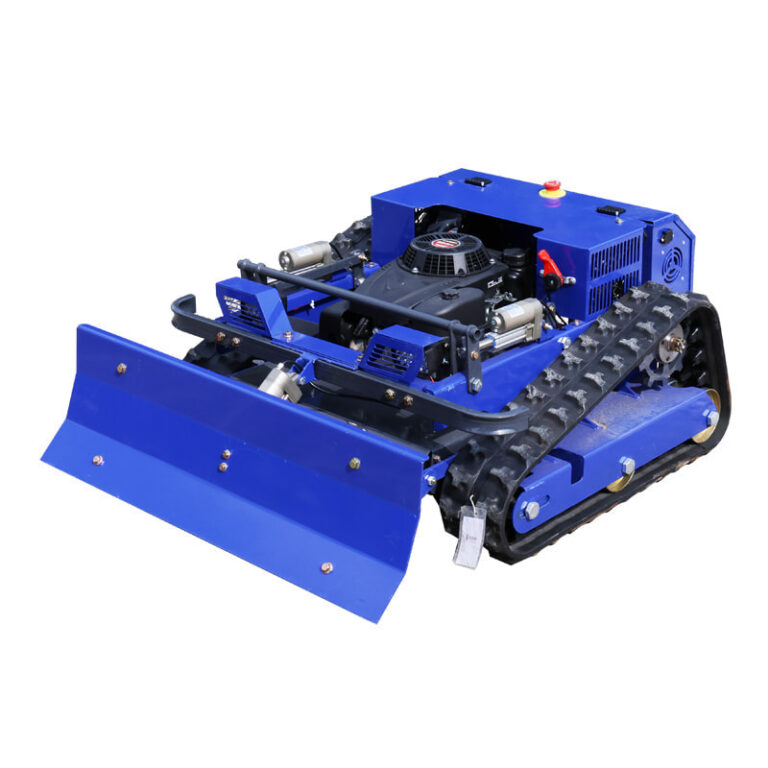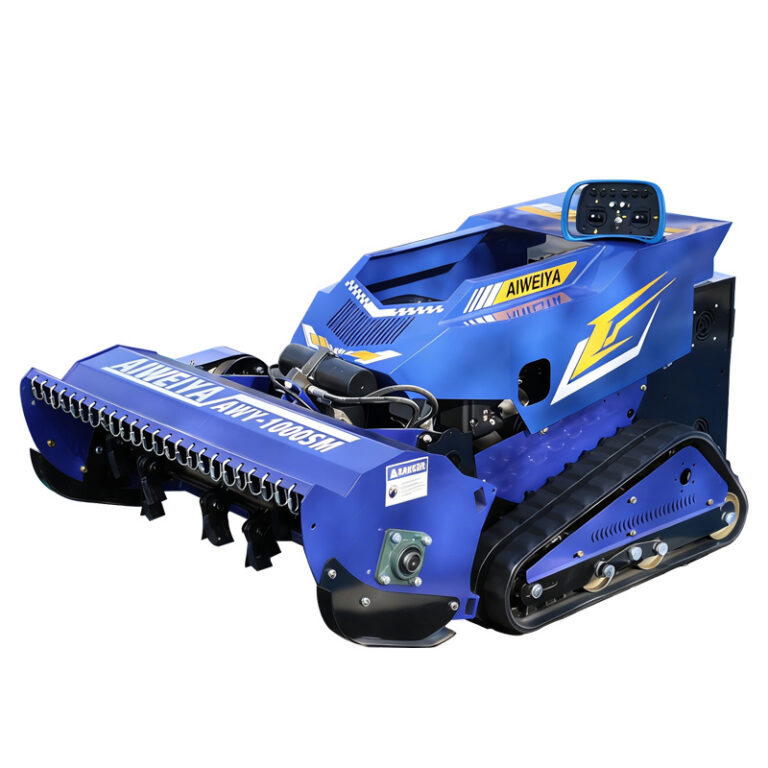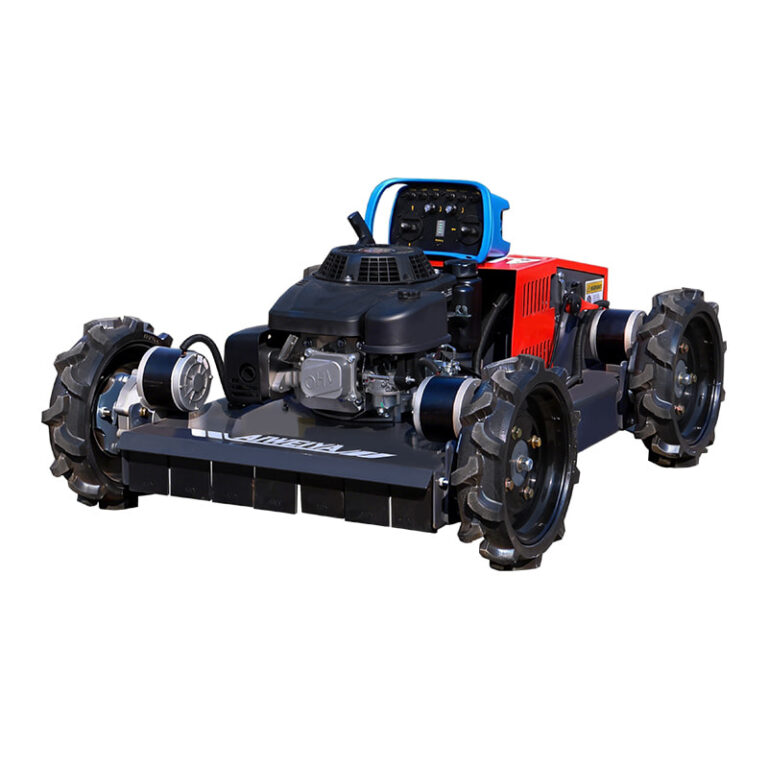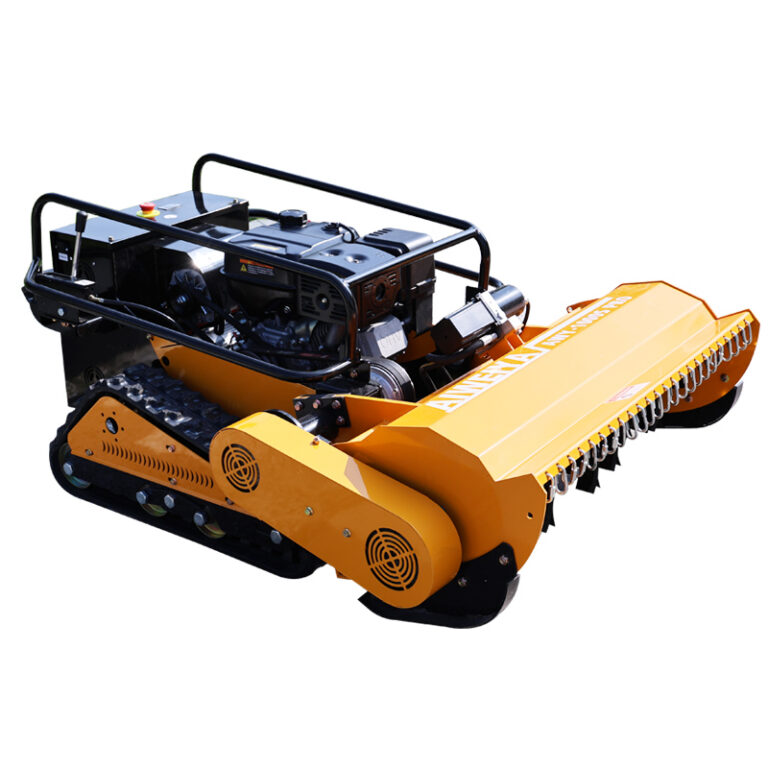
Grass is only one part of vegetation management.
Many commercial properties also contain tall weeds, dense grass, brush, overgrown field edges, roadside vegetation, and unmanaged areas that require more than routine lawn mowing.
For contractors and professional land-maintenance businesses, these conditions can create difficult mowing projects.
A remote control mower for brush and weed cutting can be considered when businesses need to manage heavier vegetation across difficult or uneven terrain.
Typical applications may include:
- Overgrown commercial land
- Farm boundaries
- Roadsides
- Embankments
- Industrial properties
- Solar-site perimeters
- Orchards
- Large estates
- Utility corridors
- Municipal land
- Construction-site vegetation
- Vacant properties
The correct machine depends on the vegetation, terrain, cutting system, operating frequency, and business requirements.
This guide explains what B2B buyers should evaluate before purchasing a remote control mower for brush and weed cutting.
1. What Is a Remote Control Mower for Brush and Weed Cutting?
A remote control mower for brush and weed cutting is a remotely operated mowing machine designed for vegetation-management applications where grass may be accompanied by taller weeds, dense growth, or certain types of brush.
Unlike conventional lawn mowing, vegetation-management work may involve inconsistent ground conditions and vegetation density.
The machine may therefore need to combine:
- Appropriate cutting technology
- Sufficient engine power
- Traction
- Stability
- Suitable ground clearance
- Remote operation
- Durable construction
The exact cutting capability depends on the machine configuration.
Buyers should always check the manufacturer’s recommended vegetation diameter, material type, operating conditions, and cutting limitations before using a machine on heavy brush.

2. What Types of Vegetation Can Be Managed?
Before choosing equipment, identify the actual vegetation.
Different jobs may involve:
Grass
Short or tall grass is generally less demanding than dense brush, although tall and wet grass can still increase the cutting load.
Weeds
Weeds can vary significantly in height, density, and stem strength.
Dense Vegetation
Overgrown areas may contain multiple vegetation types growing together.
Light Brush
Some machines can be configured for certain brush-management applications.
Heavy Brush
Heavy woody vegetation may require specialized equipment rather than a standard mower.
This distinction is critical.
A buyer should never assume that a mower designed for tall grass can automatically process heavy woody vegetation.
3. Why Flail Mowers Are Commonly Considered for Vegetation Management
Flail mowing systems are often considered for applications involving mixed vegetation.
A flail mower uses rotating cutting components within a cutting chamber to process vegetation.
Potential application areas include:
- Tall grass
- Weeds
- Mixed vegetation
- Certain brush-management tasks
The actual performance depends on:
- Flail configuration
- Cutting width
- Engine power
- Rotor design
- Cutting component type
- Material density
- Working speed
For commercial buyers, it is important to match the flail configuration to the intended vegetation.
Read How to Choose a Remote Control Flail Mower for a more detailed guide.
4. Vegetation Density Can Change Machine Requirements
Two properties may have the same acreage but completely different mowing requirements.
One property may contain regularly maintained grass.
Another may have vegetation that has been left unmanaged for months or years.
Dense vegetation can influence:
- Engine load
- Cutting speed
- Fuel consumption
- Machine productivity
- Cutting-component wear
- Maintenance frequency
Commercial buyers should therefore describe the vegetation accurately when requesting a quotation.
Useful information includes:
- Average vegetation height
- Vegetation type
- Density
- Estimated stem thickness
- Ground conditions
- Expected mowing frequency
The more accurate the application information, the easier it is for a supplier to recommend an appropriate configuration.
5. Engine Power Should Match the Cutting Load
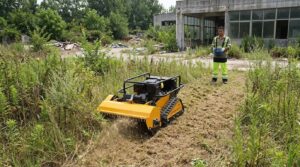
Engine power is one of the specifications buyers often focus on.
However, higher power does not automatically mean that a machine is better for every application.
The required power depends on:
Vegetation density + cutting width + cutting system + working speed + terrain
For example, a mower processing tall grass on flat ground may experience a different workload from one cutting dense vegetation on a slope.
When comparing models, buyers should examine the entire configuration rather than engine horsepower alone.
For more information, see Remote Control Mower Engine Power Explained.
6. Cutting Width and Brush-Cutting Productivity
Cutting width determines the theoretical amount of vegetation covered during each pass.
A wider cutting deck may improve productivity in open areas.
However, wider equipment can be less suitable for:
- Narrow paths
- Dense obstacles
- Tree rows
- Fences
- Small access areas
- Irregular working zones
For contractors, a practical balance is often more important than simply choosing the widest available deck.
Consider:
Cutting width + machine width + working speed + access
A mower must be able to reach the work area before cutting width can contribute to productivity.
7. Crawler Tracks for Uneven Brush-Cutting Sites
Brush and weed management frequently takes place on land that has not been maintained regularly.
Such sites may contain:
- Uneven soil
- Small depressions
- Slopes
- Loose ground
- Stones
- Grass-covered terrain
- Rough access paths
Crawler tracks can provide substantial ground contact depending on machine design.
For difficult terrain, buyers should compare:
- Track width
- Traction
- Ground clearance
- Machine weight
- Center of gravity
- Gradeability
- Turning behavior
The machine should be operated only within the manufacturer’s rated conditions.
See Crawler vs Wheel Remote Mower for a detailed comparison.
8. Remote Operation for Overgrown Areas
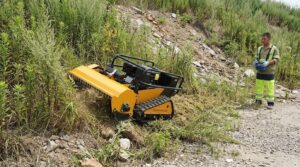
Remote operation can be particularly useful when vegetation makes the working environment difficult to observe from close range.
The operator can control the machine from a suitable position while maintaining a clear view of the mower and surrounding area.
Potential applications include:
- Overgrown slopes
- Dense weeds
- Rough field boundaries
- Brush-covered land
- Difficult access areas
However, remote control does not eliminate the need for site assessment.
Before operation, identify:
- Hidden obstacles
- Rocks
- Drainage
- Fences
- Utility infrastructure
- Workers
- Animals
- Other equipment
Operators should follow all applicable safety procedures.
9. Working Around Hidden Obstacles
Overgrown vegetation can hide objects underneath.
Potential hazards may include:
- Stones
- Metal debris
- Fallen branches
- Old fencing
- Posts
- Drainage openings
- Construction debris
- Irrigation equipment
This is one reason why a pre-operation site inspection is important.
The operator should avoid assuming that vegetation-covered ground is clear.
For contractors, a site assessment can become part of the standard work procedure before beginning vegetation-management operations.
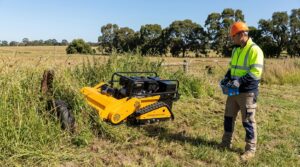
10. Brush Cutting Is Different From Tree or Stump Removal
One important distinction is the type of material being processed.
A vegetation-management mower may be designed for grass, weeds, and certain brush.
It should not automatically be considered suitable for:
- Large trees
- Large branches
- Stumps
- Thick woody material
- Construction debris
Buyers should verify the manufacturer’s maximum recommended material size.
If a site contains substantial woody growth, a dedicated brush cutter, forestry mulcher, or other specialized machine may be more appropriate.
Choosing equipment based on the actual material helps reduce misuse and unnecessary wear.
11. Ground Clearance Matters on Rough Sites
Rough vegetation-management sites can contain uneven ground and low obstacles.
Ground clearance affects the machine’s ability to pass over certain surface irregularities.
Buyers should check:
- Ground clearance
- Machine length
- Machine width
- Track dimensions
- Undercarriage design
- Weight distribution
These specifications should be considered together.
A machine with high engine power but insufficient ground clearance may not be suitable for a particular rough site.
12. Commercial Applications for Brush and Weed Cutting
Remote control brush and weed mowers can potentially serve several commercial industries.
Landscaping Contractors
For large properties and difficult vegetation-management projects.
Roadside Contractors
For grass, weeds, and certain brush along roads and infrastructure.
Municipal Buyers
For public land, drainage areas, embankments, and other vegetation-management projects.
Agricultural Contractors
For farm boundaries, rough areas, and unmanaged vegetation.
Solar O&M Contractors
For vegetation around solar installations and site boundaries.
Industrial Property Managers
For large commercial properties with unmanaged vegetation.
Property Maintenance Companies
For large estates and land-management contracts.
The appropriate mower configuration depends on each application’s vegetation and terrain.
13. Farm and Agricultural Brush Management
Agricultural properties can contain unmanaged vegetation around:
- Field boundaries
- Drainage channels
- Access roads
- Fences
- Storage areas
- Unused land
A remote mower may provide a flexible solution for some of these areas.
However, crop areas require additional care.
Operators should ensure that the mower is being used only where the machine is appropriate and that crops, irrigation systems, fencing, and other farm infrastructure are protected.
See Remote Control Mower for Farm Vegetation Management.
14. Roadside Brush and Weed Management
Roadside vegetation can become dense, particularly in areas with favorable growing conditions.
Remote mowing may be considered for:
- Road shoulders
- Drainage areas
- Embankments
- Access roads
- Industrial roads
The operator must also consider traffic, work-zone requirements, pedestrians, and nearby infrastructure.
For more information, see Remote Control Mower for Roadside Vegetation Control.
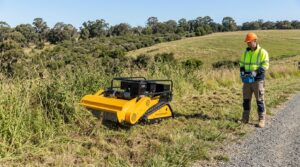
15. Slope and Brush-Cutting Applications
Some difficult vegetation is located on slopes.
In these environments, equipment selection becomes more complex because the mower must handle both:
Vegetation + Terrain
Important factors include:
- Gradeability
- Traction
- Stability
- Center of gravity
- Track configuration
- Cutting system
- Machine weight
- Operator position
A machine should never be selected solely because it is marketed as a “slope mower.”
The manufacturer’s actual operating limits should be checked against the intended site.
16. How Cutting Speed Affects Productivity
When vegetation becomes dense, operators may need to adjust working speed.
Moving too quickly through heavy vegetation can increase machine load.
Working too slowly can reduce overall productivity.
The practical operating speed depends on:
- Vegetation density
- Cutting system
- Engine power
- Terrain
- Cutting width
- Machine configuration
Professional operators should follow the manufacturer’s recommended operating procedures.
For contractors, actual productivity should be measured over completed jobs rather than estimated solely from theoretical cutting width.
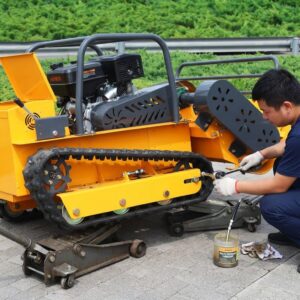
17. Maintenance After Heavy Vegetation Work
Heavy vegetation can increase the amount of material accumulated around the cutting system and machine.
After use, inspect:
- Cutting components
- Cutting deck
- Rotor
- Belts
- Tracks
- Engine area
- Cooling system
- Fasteners
- Lubrication points
Remove accumulated vegetation according to the manufacturer’s cleaning procedures.
Regular inspection can also help identify wear before it becomes a larger maintenance issue.
Read Remote Control Mower Maintenance Guide for Commercial Users.
18. Wear Parts and Spare Parts
Brush and weed cutting can place additional wear on cutting components.
Commercial buyers should understand:
- Cutting-component replacement intervals
- Recommended spare parts
- Belt availability
- Track components
- Filters
- Bearings
- Fasteners
- Remote-control batteries
For contractors running multiple machines, maintaining a basic spare-parts inventory can help reduce downtime.
Dealers should also discuss spare-parts packages with the manufacturer when purchasing machines in volume.
19. Choosing a Machine for Contractors
Contractors should evaluate a remote brush mower as part of their entire service business.
Important questions include:
- What vegetation do customers typically have?
- What terrain do projects involve?
- How many hours per week will the mower operate?
- How often will the machine be transported?
- Can the machine serve multiple industries?
- Are spare parts easy to obtain?
- What training will operators require?
- What is the expected maintenance schedule?
A machine with broad application potential can potentially support more types of commercial projects.
20. Choosing a Remote Mower for Rental Companies
Rental businesses have different requirements from end users.
A rental company may prioritize:
- Simple operation
- Durable construction
- Easy maintenance
- Operator training
- Spare parts
- Transport
- Customer documentation
- Safety instructions
The equipment should be suitable for the intended rental market and comply with applicable local requirements.
Rental businesses should also establish clear customer instructions covering operating limitations and maintenance responsibilities.
21. Wholesale Buying for Dealers
Equipment dealers can use remote brush and weed mowers as part of a broader vegetation-management product portfolio.
Potential customer groups include:
- Landscaping contractors
- Agricultural contractors
- Municipal buyers
- Road maintenance companies
- Solar O&M companies
- Property maintenance businesses
When buying wholesale, compare:
- Unit price
- MOQ
- Specifications
- Spare parts
- Warranty
- Lead time
- Packaging
- Technical support
- Branding
- OEM/ODM capability
See Remote Control Mower Wholesale Buying Guide.
22. OEM and Private Label Opportunities
Distributors may want to sell brush-cutting mowers under their own brands.
Depending on manufacturer capabilities, OEM/ODM cooperation can potentially include:
- Brand labeling
- Product colors
- Packaging
- Manuals
- Spare-parts packages
- Configuration adjustments
- Dealer materials
Before placing an order, confirm:
- MOQ
- Production lead time
- Customization scope
- Certification requirements
- Packaging
- Quality-control process
- Warranty
- Technical support
Read Private Label Remote Control Mower: A B2B Guide.
23. How to Compare Brush-Cutting Mower Quotations
Request detailed specifications from each supplier.
| Specification | Supplier A | Supplier B | Supplier C |
|---|---|---|---|
| Engine | — | — | — |
| Engine power | — | — | — |
| Cutting width | — | — | — |
| Cutting system | — | — | — |
| Recommended vegetation | — | — | — |
| Machine width | — | — | — |
| Machine weight | — | — | — |
| Drive system | — | — | — |
| Gradeability | — | — | — |
| Remote-control range | — | — | — |
| Ground clearance | — | — | — |
| Spare parts | — | — | — |
| Warranty | — | — | — |
| Lead time | — | — | — |
| OEM/ODM | — | — | — |
The most important comparison is not always the lowest price.
Instead, determine which machine is the closest match to the actual vegetation and terrain.
24. Total Cost of Ownership
The commercial cost of a remote brush mower includes more than the initial purchase.
Consider:
Purchase + Shipping + Fuel + Maintenance + Wear Parts + Spare Parts + Labor + Downtime
For contractors, equipment downtime can affect project schedules and customer commitments.
For dealers, after-sales support can influence customer satisfaction and repeat orders.
A supplier with reliable technical and spare-parts support may therefore provide greater long-term value than a supplier offering only a lower initial price.
See Remote Control Mower Price: What Affects the Cost?.
25. Common Mistakes When Buying a Brush and Weed Mower
Mistake 1: Assuming Every Flail Mower Cuts Heavy Brush
Flail mowers have different configurations and limitations.
Mistake 2: Ignoring Vegetation Thickness
Grass and woody vegetation can create very different cutting loads.
Mistake 3: Choosing Only by Horsepower
Power must be considered together with cutting width and cutting-system design.
Mistake 4: Ignoring Terrain
A mower designed for flat ground may not be appropriate for difficult slopes.
Mistake 5: Failing to Inspect the Work Area
Hidden rocks, fencing, and debris can create serious operating problems.
Mistake 6: Ignoring Wear Parts
Heavy vegetation work can increase wear on cutting components.
Mistake 7: Comparing Only Purchase Price
Commercial operating costs should also be evaluated.
26. Brush and Weed Cutting Buying Checklist
Before purchasing a remote control mower, confirm:
- Vegetation type identified
- Average vegetation height recorded
- Vegetation density evaluated
- Brush thickness evaluated
- Terrain assessed
- Slope conditions identified
- Cutting system selected
- Cutting width selected
- Engine power matched to workload
- Machine width checked
- Ground clearance checked
- Track system evaluated
- Remote-control range confirmed
- Safety functions reviewed
- Hidden obstacles identified
- Transport method planned
- Maintenance schedule reviewed
- Wear parts identified
- Spare-parts availability confirmed
- Warranty reviewed
- OEM/ODM requirements discussed if applicable
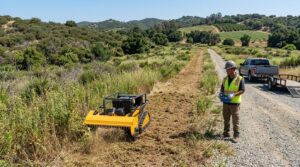
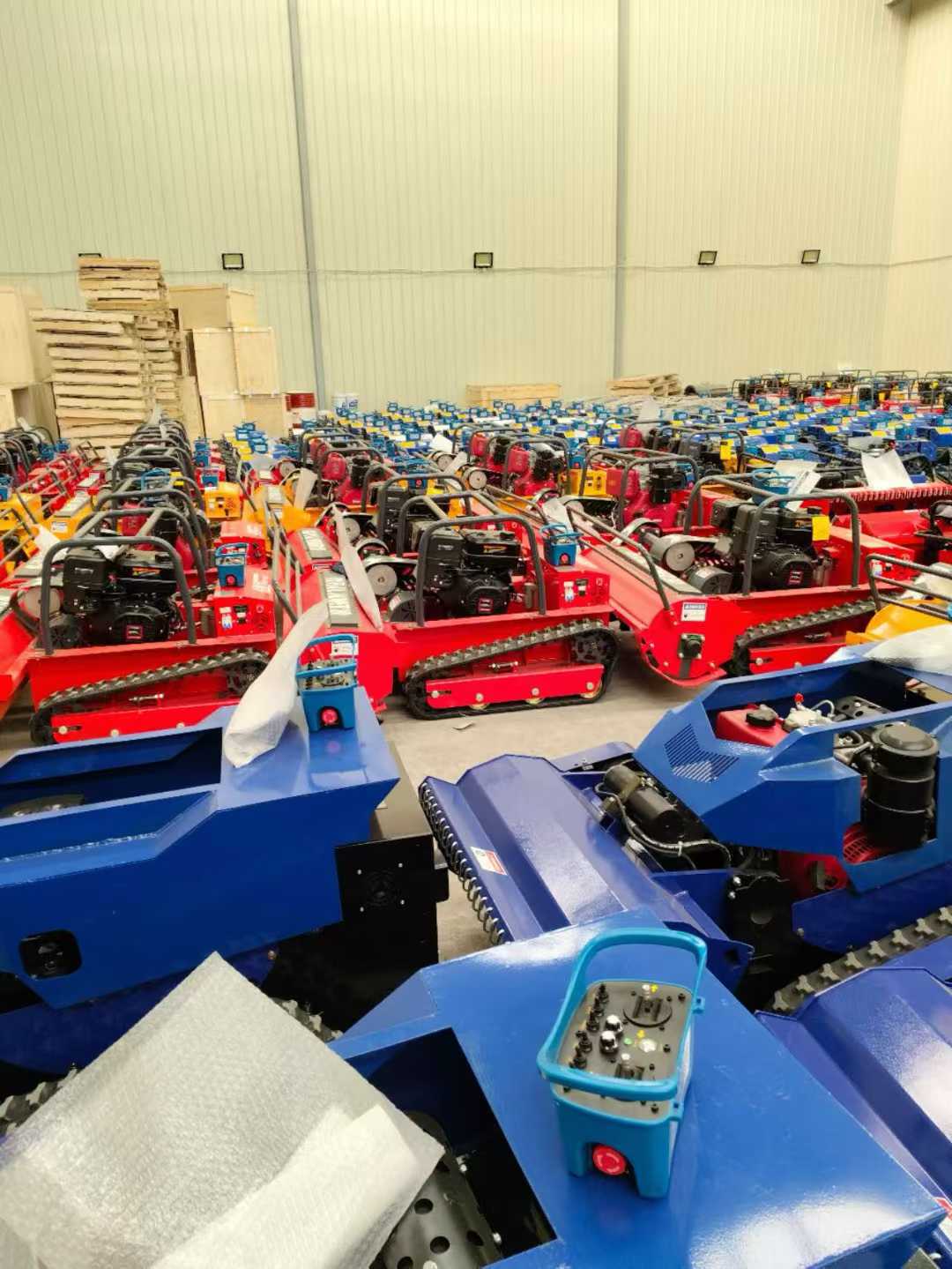
27. Why Consider NUOYU for Brush and Weed Cutting?
NUOYU provides remote-control mowing equipment for commercial vegetation-management applications.
Potential applications include:
- Brush and weed cutting
- Farm vegetation management
- Orchard maintenance
- Roadside vegetation control
- Embankment maintenance
- Solar-site vegetation management
- Landscaping
- Commercial property maintenance
For B2B customers, machine selection can be based on:
- Vegetation type
- Cutting requirements
- Terrain
- Machine dimensions
- Required productivity
- Quantity
- Spare-parts requirements
- OEM/ODM needs
Explore the NUOYU Remote Control Mower Product Range or Brush and Weed Cutting Solutions.
FAQ: Remote Control Mower for Brush and Weed Cutting
1. Can a remote control mower cut brush?
Some remote control mowers can be configured for certain brush-cutting applications. The actual capability depends on the cutting system, engine power, vegetation type, and manufacturer’s rated limits.
2. Can a flail mower cut weeds?
Yes, flail mowers are commonly considered for grass, weeds, and certain mixed-vegetation applications. The specific model should be matched to the vegetation conditions.
3. Can a remote mower cut trees or large branches?
A standard vegetation-management mower should not automatically be assumed to be suitable for large trees, stumps, or heavy woody material. Always check the manufacturer’s specifications.
4. Are tracked remote mowers suitable for brush on slopes?
Tracked models can be considered for certain sloped applications because crawler tracks can provide substantial ground contact. Actual suitability depends on the slope, ground conditions, machine design, and operating limits.
5. What information should I provide when requesting a quotation?
Provide vegetation type, approximate height, density, brush thickness, terrain, slope, required cutting width, expected operating frequency, quantity, and application location.
6. Are remote brush mowers suitable for contractors?
Yes, they can be considered for commercial vegetation-management contractors who work across farms, roadsides, industrial properties, solar sites, landscaping projects, and other large properties.
7. Can dealers purchase remote brush mowers wholesale?
Yes. Dealers can discuss wholesale pricing, MOQ, spare parts, warranty, lead time, branding, and OEM/ODM options with the manufacturer.
Final Thoughts
A remote control mower for brush and weed cutting should be selected according to the actual vegetation and terrain rather than simply the machine’s engine power or advertised cutting width.
The key factors include:
- Vegetation type
- Vegetation density
- Brush thickness
- Cutting system
- Cutting width
- Engine power
- Crawler or wheel configuration
- Terrain
- Gradeability
- Ground clearance
- Remote-control system
- Maintenance
- Wear parts
- Spare parts
- Transport
- Supplier support
For commercial buyers, the best purchasing process starts by clearly defining the vegetation-management problem.
Once the vegetation, terrain, and operating environment are understood, a manufacturer can recommend a configuration that better matches the project.
Looking for a remote control mower for brush and weed cutting?
Contact NUOYU for an application-based commercial quotation.