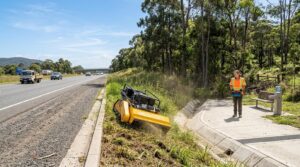
Roadside vegetation management is an ongoing requirement for many infrastructure, landscaping, municipal, and vegetation-maintenance projects.
Grass, weeds, brush, and other vegetation can grow along road shoulders, embankments, drainage channels, access roads, and around roadside infrastructure.
Some areas are easy to maintain with conventional mowing equipment. Others may be narrow, uneven, sloped, heavily overgrown, or difficult to access.
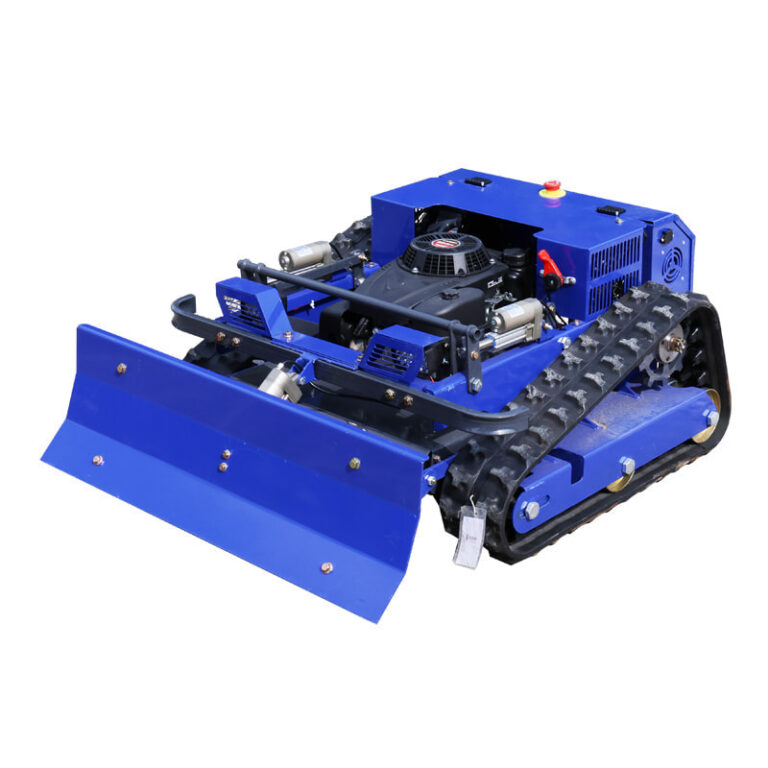
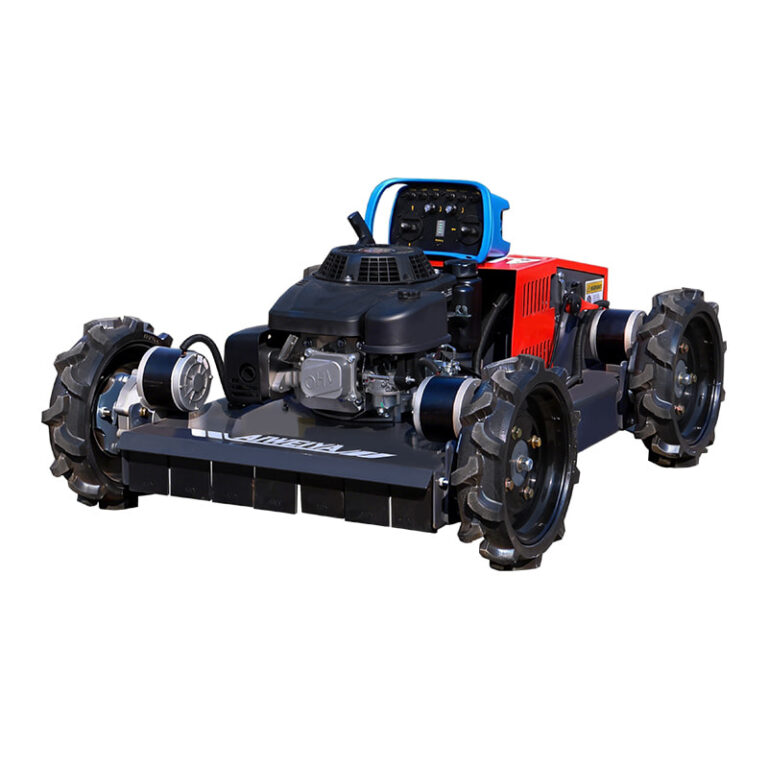
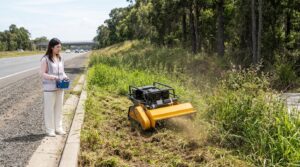
A remote control mower for roadside vegetation control can provide a specialized solution for these more challenging areas.
Instead of placing the operator directly on the mower, the machine can be controlled remotely from a suitable operating position.
For B2B users, the value of remote mowing equipment is not simply the ability to cut grass. The machine needs to fit into a complete vegetation-management workflow involving site access, productivity, operator control, maintenance, transportation, and long-term equipment support.
1. What Is Roadside Vegetation Control?
Roadside vegetation control refers to the management of unwanted or overgrown vegetation around roads and transportation infrastructure.
Depending on the project, vegetation management may include:
- Grass cutting
- Weed control
- Brush cutting
- Shoulder maintenance
- Embankment mowing
- Drainage-area maintenance
- Roadside clearing
- Vegetation around signs and barriers
- Access-road maintenance
The objective is usually to keep designated areas maintained according to project requirements.
Different locations require different equipment.
Flat roadside grass may be relatively simple.
A steep embankment covered with dense weeds and brush requires a different approach.
This is where specialized remote-controlled mowing equipment can become useful.
2. Where Roadside Remote Mowers Can Be Used
Roadside vegetation exists in many different forms.
Road Shoulders
Road shoulders may accumulate grass and weeds, particularly during growing seasons.
A mower suitable for the available working width can help contractors maintain these areas.
Road Embankments
Embankments can introduce steep terrain and uneven ground.
Tracked remote mowers can be considered for suitable slope applications.
Remote Control Mower for Highway Slope Maintenance
Drainage Areas
Drainage channels and ditches often contain vegetation that requires periodic maintenance.
The terrain may be uneven and difficult to access with conventional equipment.
Roadside Brush
Some roadsides may contain taller weeds, brush, or mixed vegetation.
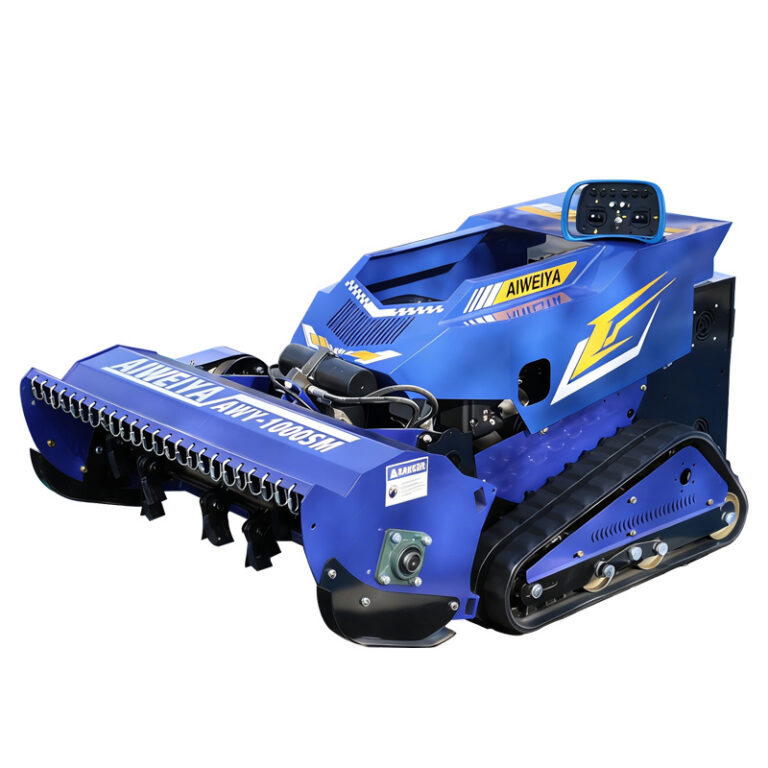
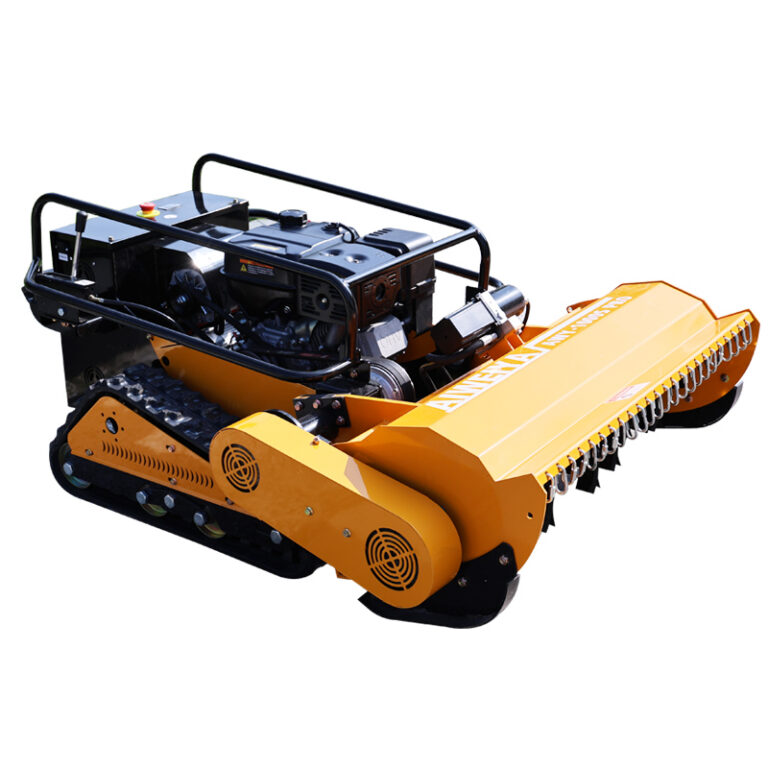
A flail-type cutting system can be suitable for many vegetation-management applications.
Industrial Access Roads
Factories, warehouses, energy facilities, and other industrial properties may also have roads with unmanaged vegetation along their boundaries.
3. Why Roadside Vegetation Can Be Difficult to Maintain
Roadside vegetation management has several practical challenges.
Uneven Terrain
Road edges rarely form a perfectly flat surface.
Limited Access
Guardrails, drainage structures, trees, signs, and other infrastructure can restrict access.
Variable Vegetation
A single project may contain grass, weeds, and brush in different areas.
Slopes
Roadside embankments can have significant inclines.
Traffic
Where roads remain in service, equipment operation needs to be integrated with appropriate work-zone procedures.
Changing Ground Conditions
Rain can change soil firmness and traction.
Because of these variables, contractors need equipment that can be matched to the working environment.
4. Remote Operation for Roadside Work
One of the defining features of a remote control mower is the separation between the operator and the machine.
The operator can stand at a suitable observation position while controlling the mower remotely.
This operating method can be useful when the mower is working:
- On a slope
- Near dense vegetation
- In a ditch
- On uneven ground
- In an area with limited direct access
Remote control systems vary between models.
Depending on the machine, the controller may manage functions such as:
- Forward movement
- Reverse movement
- Steering
- Cutting operation
- Working speed
- Other machine functions
Commercial buyers should verify the exact control functions and operating range with the manufacturer.
5. Crawler Tracks for Uneven Roadside Terrain
Roadside environments can contain slopes, soft ground, uneven soil, and vegetation-covered terrain.
Crawler tracks can provide a larger ground-contact area than many wheel-based configurations.
This can be useful for machines designed to work across uneven or sloped surfaces.
However, track configuration should be considered together with:
- Machine weight
- Track width
- Ground pressure
- Center of gravity
- Engine power
- Ground clearance
- Slope capability
- Cutting system
A tracked mower is not automatically suitable for every roadside environment.
The complete machine specification needs to match the application.
6. Choosing the Right Cutting System for Roadside Vegetation
Roadside vegetation can vary considerably.
A mower used for short grass may not be configured the same way as equipment intended for dense weeds or brush.
For mixed roadside vegetation, a remote control flail mower can be an appropriate configuration for many professional applications.
Flail mowing can be used for vegetation such as:
- Grass
- Tall weeds
- Dense vegetation
- Small brush
- Overgrown roadside areas
The actual cutting capability depends on the machine design, cutting components, and manufacturer’s recommended operating conditions.
How to Choose a Remote Control Flail Mower
7. Roadside Grass Management
Grass is one of the most common forms of roadside vegetation.
Regular mowing can help contractors maintain designated roadside areas.
For grass-focused applications, buyers may prioritize:
- Cutting width
- Working speed
- Fuel efficiency
- Machine maneuverability
- Maintenance requirements
A wider cutting deck can increase theoretical coverage, but actual productivity depends on terrain and obstacles.
For narrow roadside areas, a more compact machine may be easier to operate.
8. Managing Tall Weeds and Dense Vegetation
When roadside vegetation is allowed to grow for longer periods, the working conditions can become more demanding.
Tall weeds can increase cutting resistance and may become tangled within unsuitable cutting systems.
Contractors should therefore communicate the expected vegetation height and density when discussing machine configurations with suppliers.
Important factors can include:
- Engine power
- Cutting width
- Flail configuration
- Working speed
- Machine weight
- Track performance
Remote Control Flail Mower for Dense Vegetation
9. Roadside Brush Management
Some roadside projects involve more than grass and weeds.
Vegetation can include brush and woody growth.
The appropriate cutting system depends on the size and type of material that needs to be processed.
Buyers should never assume that a general-purpose mower can process every type of brush.
Instead, provide the manufacturer with information about:
- Typical vegetation
- Maximum stem diameter
- Vegetation density
- Ground conditions
- Required cutting frequency
This allows the supplier to recommend a suitable configuration based on the actual project.
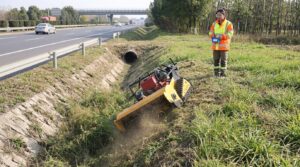
10. Drainage Ditches and Roadside Channels
Drainage areas can be particularly difficult to maintain.
A ditch may combine:
- Sloped sides
- Uneven soil
- Dense grass
- Wet conditions
- Mud
- Standing water
- Restricted access
Remote-controlled equipment can be considered for suitable drainage-area applications where conventional equipment cannot easily reach.
However, contractors should evaluate the ground conditions carefully before operation.
Waterlogged soil can significantly change traction and stability.
11. Cutting Width vs. Roadside Access
Cutting width is an important productivity factor.
A wider deck can potentially cover more ground in each pass.
But roadside environments often contain obstacles.
Examples include:
- Guardrails
- Traffic signs
- Utility poles
- Trees
- Drainage structures
- Fences
- Concrete barriers
A large machine may not be the most practical choice for every section.
Contractors should compare:
Cutting Width
with
Machine Width + Working Access + Obstacles + Required Productivity
This application-based approach can help avoid choosing equipment that is difficult to maneuver.
Remote Control Mower Cutting Width Explained
12. Machine Dimensions Matter on Roadside Projects
The physical dimensions of the mower can influence where it can operate.
Before purchasing, check:
- Machine width
- Machine length
- Machine height
- Cutting-deck width
- Ground clearance
- Turning requirements
- Transport dimensions
For contractors working across different road networks, a compact configuration can sometimes provide greater access flexibility.
13. Engine Power and Continuous Roadside Work
Commercial roadside mowing can involve long operating periods.
The engine needs to support both machine movement and cutting.
Engine power should therefore be evaluated with the complete configuration.
Consider:
- Cutting width
- Vegetation density
- Terrain
- Working speed
- Machine weight
- Cutting system
The objective is to achieve a suitable balance between power and the actual workload.
Remote Control Mower Engine Power Explained
14. Roadside Mowing Productivity
For B2B customers, productivity is usually an important part of equipment evaluation.
A simple theoretical calculation is:
Theoretical Mowing Capacity = Cutting Width × Working Speed
But actual field productivity is lower because of:
- Turning
- Obstacles
- Terrain
- Transport
- Refueling
- Setup
- Maintenance
- Operator adjustments
Contractors should therefore use realistic field estimates when planning project capacity.
For example, a mower with a wide cutting deck may have excellent theoretical coverage but still require additional time when working around roadside infrastructure.
15. Remote Mowers for Road Maintenance Contractors
Road maintenance contractors often work under project-based agreements.
They may be responsible for maintaining specific sections of a road network over a defined period.
Equipment selection can therefore influence:
- Crew productivity
- Project scheduling
- Transport requirements
- Maintenance planning
- Equipment utilization
A remote mower can become part of a contractor’s specialized equipment fleet for difficult roadside areas.
It does not necessarily need to replace conventional mowing equipment.
Instead, contractors can assign different machines to different terrain conditions.
16. Combining Remote and Conventional Mowing Equipment
A mixed equipment strategy can make sense for larger maintenance businesses.
For example:
Conventional mower
→ flat, open grass areas
Remote tracked mower
→ steep slopes and difficult terrain
Remote flail mower
→ dense weeds and mixed vegetation
Brush equipment
→ heavier vegetation where appropriate
This allows each machine to perform the work for which it is configured.
The exact fleet structure depends on the contractor’s project requirements.
17. Safety and Roadside Work-Zone Management
Roadside mowing requires careful work-zone management.
The presence of passing vehicles means that equipment operation must follow applicable project and local requirements.
Contractors should consider:
- Work-zone boundaries
- Traffic control
- Operator location
- Visibility
- Warning systems
- Communication
- Access and exit routes
- Emergency procedures
Remote operation does not eliminate the need for proper traffic-management procedures.
The mower should be operated according to both manufacturer instructions and applicable project requirements.
18. Operator Positioning
One benefit of remote operation is that the operator can choose an appropriate position rather than sitting directly on the mower.
For roadside work, the operator should have:
- Clear visibility
- Stable footing
- Appropriate distance
- Awareness of traffic
- Awareness of obstacles
- Ability to stop the machine according to the manufacturer’s procedures
Training should cover both the remote controller and the specific working environment.
19. Weather Conditions and Roadside Mowing
Weather can affect roadside mowing conditions.
Rain can change:
- Soil firmness
- Traction
- Machine stability
- Vegetation weight
- Visibility
Wet vegetation can also behave differently during cutting.
For recurring maintenance contracts, contractors can establish weather-based operating procedures to determine when mowing should proceed or be postponed.
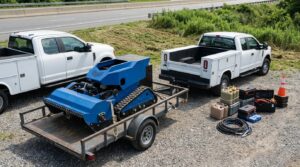
20. Transportation Between Multiple Road Sections
A roadside contractor may maintain many separate sections of a road network.
This means transportation efficiency can influence the total project cost.
Before purchasing, evaluate:
- Machine transport dimensions
- Operating weight
- Loading method
- Trailer requirements
- Setup time
- Unloading procedure
21. Maintenance After Roadside Mowing
Roadside mowing can expose equipment to considerable debris.
After operation, contractors should follow the manufacturer’s maintenance schedule and inspect the machine.
Areas that may require attention include:
Cutting Deck
Remove accumulated grass and vegetation according to the manufacturer’s instructions.
Cutting Components
Inspect for wear or damage.
Tracks
Check track condition and remove trapped debris.
Engine
Perform required engine maintenance.
Cooling System
Keep cooling components clean according to manufacturer recommendations.
Remote Controller
Check the controller and charging system where applicable.
Regular maintenance can help commercial operators keep equipment available for scheduled projects.
Remote Control Mower Maintenance Guide for Commercial Users
22. Spare Parts for Roadside Vegetation Equipment
For contractors, spare-parts availability can affect equipment uptime.
Before purchasing, ask suppliers about:
- Cutting components
- Belts
- Filters
- Track components
- Electrical parts
- Remote-control parts
- Engine service parts
International B2B buyers should also ask about:
- Parts stock
- Lead times
- Shipping options
- Parts manuals
- Technical support
This is particularly important for contractors who depend on the machine for recurring commercial work.
23. Selecting a Supplier for Roadside Mowers
A commercial mower purchase should include supplier evaluation.
Useful questions include:
Does the supplier manufacture the equipment directly?
Can the supplier provide technical documentation?
Are spare parts available?
Can the supplier support international customers?
Is OEM/ODM available?
What is the production lead time?
What warranty and after-sales support are offered?
Can the supplier provide different machine configurations?
For distributors and contractors, supplier support can become an important part of the long-term equipment relationship.
How to Find a Reliable Remote Control Mower Manufacturer in China
24. B2B Purchasing for Roadside Vegetation Control
Commercial customers may purchase equipment for different reasons.
Contractor
Needs equipment for project execution.
Distributor
Needs products to resell to local customers.
Rental Company
Needs equipment suitable for repeated rental operations.
Municipal Buyer
Needs equipment for public-property maintenance.
Importer
Needs a stable overseas supply source.
Each buyer may have different requirements for:
- Quantity
- Configuration
- Spare parts
- Packaging
- Documentation
- Warranty
- Delivery
Therefore, suppliers should receive enough information to understand the buyer’s business model.
25. OEM and Private-Label Roadside Mowers
For distributors, a remote mower can become part of a private-label equipment portfolio.
Depending on the manufacturer’s capabilities, customization may include:
- Brand identity
- Product color
- Packaging
- Manuals
- Product labels
- Spare-parts packages
- Product configuration
Before starting an OEM project, buyers should confirm minimum order quantities, customization requirements, production lead times, and technical documentation.
Remote Control Mower OEM and ODM Guide
26. How to Request a Roadside Mower Quotation
A detailed inquiry can make the quotation process more efficient.
Instead of sending only:
“Please send price.”
Provide information such as:
Application: Roadside vegetation control
Terrain: Road shoulder / ditch / embankment
Vegetation: Grass / weeds / brush
Approximate vegetation height: ______
Slope: ______
Required cutting width: ______
Quantity: ______
Destination country: ______
Business type: Contractor / dealer / importer / municipality
OEM/ODM: Yes / No
Additional requirements: ______
This information gives the manufacturer a better basis for recommending equipment.
What to Ask a Remote Control Mower Supplier Before Ordering
27. Total Cost of Ownership
The purchase price is only one part of the cost of commercial mowing equipment.
B2B buyers should also consider:
- Purchase price
- Shipping
- Fuel
- Maintenance
- Spare parts
- Operator labor
- Transport
- Downtime
- Replacement components
A machine with a higher initial price may have a different operating cost from another configuration.
Therefore, contractors should compare the complete cost structure rather than comparing the machine price alone.
Remote Control Mower Price: What Affects the Cost?
28. Building a Roadside Vegetation Management Fleet
For larger contractors, one remote mower may be only the beginning of a broader equipment strategy.
A fleet can potentially include machines designed for:
- Flat grass
- Road shoulders
- Steep embankments
- Dense weeds
- Brush
- Drainage channels
- Large open vegetation areas
Standardizing machine platforms where practical can also simplify:
- Operator training
- Spare parts
- Maintenance
- Fleet management
- Procurement
The right fleet structure depends on the contractor’s project portfolio.
29. Common Mistakes When Selecting a Roadside Mower
Mistake 1: Choosing Based Only on Cutting Width
A wide deck is not always practical around roadside infrastructure.
Mistake 2: Ignoring Machine Width
The mower needs enough space to reach the working area safely.
Mistake 3: Choosing a Machine Without Defining Vegetation
Grass, weeds, and brush can place different demands on the cutting system.
Mistake 4: Ignoring Drainage Conditions
Wet or muddy ground can change machine performance.
Mistake 5: Forgetting Transportation
Contractors may need to move equipment between many locations.
Mistake 6: Buying Without Parts Support
Commercial equipment requires ongoing maintenance.
Mistake 7: Comparing Only Purchase Prices
Different configurations can have different operating costs and support packages.
30. Roadside Vegetation Control Buyer Checklist
Before purchasing a remote control mower, review:
Application
- Roadside grass
- Road shoulder
- Embankment
- Drainage ditch
- Brush
- Mixed vegetation
Terrain
- Flat
- Uneven
- Sloped
- Wet
- Rocky
- Loose soil
Machine
- Crawler system
- Engine power
- Cutting width
- Machine width
- Ground clearance
- Machine weight
Operation
- Remote-control range
- Operator visibility
- Control functions
- Safety procedures
Commercial Support
- Spare parts
- Warranty
- Technical support
- Maintenance documentation
- Production capacity
- OEM/ODM options
31. Applications Beyond Roadsides
One advantage of a commercial remote mower is that the same basic machine platform may have applications beyond roadside vegetation.
Depending on the configuration, businesses may also use remote mowers for:
- Farms
- Orchards
- Solar farms
- Industrial properties
- Large estates
- Drainage areas
- Embankments
- Landscaping projects
This can help contractors increase machine utilization across different projects.
Remote Control Mower for Farms and Orchards
Remote Control Mower for Solar Farm Vegetation Management
32. Why Remote Control Mowers Are Relevant to Roadside Contractors
Roadside vegetation management combines terrain, vegetation, access, transportation, and operational challenges.
A remote control mower can provide a specialized option for areas where conventional equipment is less convenient.
Its potential commercial value comes from combining:
- Remote operation
- Tracked mobility
- Suitable cutting systems
- Compact machine configurations
- Commercial construction
- Multi-application capability
- Manufacturer support
The most suitable machine depends on the actual road environment and project requirements.
33. NUOYU Remote Control Mower Solutions
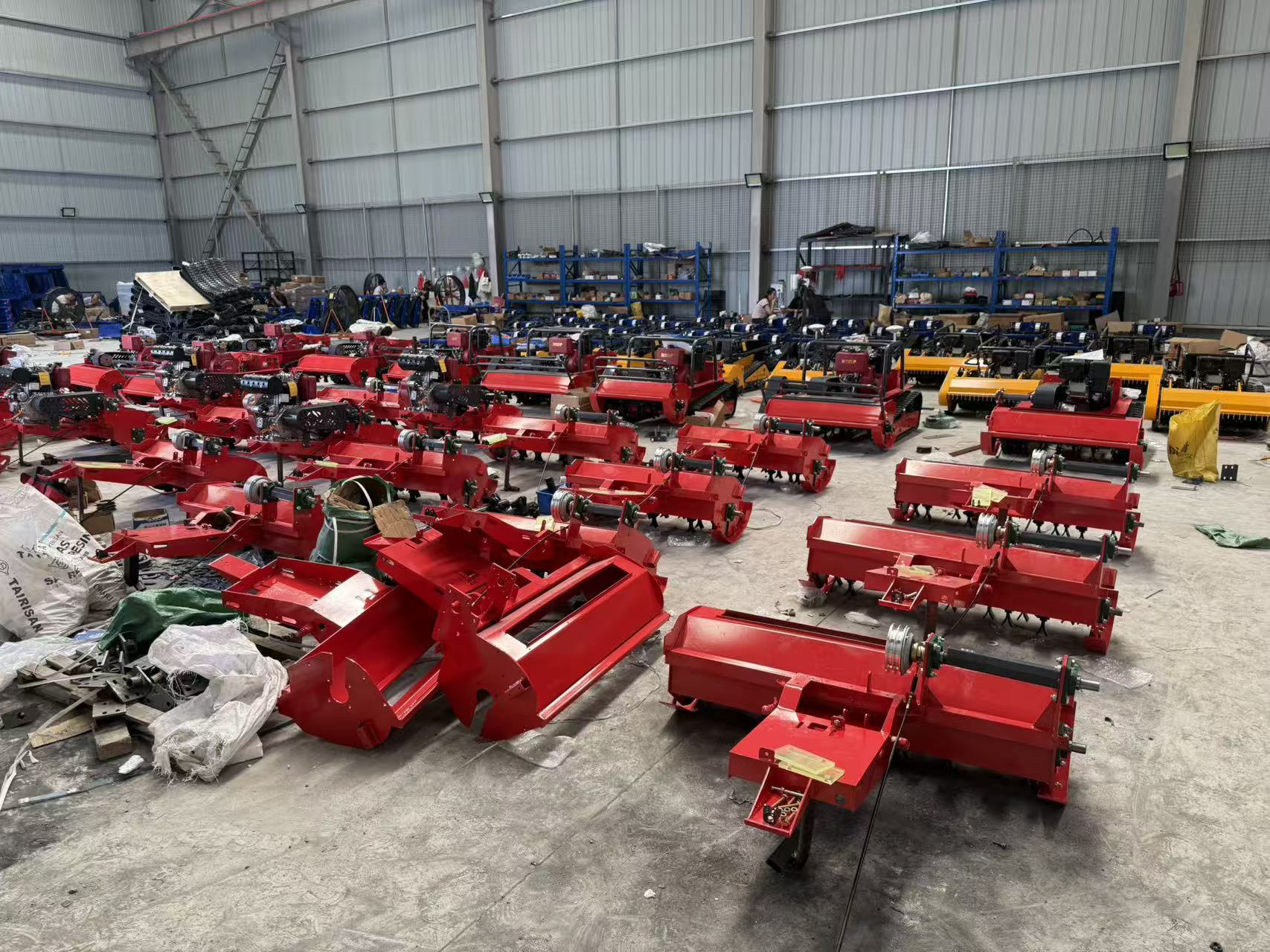
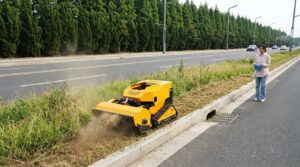
NUOYU provides remote control mower solutions for professional vegetation-management applications, including roadside vegetation control, slope mowing, brush cutting, farm and orchard maintenance, landscaping, and other commercial applications.
For roadside contractors and B2B buyers, equipment selection can be based on:
- Terrain
- Vegetation type
- Working width
- Engine power
- Track configuration
- Slope requirements
- Expected workload
- Order quantity
NUOYU also supports business cooperation for distributors, dealers, importers, contractors, and OEM/ODM customers.
NUOYU Remote Control Mower Products
NUOYU Roadside Vegetation Control Solutions
For a project quotation, buyers can provide details about the road environment, vegetation, terrain, required cutting width, quantity, and destination market.
FAQ
1. What is a remote control mower for roadside vegetation control?
It is a remotely operated mowing machine designed to manage grass, weeds, brush, and other vegetation in roadside and difficult-access environments.
2. Can remote control mowers be used on road shoulders?
Yes, suitable models can be used for roadside grass and vegetation maintenance when the machine dimensions and operating conditions match the project.
3. Can remote mowers work in drainage ditches?
Some models can be used for suitable drainage-area applications. Ground conditions, slope, moisture, and machine specifications should be evaluated before operation.
4. What type of mower is suitable for dense roadside vegetation?
A remote control flail mower can be suitable for many grass, weed, and mixed-vegetation applications. The correct machine depends on the vegetation and manufacturer’s specifications.
5. Are crawler tracks useful for roadside terrain?
Crawler tracks can provide useful ground-contact and traction characteristics on uneven terrain. Actual performance depends on the complete machine configuration and working conditions.
6. How wide should a roadside mower be?
There is no single ideal width. Contractors should consider cutting width together with machine width, roadside access, obstacles, and required productivity.
7. What information should I provide when requesting a quotation?
Provide the application, terrain, slope, vegetation type, vegetation height, required cutting width, quantity, destination, and any OEM/ODM requirements.
8. Can distributors buy remote control mowers wholesale?
Yes. Dealers, distributors, importers, contractors, and other B2B customers can discuss wholesale supply requirements with manufacturers.
9. Can the same mower be used for other applications?
Depending on its configuration, a remote mower may also be suitable for farms, orchards, solar farms, embankments, landscaping, and other vegetation-management projects.
Remote Control Mower for Farms and Orchards
Conclusion
Roadside vegetation control involves much more than simply cutting grass.
Contractors may need to maintain road shoulders, drainage channels, embankments, brush-covered areas, and other difficult-access locations.
A remote control mower for roadside vegetation control can provide a specialized option for these applications by combining remote operation, tracked mobility, and commercial cutting systems.
Before purchasing, B2B buyers should evaluate:
- Roadside terrain
- Vegetation type
- Machine width
- Cutting width
- Engine power
- Crawler configuration
- Remote-control functions
- Transportation
- Maintenance
- Spare parts
- Supplier support
The best configuration depends on the actual project rather than a single machine specification.
For contractors, distributors, municipalities, and professional vegetation-management companies, discussing the application directly with the manufacturer can help identify a suitable machine configuration.
Looking for a remote control mower for roadside vegetation control?
View NUOYU Remote Control Mower Products