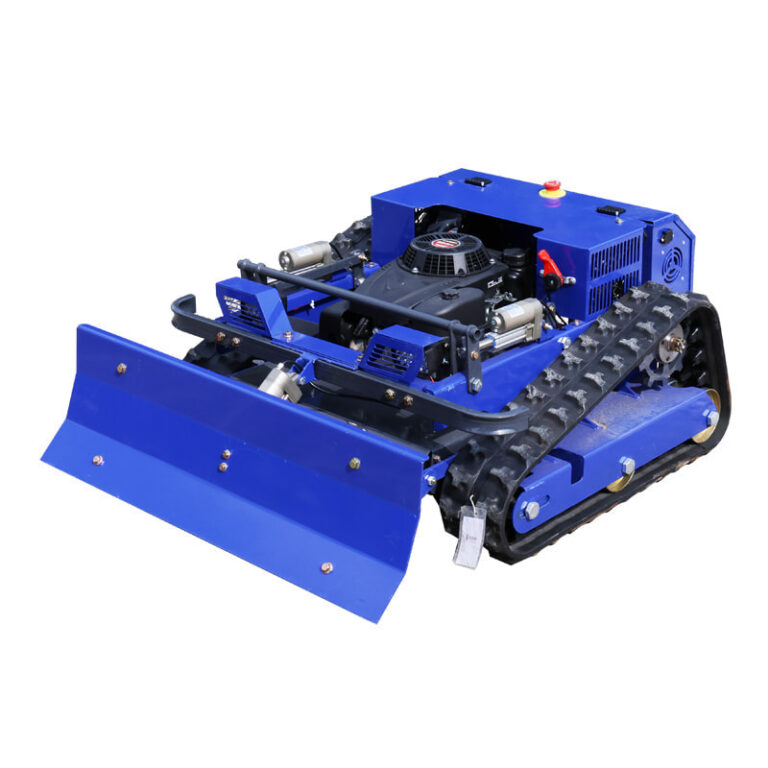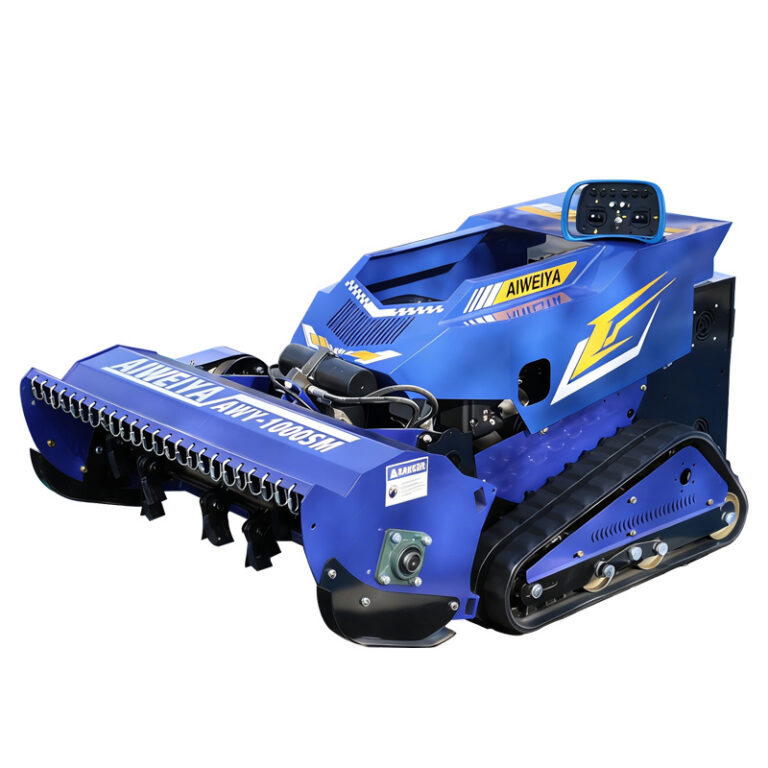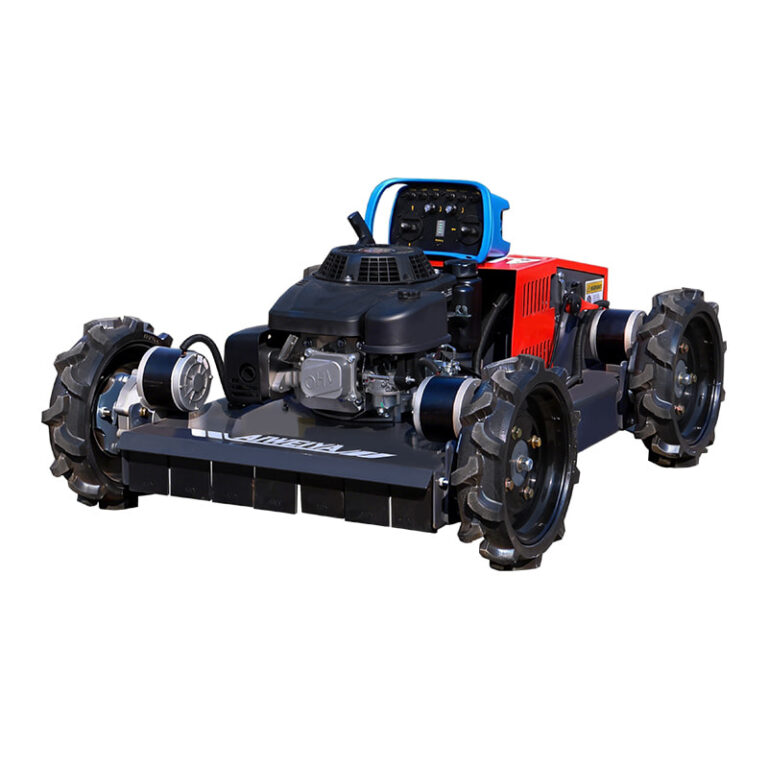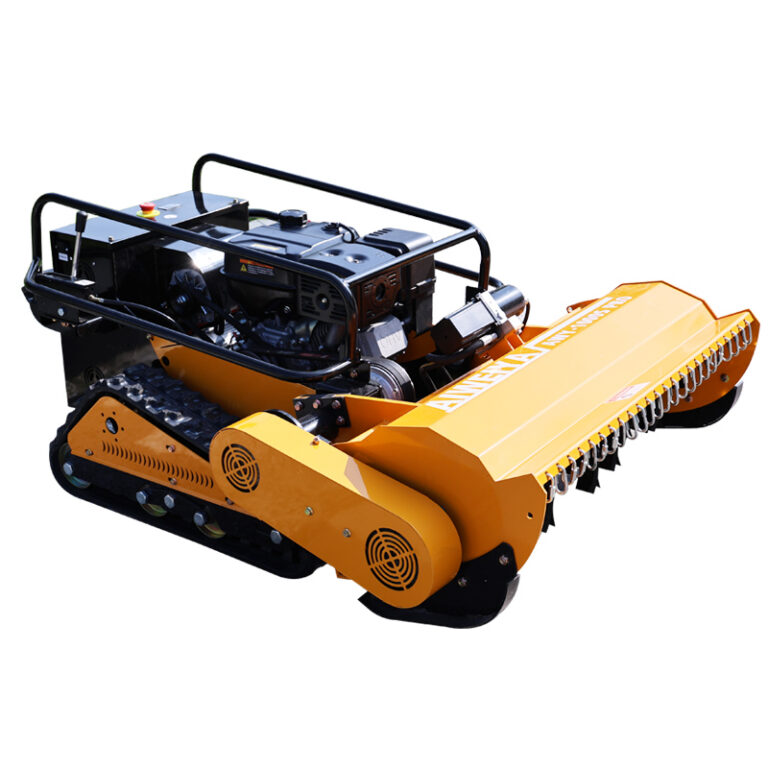
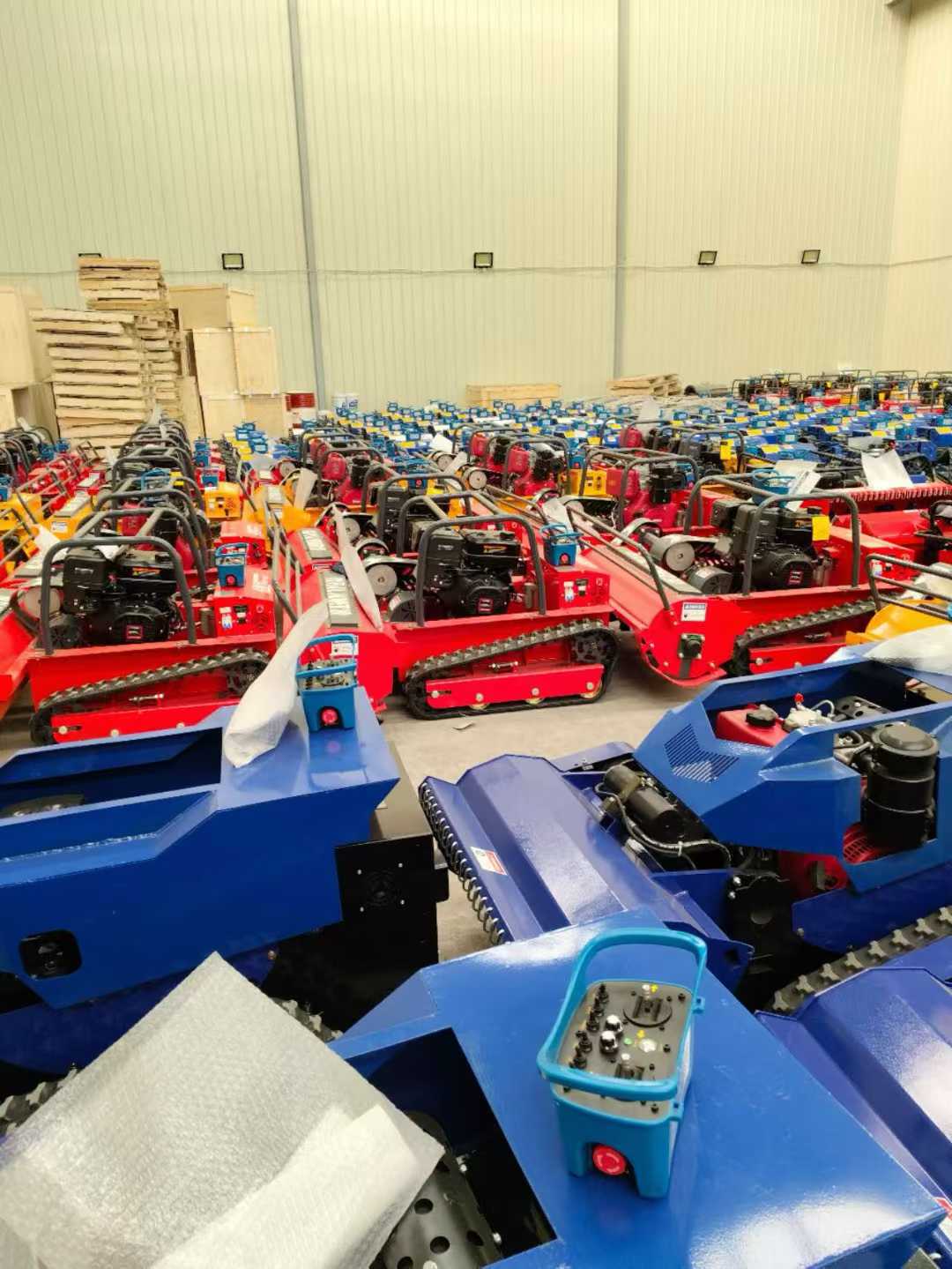
When purchasing a remote control mower for commercial or agricultural use, one of the first decisions is the type of drive system.
Should you choose a crawler remote control mower or a wheeled remote control mower?
The answer depends largely on the terrain, vegetation, slope, working environment, transportation requirements, and expected workload.
A wheeled machine may be suitable for relatively flat and accessible properties, while a tracked machine can be useful when the working environment includes uneven ground, slopes, soft soil, or difficult terrain.
However, the drive system should not be evaluated separately from the rest of the mower.
Engine power, machine weight, cutting system, center of gravity, track or wheel design, and remote-control performance all contribute to the overall working capability.
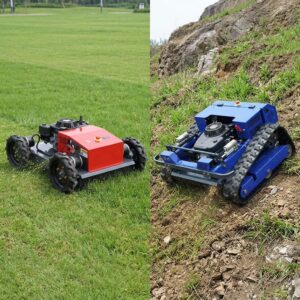
This guide explains the major differences between crawler and wheel remote mowers and how commercial buyers can match the drive system to their application.
1. What Is a Crawler Remote Control Mower?
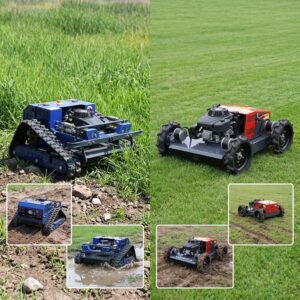
A crawler remote control mower uses continuous tracks instead of conventional wheels.
The tracks create a larger contact area with the ground and distribute machine weight across a broader surface.
This design is often associated with difficult-terrain applications.
Crawler remote mowers can be considered for:
- Steep slopes
- Uneven fields
- Orchards
- Embankments
- Roadsides
- Soft ground
- Dense vegetation
- Rough properties
The exact performance depends on the machine’s complete design and operating conditions.
A crawler system does not automatically make a machine suitable for every terrain.
2. What Is a Wheeled Remote Control Mower?
A wheeled remote mower uses conventional wheels as its primary drive system.
Wheels can offer advantages in applications where the ground is relatively firm, stable, and accessible.
Potential applications include:
- Flat lawns
- Parks
- Large estates
- Open grassland
- Commercial landscaping
- Regularly maintained properties
Wheeled systems can also provide straightforward transportation and familiar maintenance requirements.
For buyers working primarily on flat or gently sloped ground, a wheeled machine may satisfy the application without requiring a tracked configuration.
3. The Main Difference: Ground Contact
One of the most important differences between tracks and wheels is the way the machine contacts the ground.
A crawler track typically provides a longer continuous contact area.
Wheels concentrate contact around individual tire locations.
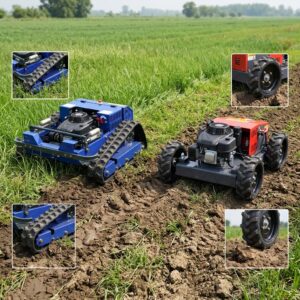
This difference can become important when operating on soft, uneven, or sloped terrain.
However, actual traction also depends on:
- Ground condition
- Track or tire material
- Machine weight
- Drive motors
- Contact pressure
- Surface moisture
- Vegetation
Therefore, buyers should avoid evaluating traction based only on whether the machine has tracks or wheels.
4. Crawler Mowers for Sloped Terrain
Slope applications are one of the situations where tracked machines are frequently considered.
A crawler remote control mower can provide a large contact surface and stable ground engagement.
This can be useful for:
- Roadside slopes
- Farm embankments
- Orchard slopes
- Drainage areas
- Hillside vegetation
- Large landscaped slopes
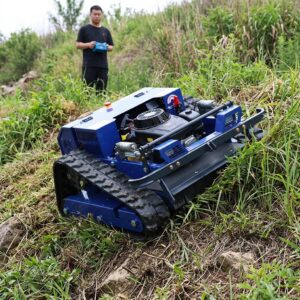
However, buyers should always check the manufacturer’s rated gradeability and operating conditions.
Factors such as wet grass, loose soil, slope direction, machine load, and surface condition can affect actual performance.
How to Choose a Remote Control Mower for Steep Slopes
5. When a Wheeled Mower May Be Suitable
Not every mowing application requires tracks.
A wheeled remote control mower may be appropriate when the working environment is mainly:
- Flat
- Firm
- Open
- Regularly maintained
- Easily accessible
For example, a commercial property maintenance company may primarily maintain large flat grass areas.
In such a situation, the additional terrain capability of a crawler system may not be necessary.
The key is to match the machine to the working environment.
6. Consider Soil Conditions
Soil conditions can significantly affect machine performance.
Common agricultural and landscaping surfaces include:
Firm Ground
Both wheels and tracks can perform effectively when the surface is stable.
Soft Soil
Tracks may provide advantages by distributing machine weight across a larger contact area.
Wet Ground
Moisture can reduce traction for both wheels and tracks.
Mud
Deep mud creates demanding operating conditions and should be evaluated according to the machine manufacturer’s recommendations.
Rocky Ground
The machine’s chassis, ground clearance, track or tire construction, and cutting system all become relevant.
7. Machine Stability Matters
Drive type is only one part of stability.
Other important factors include:
- Machine width
- Machine height
- Center of gravity
- Weight distribution
- Track or wheel position
- Cutting deck position
- Chassis design
A machine with a low and balanced chassis may behave differently from a taller machine even if both use similar drive systems.
This is particularly important for slope mowing.
Commercial buyers should request complete technical specifications rather than relying on the drive-system name alone.
8. Compare Traction
Traction determines how effectively the machine transfers drive power to the ground.
Crawler systems can provide substantial ground contact.
Wheeled systems can provide good traction on appropriate firm surfaces, especially when equipped with suitable tires.
When comparing machines, ask suppliers about:
- Track width
- Tire size
- Ground pressure
- Drive motor
- Machine weight
- Surface conditions
- Recommended applications
A professional supplier should be able to explain the expected performance for the buyer’s specific terrain.
9. Maneuverability and Turning
Maneuverability is another factor worth considering.
A mower operating between orchard rows may need to make frequent turns.
A machine working on a large open field may have fewer maneuvering requirements.
Consider:
- Turning space
- Row width
- Obstacles
- Tree spacing
- Fence lines
- Buildings
- Landscaping features
For orchard operations, compact dimensions may be particularly important.
How to Choose a Remote Control Mower for Farms and Orchards
10. Working on Uneven Terrain
Uneven terrain can include:
- Ruts
- Small slopes
- Roots
- Rocks
- Drainage channels
- Ground transitions
Crawler systems can be useful in applications where continuous ground contact is valuable.
However, machine geometry remains important.
Check:
- Ground clearance
- Approach angle
- Chassis clearance
- Track or wheel configuration
- Cutting-deck position
The objective is to choose a machine that matches the actual terrain rather than simply choosing the most rugged-looking model.
11. Cutting System Still Matters
Choosing between crawler and wheel drive does not determine the cutting capability.
The cutting system should be evaluated separately.
A remote mower may use:
- Rotary cutting
- Flail cutting
- Other specialized cutting configurations
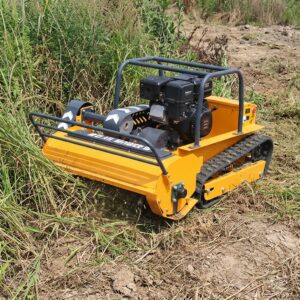
For dense vegetation, a flail system may be more appropriate.
For regularly maintained grass, a different configuration may be sufficient.
How to Choose a Remote Control Flail Mower
12. Compare Machine Weight
Machine weight can affect:
- Ground pressure
- Traction
- Transportation
- Stability
- Loading requirements
A heavier machine is not automatically better.
Likewise, a lighter machine is not automatically easier to operate.
The appropriate weight depends on the complete application.
For example, contractors transporting equipment frequently may prioritize manageable transport requirements.
A user working on difficult terrain may place greater importance on ground contact and machine stability.
13. Transportation Requirements
Transportation can be an important difference for commercial buyers.
Before purchasing, consider:
- Machine weight
- Machine dimensions
- Trailer capacity
- Loading method
- Storage requirements
- Frequency of transportation
If the machine will remain at one farm, transportation may be less important.
For contractors who visit several customer sites every week, transportation efficiency becomes much more relevant.
14. Maintenance Differences
Crawler and wheeled systems have different maintenance considerations.
Crawler System
Potential maintenance areas include:
- Track inspection
- Track tension
- Drive components
- Rollers
- Track wear
Wheeled System
Potential maintenance areas include:
- Tire condition
- Tire pressure
- Wheel components
- Bearings
- Drive components
The exact maintenance requirements depend on the machine design.
Before purchasing, ask the supplier for a maintenance schedule and recommended replacement intervals.
15. Spare Parts Availability
Commercial buyers should also consider spare parts.
For crawler machines, commonly stocked parts may include:
- Track components
- Rollers
- Drive-system components
- Cutting tools
- Belts
- Filters
For wheeled machines, potential parts may include:
- Tires
- Wheels
- Bearings
- Drive components
- Cutting tools
- Filters
A manufacturer that can supply replacement parts consistently can help commercial operators reduce equipment downtime.
Remote Control Mower Maintenance Guide for Commercial Users
16. Compare Productivity
Productivity depends on much more than drive type.
Important factors include:
- Cutting width
- Working speed
- Vegetation density
- Terrain
- Turning requirements
- Operator workflow
- Machine downtime
A wider machine may cover more ground per pass.
A compact machine may be more productive in restricted spaces because it can maneuver more easily.
For this reason, calculate productivity based on your actual application.
17. Remote Control Performance
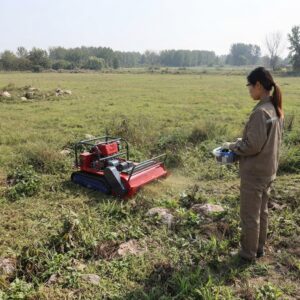
Both crawler and wheeled machines can use remote-control systems.
Important factors include:
- Operating range
- Signal stability
- Response time
- Controller design
- Battery life
- Emergency stop
- Machine status feedback
18. Consider the Type of Business
Drive-system selection can vary according to the buyer’s business.
| Buyer | Typical Application | Important Considerations |
|---|---|---|
| Farm Owner | Fields and orchards | Terrain, traction, access |
| Landscaping Company | Lawns and properties | Maneuverability, productivity |
| Vegetation Contractor | Slopes and roadsides | Terrain capability, cutting performance |
| Rental Company | Multiple applications | Versatility, durability |
| Dealer | Regional customers | Product range, support |
| Municipal Buyer | Public vegetation | Safety, reliability, service |
The same machine may not be appropriate for every customer.
Dealers in particular may want multiple configurations to serve different market segments.
19. How to Choose for Farms and Orchards
For agricultural customers, consider the following:
Flat Farm
A wheeled mower may be sufficient if the terrain is firm and accessible.
Sloped Farm
A crawler configuration may be worth evaluating because traction and ground contact become more important.
Orchard
Machine width and maneuverability are critical.
Overgrown Agricultural Land
Cutting-system capability becomes particularly important.
Mixed Terrain
A versatile crawler flail mower may be considered where the machine needs to handle several types of ground and vegetation.
20. How to Choose for Roadside Vegetation
Roadside maintenance often combines:
- Slopes
- Dense vegetation
- Uneven ground
- Limited operator access
- Obstacles
- Long working areas
These conditions can place greater demands on the mower.
For this type of application, buyers should evaluate:
- Crawler traction
- Gradeability
- Cutting system
- Remote control range
- Machine stability
- Working width
- Transport
Remote Control Mower for Highway Slope Maintenance
Remote Control Mower for Roadside Vegetation Control
21. Crawler vs Wheel: Practical Comparison
| Factor | Crawler Remote Mower | Wheeled Remote Mower |
|---|---|---|
| Uneven Terrain | Strong application fit | Depends on surface |
| Soft Ground | Often considered | Depends on tires and soil |
| Steep Slopes | Often considered | Application-dependent |
| Flat Grass | Suitable | Suitable |
| Orchard Access | Depends on dimensions | Depends on dimensions |
| Ground Contact | Continuous track area | Individual wheels |
| Transportation | Depends on machine weight | Depends on machine weight |
| Maintenance | Track components | Tires/wheels |
| Heavy Vegetation | Depends on cutting system | Depends on cutting system |
| Commercial Use | Common in demanding applications | Suitable for appropriate terrain |
This table should be treated as a general equipment-selection framework. Actual performance depends on the specifications of each individual model.
22. Don’t Choose Based on Tracks or Wheels Alone
One of the most common purchasing mistakes is treating the drive system as the only important specification.
A crawler machine with an unsuitable cutting system may not perform well for heavy vegetation.
Likewise, a powerful wheeled machine may be appropriate for a large flat property.
Before buying, evaluate the complete machine:
- Drive system
- Engine
- Cutting system
- Cutting width
- Gradeability
- Weight
- Dimensions
- Remote control
- Safety features
- Maintenance
- Spare parts
Remote Control Mower Specifications Buyers Should Compare
23. How B2B Buyers Should Compare Quotations
When requesting quotations from manufacturers, provide the same information to every supplier.
For example:
Application: Orchard vegetation management
Working Area: 20,000 m²
Terrain: Flat to moderately sloped
Vegetation: Grass and dense weeds
Required Cutting Width: Approximately 80–100 cm
Drive Requirement: Crawler preferred
Purchase Quantity: Multiple units
Then request:
- Complete machine price
- Cutting configuration
- Spare parts package
- Packaging
- Warranty
- Delivery terms
- OEM/ODM options
This creates a more useful comparison between suppliers.
24. What Dealers Should Consider
For dealers, the decision is often broader than selecting one machine.
A dealer may need to determine whether the local market has greater demand for:
- Compact remote mowers
- Crawler slope mowers
- Flail mowers
- Agricultural mowers
- Landscaping machines
- Heavy-duty vegetation equipment
Market requirements should be researched before building a product range.
A manufacturer that can provide multiple configurations can make product-line development more flexible.
How to Choose a Remote Control Mower Supplier for Your Market
25. OEM and ODM Options
For distributors and established equipment brands, OEM/ODM can be another consideration.
Possible customization areas include:
- Brand logo
- Product color
- Labels
- Packaging
- User manuals
- Product configuration
- Accessories
- Spare-parts packages
When evaluating a manufacturer, ask about minimum order quantity, customization requirements, lead time, and technical support.
Remote Control Mower OEM and ODM Guide
26. Why NUOYU Offers Different Remote Mowing Solutions
NUOYU focuses on remote control mowing equipment for commercial vegetation management.
Its application areas include:
- Slope mowing
- Farm vegetation management
- Orchard maintenance
- Roadside vegetation control
- Brush cutting
- Landscaping
- Solar farm maintenance
- Large property management
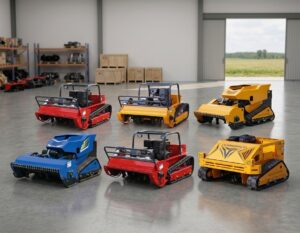
For B2B buyers, NUOYU supports customers such as:
- Dealers
- Distributors
- Importers
- Contractors
- Rental companies
- Agricultural buyers
- OEM/ODM customers
NUOYU Remote Control Mower Products
NUOYU Commercial Mowing Solutions
27. Crawler or Wheel: A Simple Decision Process
Use the following process when selecting a machine.
Step 1: Identify the terrain
Is the working area mainly flat, uneven, soft, or sloped?
Step 2: Identify vegetation
Is the machine cutting short grass, tall grass, weeds, or brush?
Step 3: Measure access
What are the narrowest areas the mower must enter?
Step 4: Determine productivity
How much area needs to be maintained?
Step 5: Evaluate transport
How frequently will the machine be moved?
Step 6: Compare complete specifications
Compare the complete machine rather than just the drive system.
Step 7: Discuss the application with the manufacturer
Provide real working conditions and request a model recommendation.
28. Buying Checklist
Before placing an order, confirm:
Terrain
- Slope
- Ground condition
- Soil type
- Obstacles
- Access
Drive System
- Crawler or wheels
- Track/tire specifications
- Traction
- Ground contact
- Gradeability
Cutting
- Cutting width
- Rotary or flail
- Vegetation type
- Cutting-tool durability
Machine
- Engine power
- Machine weight
- Machine dimensions
- Ground clearance
- Working speed
Remote Control
- Control range
- Signal stability
- Emergency stop
- Battery life
Supplier
- Spare parts
- Warranty
- Technical support
- OEM/ODM
- Bulk purchasing
FAQ
Are crawler remote mowers better than wheeled remote mowers?
The appropriate drive system depends on the application. Crawler machines can be suitable for uneven, soft, or sloped terrain, while wheeled machines can be suitable for many flat and firm-ground applications.
Are wheeled remote mowers suitable for slopes?
Some wheeled machines can operate on slopes depending on their design and specifications. Buyers should check the manufacturer’s recommended operating conditions.
Why are crawler tracks used on remote control mowers?
Crawler tracks provide continuous ground contact and can be useful when traction and terrain adaptability are important.
Are crawler mowers suitable for orchards?
They can be suitable for orchards when the machine width, maneuverability, and ground characteristics match the orchard layout.
Which type is better for roadside mowing?
Roadside mowing requirements vary. Buyers should consider slope, vegetation, terrain, access, cutting system, and remote-control requirements rather than selecting a drive type alone.
Which type requires less maintenance?
Maintenance requirements depend on the specific machine. Crawler systems require track-related inspections, while wheeled machines require tire and wheel maintenance.
Do crawler mowers cost more?
Pricing depends on the complete machine configuration, including engine, cutting system, chassis, tracks, remote-control system, and customization. The drive system is only one factor.
Can I purchase crawler remote mowers wholesale?
Yes. Dealers, distributors, contractors, importers, and other commercial buyers can discuss bulk orders and OEM/ODM requirements with manufacturers.
Conclusion
The choice between a crawler remote control mower and a wheeled remote control mower should be based on the actual working environment.
Crawler systems can be considered when the application involves:
- Slopes
- Uneven terrain
- Soft ground
- Difficult access
- Demanding vegetation management
Wheeled systems can be suitable for applications involving:
- Flat terrain
- Firm ground
- Open grass areas
- Regular property maintenance
- Accessible working environments
But the drive system is only one part of the selection process.
Commercial buyers should also evaluate:
- Cutting system
- Engine power
- Cutting width
- Machine dimensions
- Weight
- Gradeability
- Remote control performance
- Safety functions
- Maintenance
- Spare parts
- Supplier support
For dealers, contractors, farms, landscaping companies, and professional vegetation-management businesses, the most useful approach is to start with the actual application and then select the machine configuration that matches those requirements.
Looking for a Crawler or Wheeled Remote Control Mower?
Send NUOYU your terrain conditions, vegetation type, working area, required cutting width, and purchasing quantity to receive a suitable product recommendation and commercial quotation.