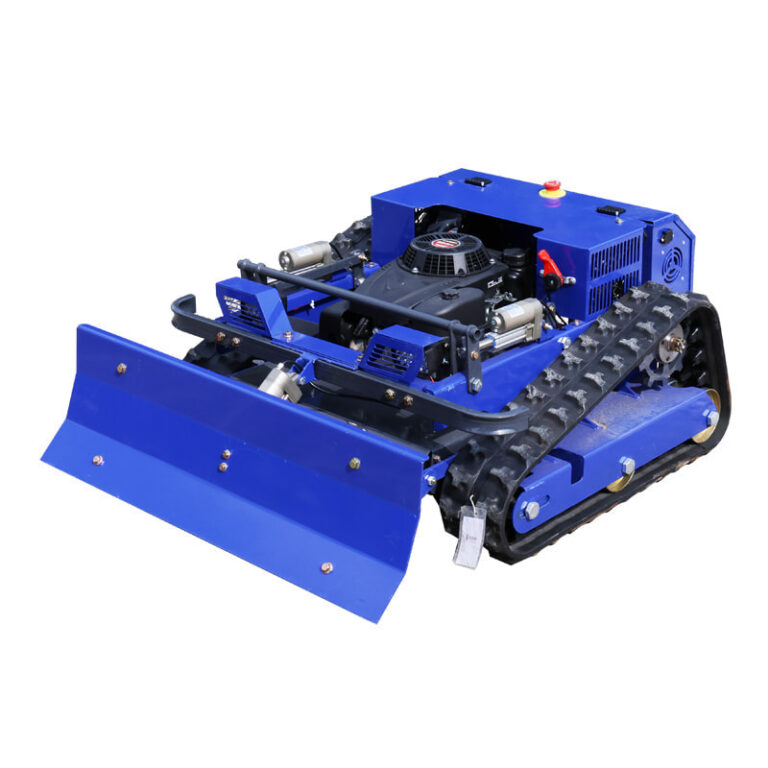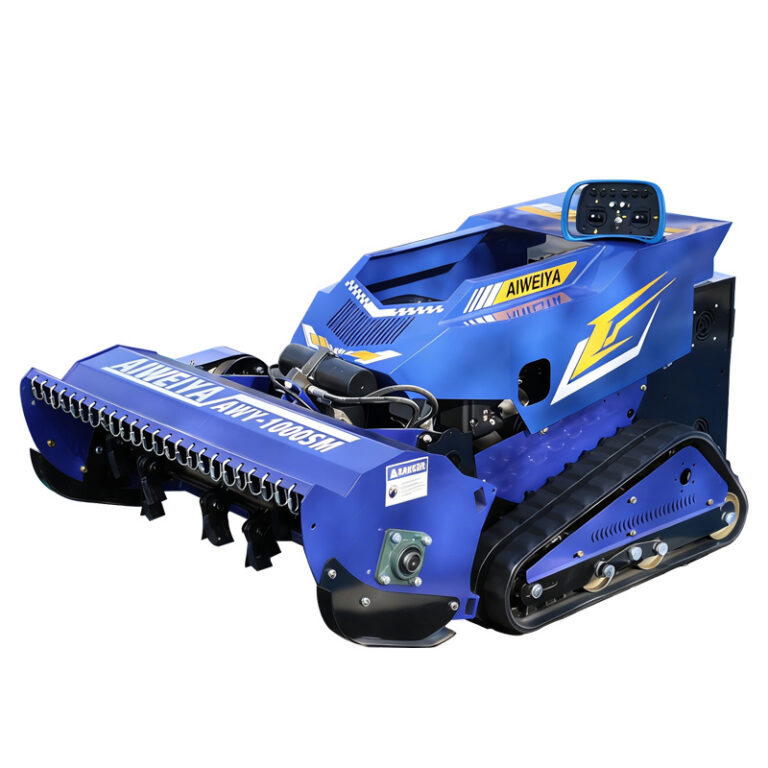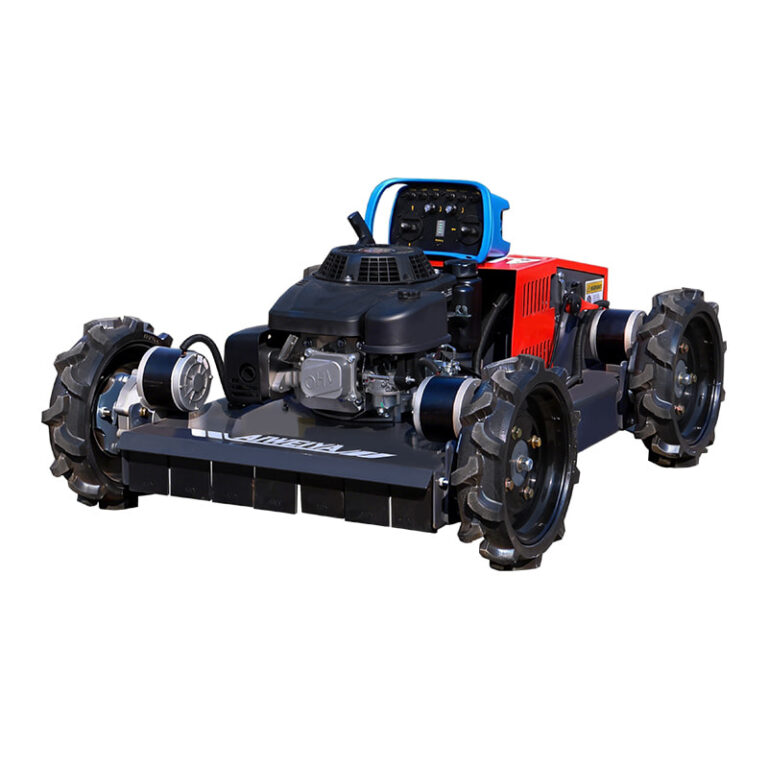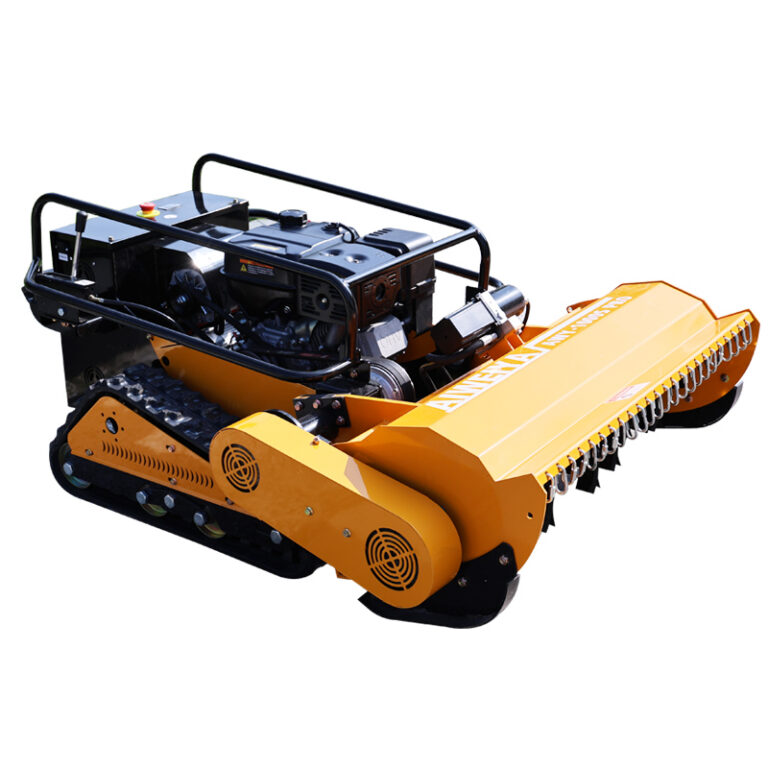
When vegetation becomes too tall, dense, or difficult to access for conventional lawn equipment, a remote control flail mower can provide a practical solution for professional vegetation management.
Unlike a standard lawn mower designed primarily for maintaining relatively short grass, a flail mower is built around a cutting system that uses rotating flails to process vegetation.
Combined with remote control operation and a crawler drive system, this type of mower can be used in applications such as:
- Steep slopes
- Roadside embankments
- Farms
- Orchards
- Overgrown properties
- Brush management
- Construction sites
- Solar farms
- Landscaping projects
- Municipal vegetation maintenance
However, not every remote control flail mower is designed for the same working conditions.
A commercial buyer should evaluate the complete machine rather than choosing based only on engine power or price.

This guide explains the major factors buyers should consider before purchasing a remote control flail mower for commercial or agricultural use.
1. Understand What a Remote Control Flail Mower Is
A remote control flail mower combines three major components:
- A remote control operating system
- A drive system, often using crawler tracks
- A flail cutting system
The remote control system allows the operator to control the mower from a distance.
The crawler system provides traction and mobility across challenging terrain.
The flail cutting system is designed to process grass, weeds, and other vegetation.
This combination makes remote control flail mowers particularly relevant for difficult vegetation-management applications.
They are not necessarily intended to replace every conventional mower.
Instead, they are especially useful where terrain, vegetation, or operator access makes conventional mowing less practical.
2. Identify What You Need to Cut
Before selecting a machine, determine the type of vegetation you need to manage.
Different working environments may include:
Short Grass
If the machine will mainly maintain regularly cut grass, a lighter cutting configuration may be sufficient.
Tall Grass
Tall grass creates a greater cutting load and may require a more robust flail system.
Dense Weeds
Dense weeds can require additional cutting capacity and machine power.
Brush
Brush and heavier vegetation require attention to flail design, cutting durability, and machine construction.
Mixed Vegetation
Commercial contractors may encounter different vegetation types on the same job site.
In this situation, versatility can become an important purchasing factor.
Internal Link:
[LINK: Remote Control Mower for Brush and Weed Cutting]
3. Consider the Working Environment
The same mower may perform differently depending on where it is used.
A flat agricultural field is very different from a roadside embankment.
Consider whether the machine will operate on:
- Flat farmland
- Sloped farmland
- Orchards
- Roadside slopes
- Drainage areas
- Construction sites
- Solar farms
- Parks
- Large private estates
- Overgrown land
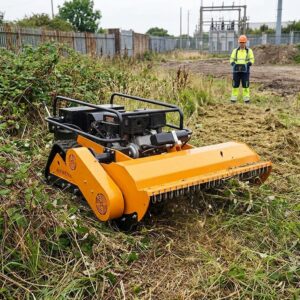
The environment should influence the machine specification you select.
4. Choose the Right Flail Cutting System
The cutting system is one of the most important parts of a remote control flail mower.
A flail mower typically uses rotating components equipped with cutting tools.
As the rotor spins, the flails process vegetation beneath the cutting deck.
For commercial buyers, important considerations include:
- Rotor design
- Flail type
- Number of cutting tools
- Cutting chamber design
- Cutting width
- Rotor speed
- Cutting durability
- Ease of maintenance
The appropriate configuration depends on the type of vegetation and expected workload.
For light grass maintenance, a heavy-duty configuration may not be necessary.
For brush and dense vegetation, durability becomes much more important.
5. Flail Type Can Affect Cutting Performance
Different flail configurations can be designed for different vegetation conditions.
Depending on the machine, cutting tools may be optimized for:
- Grass
- Weeds
- Dense vegetation
- Brush
- Rough vegetation
When requesting a quotation, ask the supplier what type of flail configuration is included.
Also ask whether alternative cutting tools are available.
For commercial customers, interchangeable or replaceable cutting components can be useful because working conditions can vary between projects.
6. Match Cutting Width to Your Application
Cutting width affects how much vegetation the machine can process during each pass.
A wider cutting deck can potentially increase productivity on large open areas.
However, a narrower machine can provide better access in restricted areas.
For example:
Large open farm:
A wider cutting system may improve coverage.
Orchard:
Machine width must fit between tree rows.
Roadside embankment:
The cutting width should match the available working space.
Landscaping:
Maneuverability may be more important than maximum width.
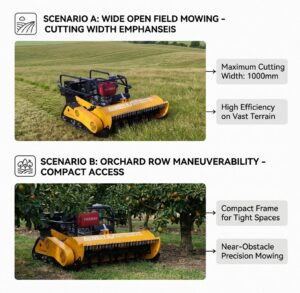
Remote Control Mower Cutting Width Explained
7. Check Engine Power
Engine power affects the machine’s ability to operate the cutting system and drive system.
However, buyers should not assume that the highest horsepower automatically represents the most suitable machine.
Engine requirements depend on:
- Cutting width
- Vegetation density
- Flail configuration
- Working speed
- Terrain
- Machine weight
- Expected workload
A mower working through thick brush may require a different power configuration from a mower maintaining short grass.
For commercial applications, it is better to match engine power to the expected workload.
Remote Control Mower Engine Power Explained
8. Evaluate Crawler Track Performance
For many commercial flail mower applications, crawler tracks are an important consideration.
Tracked machines can provide a large contact area with the ground and can be useful on uneven or sloped surfaces.
Evaluate:
- Track width
- Track length
- Ground contact
- Traction
- Chassis construction
- Drive motors
- Ground pressure

Why Crawler Tracks Are Important for Slope Mowing
9. Consider Slope Capability
Remote control flail mowers are often considered for slope vegetation management.
However, buyers should check the manufacturer’s actual operating specifications.
Important factors include:
- Maximum recommended slope
- Track configuration
- Machine stability
- Center of gravity
- Ground conditions
- Traction
- Direction of travel
A published maximum slope figure should be interpreted together with the conditions under which it was measured.
Wet grass, loose soil, mud, and uneven terrain can change actual traction.
How to Choose a Remote Control Mower for Steep Slopes
10. Look at Machine Stability
Stability is particularly important when a flail mower is working on uneven ground.
Evaluate the overall relationship between:
- Machine height
- Machine width
- Track position
- Engine position
- Cutting deck
- Weight distribution
- Center of gravity
A compact and appropriately balanced design can help the operator maintain controlled movement over irregular terrain.
For B2B buyers, stability should be evaluated as part of the complete machine design.
11. Check the Remote Control System
Remote control is a central feature of this type of equipment.
The operator should be able to control the machine accurately from a suitable position.
Important specifications include:
- Control range
- Signal stability
- Forward/reverse control
- Steering
- Cutting control
- Speed adjustment
- Emergency stop
- Controller battery life

12. Safety Features Should Be Evaluated Carefully
A remote control mower is still powerful industrial equipment.
Safety should therefore be considered throughout the purchasing process.
Ask about available features such as:
- Emergency stop
- Signal-loss response
- Controlled shutdown
- Overload protection
- Warning indicators
- Remote engine shutdown
The machine should also be operated according to the manufacturer’s instructions.
Operators should maintain an appropriate observation position and keep people away from the cutting area.
Remote operation can reduce the need for the operator to stand directly beside the cutting equipment, but it does not remove all operating risks.
13. Consider Working Speed
Working speed affects productivity.
However, maximum travel speed is not necessarily the same as practical mowing speed.
Actual mowing speed depends on:
- Vegetation density
- Cutting width
- Terrain
- Slope
- Ground conditions
- Cutting system
- Desired finish
For commercial buyers, practical working productivity is more useful than simply comparing the highest travel-speed specification.
14. Think About Ground Clearance
Agricultural and commercial properties may contain:
- Stones
- Roots
- Drainage channels
- Ruts
- Uneven soil
- Fallen branches
Ground clearance can therefore affect where the machine can operate.
However, clearance should be considered together with chassis height and stability.
The objective is to find a machine that can negotiate the expected terrain without compromising the overall working characteristics.
15. Check Machine Weight and Dimensions
Machine dimensions influence transportation and accessibility.
Important measurements include:
- Overall length
- Overall width
- Overall height
- Machine weight
- Cutting width
A large machine may provide greater cutting capacity but can require more transport space.
A compact machine may access tighter areas more easily.
For contractors, machine dimensions should be compared with trailer capacity and typical job-site access.
16. Consider Fuel Capacity and Working Time
For gasoline-powered remote control flail mowers, fuel capacity affects operating convenience.
Ask the manufacturer about:
- Fuel tank capacity
- Expected operating time
- Fuel consumption
- Engine type
- Refueling process
Actual fuel consumption depends on the workload.
Dense vegetation, heavy cutting, and difficult terrain may increase fuel use.
17. Maintenance of a Remote Control Flail Mower
Flail mowing can generate significant plant debris.
After operation, the machine should be inspected and cleaned according to the manufacturer’s maintenance instructions.
Regular checks may include:
- Cutting tools
- Rotor
- Bearings
- Belts
- Fasteners
- Track system
- Engine
- Filters
- Lubrication points
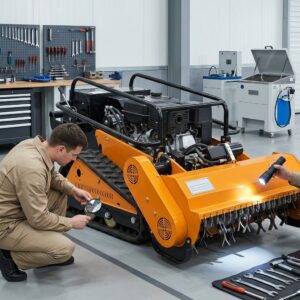
Remote Control Mower Maintenance Guide for Commercial Users
18. Spare Parts Availability
For contractors and commercial operators, spare parts support should be discussed before purchase.
Potential wear parts include:
- Flails
- Cutting tools
- Belts
- Bearings
- Filters
- Track components
- Electrical components
- Controller batteries
Ask the manufacturer whether recommended spare parts packages can be supplied with the machine.
For dealers, keeping commonly replaced parts available can also help reduce customer downtime.
19. Consider the Total Cost of Ownership
The purchase price is only one part of the cost.
Commercial buyers should also consider:
- Fuel
- Maintenance
- Cutting tool replacement
- Spare parts
- Transportation
- Operator time
- Downtime
- Warranty support
A machine with a lower initial price may not necessarily have the lowest long-term operating cost.
This is why B2B buyers should compare complete quotations rather than only the machine purchase price.
Remote Control Mower Price: What Affects the Cost?
20. Choose According to Your Business Model
Different buyers have different priorities.
Farm Owner
Main concerns may include:
- Terrain
- Vegetation
- Reliability
- Ease of operation
- Maintenance
Landscaping Company
May prioritize:
- Maneuverability
- Productivity
- Versatility
- Transport
Vegetation Contractor
May focus on:
- Heavy-duty cutting
- Slope capability
- Working efficiency
- Spare parts
Rental Company
May prioritize:
- Durability
- Ease of operation
- Multiple applications
- Service support
Dealer / Distributor
May require:
- Product range
- Wholesale pricing
- Spare parts
- Marketing support
- OEM/ODM
- Factory support
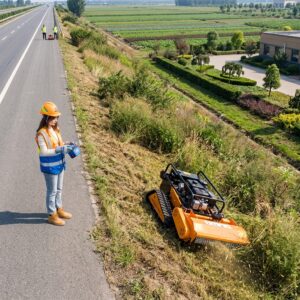
21. Questions to Ask the Manufacturer
Before requesting a quotation, prepare a list of technical questions.
Machine
- What is the engine power?
- What is the cutting width?
- What is the machine weight?
- What are the overall dimensions?
- What is the working speed?
Cutting System
- What type of flails are used?
- What vegetation can the machine handle?
- Are replacement flails available?
- How easy is cutting-tool replacement?
Terrain
- Is the machine designed for slopes?
- What is the recommended gradeability?
- How does the crawler system perform on uneven terrain?
Remote Control
- What is the effective control range?
- What happens if the signal is interrupted?
- Is an emergency stop included?
- How long does the controller battery last?
After-Sales
- Are spare parts available?
- What warranty is provided?
- Is technical support available?
- Can operation and maintenance training be provided?
22. How to Compare Two Remote Control Flail Mowers
When comparing two models, avoid focusing on only one specification.
Create a comparison sheet like this:
| Specification | Model A | Model B |
|---|---|---|
| Engine Power | Check supplier | Check supplier |
| Cutting Width | Check supplier | Check supplier |
| Cutting System | Flail | Flail |
| Drive System | Crawler | Crawler |
| Gradeability | Check supplier | Check supplier |
| Machine Weight | Check supplier | Check supplier |
| Control Range | Check supplier | Check supplier |
| Fuel Capacity | Check supplier | Check supplier |
| Safety Functions | Check supplier | Check supplier |
| Spare Parts | Check supplier | Check supplier |
| Warranty | Check supplier | Check supplier |
| OEM/ODM | Check supplier | Check supplier |
This approach makes supplier quotations easier to evaluate.
23. When Should You Choose a Remote Control Flail Mower?
A remote control flail mower may be considered when the application involves a combination of:
- Difficult terrain
- Tall vegetation
- Dense weeds
- Brush
- Slopes
- Restricted operator access
- Large vegetation-management areas
For simple residential lawn mowing, a conventional lawn mower may be sufficient.
For professional vegetation management, however, a remote control flail mower can provide a different equipment option.
24. Why NUOYU Remote Control Flail Mowers Are Designed for Commercial Applications
NUOYU provides remote control mowing equipment for applications including:
- Slope mowing
- Farm vegetation management
- Orchard maintenance
- Roadside vegetation control
- Brush cutting
- Landscaping
- Solar farm maintenance
- Large property management
The product range includes crawler-based remote control mowing solutions designed for different commercial applications.
For B2B customers, NUOYU can also support:
- Dealers
- Distributors
- Importers
- Contractors
- Rental companies
- Farm buyers
- OEM/ODM customers

NUOYU Remote Control Flail Mower Products
NUOYU Commercial Mowing Solutions
25. Final Buying Checklist
Before purchasing a remote control flail mower, confirm:
Application
- Main vegetation type identified
- Working area measured
- Terrain evaluated
- Slope conditions confirmed
Machine
- Engine power
- Cutting width
- Machine width
- Machine weight
- Crawler configuration
- Ground clearance
Cutting System
- Flail type
- Rotor configuration
- Cutting-tool availability
- Replacement procedure
Remote Control
- Control range
- Signal stability
- Emergency stop
- Battery duration
Commercial Support
- Spare parts
- Warranty
- Technical support
- OEM/ODM
- Bulk-order support
FAQ
What is a remote control flail mower?
A remote control flail mower is a vegetation-management machine that combines a flail cutting system with remote operation. Many models also use crawler tracks for difficult terrain.
What can a remote control flail mower cut?
Depending on the specific model and cutting configuration, it can be used for grass, weeds, tall vegetation, brush, and other vegetation-management applications.
Is a flail mower good for steep slopes?
Remote control flail mowers can be used for some slope applications, especially when combined with a suitable crawler drive system. Buyers should always verify the manufacturer’s operating specifications for the intended terrain.
What is the difference between a flail mower and a regular mower?
A flail mower uses rotating cutting tools mounted on a rotor, while conventional rotary lawn mowers typically use blades. Flail systems are commonly used for heavier vegetation-management applications.
Are crawler flail mowers suitable for farms?
They can be suitable for farm applications involving uneven terrain, tall grass, weeds, field edges, and other vegetation-management requirements.
How do I choose the right flail mower?
Start with the vegetation and terrain. Then compare cutting width, engine power, crawler system, slope capability, machine dimensions, remote control functions, maintenance requirements, and supplier support.
Can I buy remote control flail mowers wholesale?
Yes. Commercial buyers such as distributors, dealers, contractors, and importers can discuss bulk purchasing and OEM/ODM requirements with manufacturers.
Conclusion
Choosing a remote control flail mower requires a complete evaluation of the working environment, vegetation, cutting system, drive system, remote control technology, and long-term support.
For commercial applications, buyers should pay particular attention to:
- Vegetation type
- Flail configuration
- Cutting width
- Engine power
- Crawler traction
- Slope capability
- Machine stability
- Remote control range
- Safety functions
- Maintenance
- Spare parts
- Total operating cost
- Manufacturer support
Instead of selecting equipment based on one specification, compare the entire machine with the requirements of your actual application.
For farms, orchards, roadside maintenance, contractors, landscaping companies, and other professional users, a properly configured remote control flail mower can provide a flexible solution for managing difficult vegetation.
Looking for a Remote Control Flail Mower for Your Business?
Contact NUOYU with your vegetation type, terrain conditions, required cutting width, working area, and purchasing requirements.