Choosing the right mower is not always as simple as comparing cutting width or engine power. For homeowners, property managers, landscapers, farmers, and orchard owners, the best mowing equipment depends heavily on the size of the property, terrain conditions, available labor, operating environment, and long-term maintenance costs.
Two popular options are the traditional walk-behind mower and the increasingly popular remote control mower. A walk-behind mower is familiar, relatively inexpensive, and easy to find. A remote controlled mower, on the other hand, allows the operator to control the machine from a distance, making it particularly useful for slopes, rough terrain, orchards, overgrown areas, and other difficult mowing environments.
So which one should you choose?
The answer depends on your property and priorities. This guide compares remote control mowers and walk-behind mowers across the factors that matter most, including safety, mowing efficiency, terrain capability, operator comfort, maneuverability, price, maintenance, and overall value.
What Is the Difference Between a Walk-Behind Mower and a Remote Control Mower?
A walk-behind mower is a conventional lawn mower operated directly from behind the machine. The operator holds a handlebar and walks with the mower while controlling its direction and speed. Depending on the model, a walk-behind mower may use gasoline, batteries, or an electric motor.
Walk-behind mowers are particularly suitable for relatively small, flat, and well-maintained lawns. They are widely available and generally have a lower purchase price.
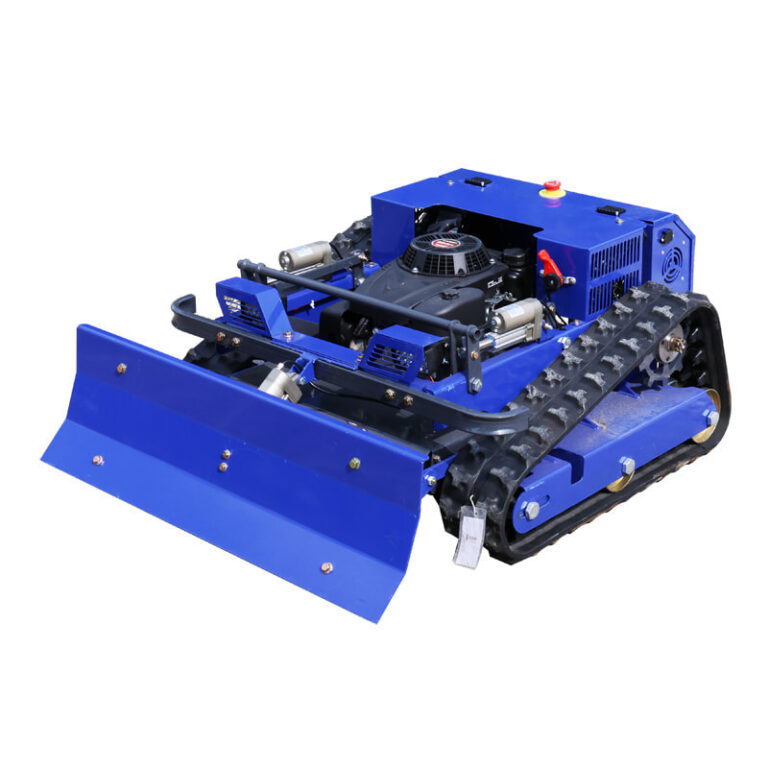
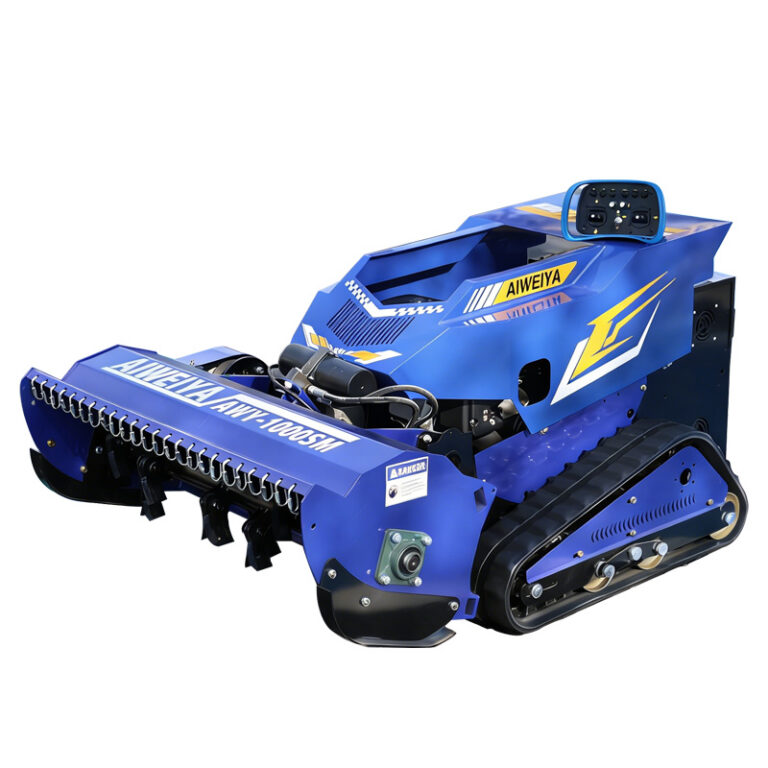
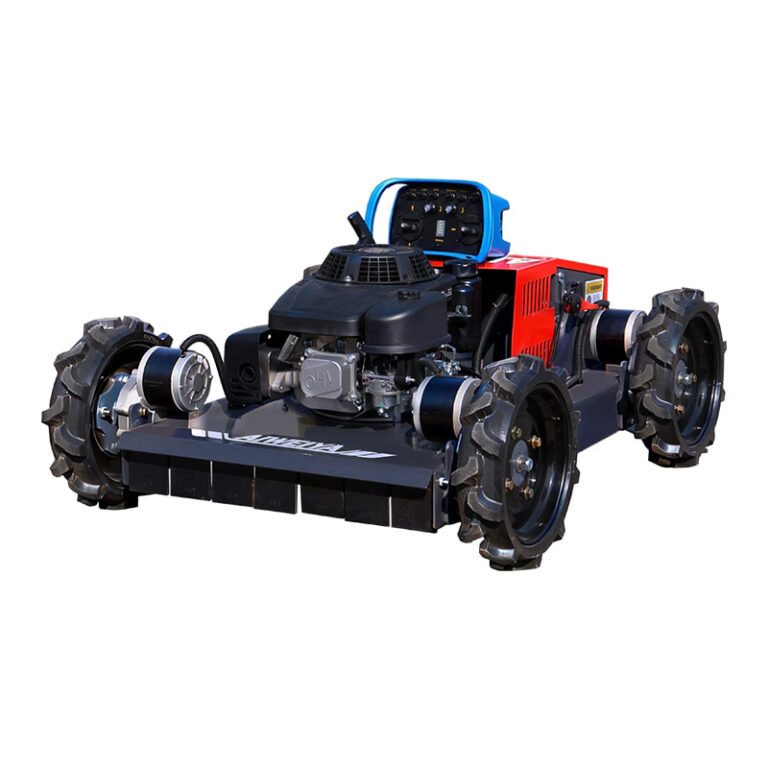
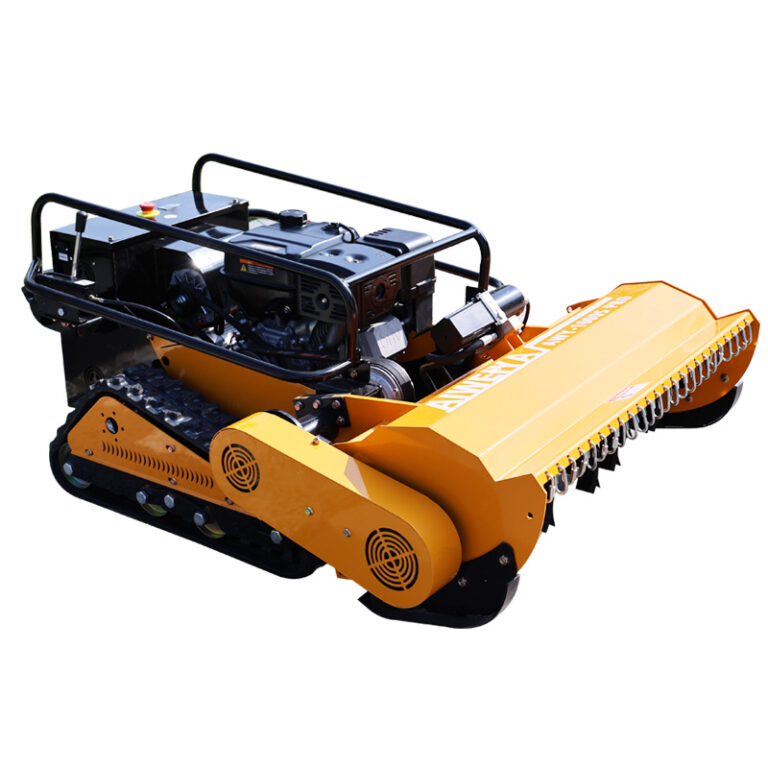
A remote control mower, also known as an RC mower or remote controlled lawn mower, is operated wirelessly using a handheld remote transmitter. Instead of walking directly behind the cutting deck, the operator controls the machine from a safer distance.
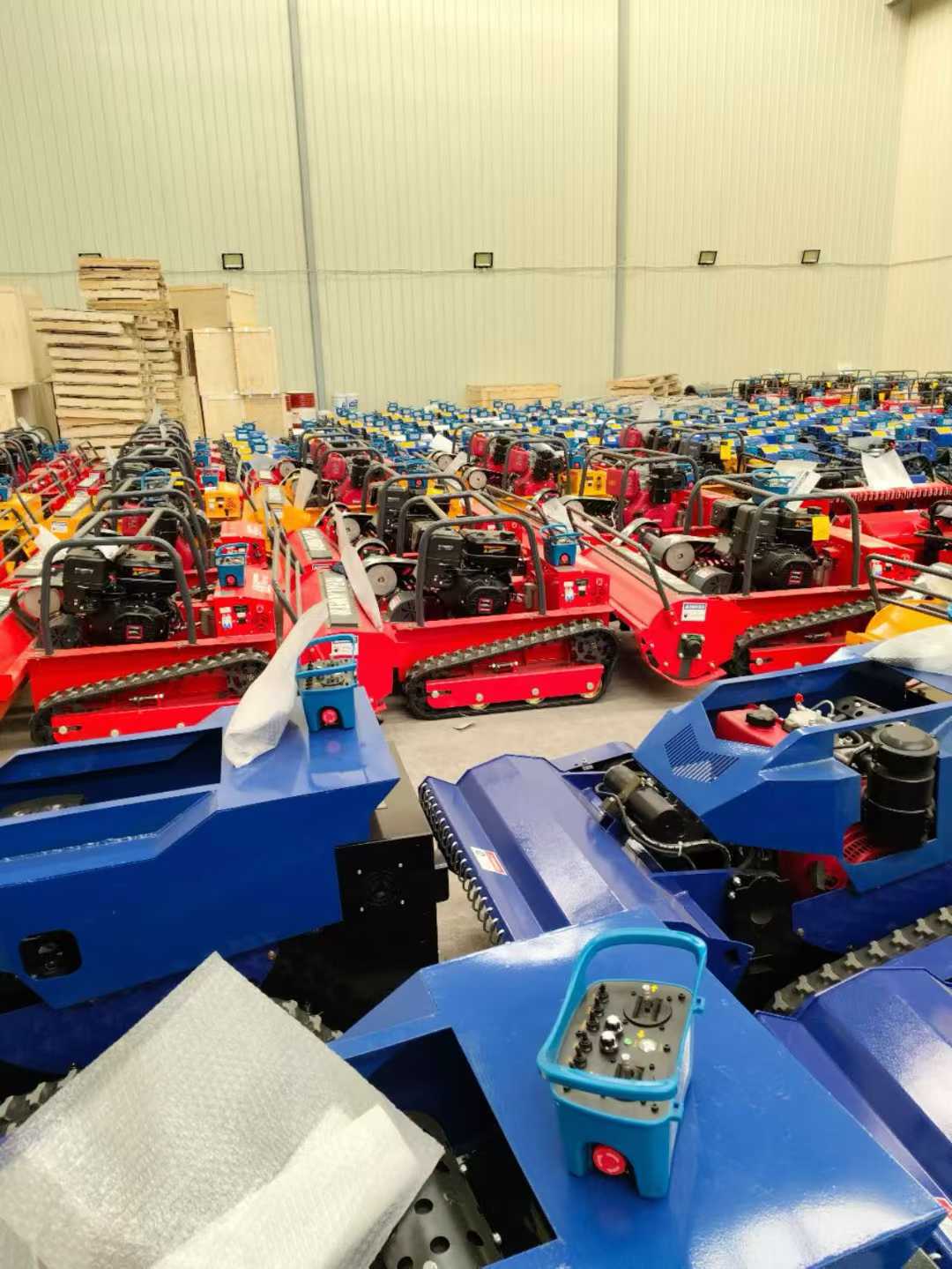
Many remote control mowers use tracked drive systems, which provide strong traction and stability on slopes, uneven ground, muddy areas, and rough vegetation. Depending on the model, remote operation can control movement, steering, blade engagement, and other functions.
The fundamental difference is simple: a walk-behind mower requires the operator to stay with the machine, while a remote control mower allows the operator to work from a distance.
Remote Control Mower vs Walk-Behind Mower: Side-by-Side Comparison
| Feature | Remote Control Mower | Walk-Behind Mower |
|---|---|---|
| Operator position | Away from the machine | Directly behind the machine |
| Slopes | Excellent on suitable models | Limited |
| Rough terrain | Very capable | More difficult |
| Narrow areas | Excellent maneuverability | Good |
| Operator fatigue | Low | High |
| Upfront cost | Higher | Lower |
| Large properties | Well suited | Labor intensive |
| Orchards | Highly suitable | More difficult around trees |
| Wet or uneven terrain | Suitable with proper tracks | Limited |
| Long mowing sessions | More comfortable | Physically demanding |
The table provides a quick overview, but each factor deserves a closer look.
1. Safety: One of the Biggest Differences
Safety should be one of the first considerations when choosing mowing equipment.
With a walk-behind mower, the operator remains close to the cutting deck throughout the job. When mowing around rocks, branches, uneven ground, or other obstacles, there is always a possibility of debris being thrown from the cutting area.
Slopes introduce another concern. Maintaining control of a heavy mower while walking uphill or downhill can become difficult, particularly when the ground is wet or loose. A loss of footing can make the situation more dangerous.
A remote control mower changes the operator’s position completely.
Instead of standing directly behind the machine, the operator can remain several meters away while controlling its movement. This creates greater separation between the person and the cutting equipment.
For difficult terrain, this can be particularly valuable. The operator can stand on stable ground while the mower works on a slope, in dense vegetation, or in an area that would be uncomfortable or unsafe to access directly.
Many modern RC mowers also include safety features such as emergency stops and automatic blade shutdown when communication with the remote controller is interrupted.
Winner: Remote Control Mower
For slopes, rough ground, obstacles, and demanding mowing environments, remote operation provides a significant safety advantage.
2. Mowing Efficiency and Productivity
Mowing efficiency is not simply about how quickly a machine moves. It also depends on cutting width, terrain, operator fatigue, maneuverability, and how frequently the machine needs to stop.
Walk-behind mowers can perform very well on small, flat lawns. A self-propelled model reduces some of the physical effort, allowing the operator to maintain a steady mowing speed.
However, productivity can decrease significantly when the property becomes larger or more difficult to navigate.
Thick vegetation, steep slopes, wet ground, and uneven surfaces can force the operator to slow down. Long mowing sessions can also become tiring, which may reduce the amount of work that can realistically be completed in one day.
A remote control lawn mower allows the operator to control the machine without physically walking behind it.
This makes long mowing sessions less physically demanding. The operator can remain in one position and focus on guiding the machine rather than continuously pushing, walking, and turning.
For commercial properties, farms, orchards, and large lawns, this can make a substantial difference in overall productivity.
Winner: Remote Control Mower
For larger properties and difficult terrain, remote-controlled operation can improve productivity by reducing operator fatigue and making challenging areas easier to access.
3. Performance on Slopes and Uneven Terrain
Terrain is one area where the difference between the two mower types becomes especially obvious.
Walk-behind mowers are most comfortable on relatively flat ground. As the slope becomes steeper, the operator has to work harder to maintain balance and control.
Wet grass, loose soil, mud, ditches, and uneven surfaces can make the problem even more challenging.
A tracked RC mower is designed for a very different type of environment.
Rubber tracks provide a larger contact area than conventional mower wheels, helping distribute the machine’s weight and improve traction. A low center of gravity can also contribute to stability on sloped terrain.
This makes tracked remote control mowers particularly useful for:
- Hillsides
- Embankments
- Orchards
- Pastures
- Rough grassland
- Drainage areas
- Construction sites
- Solar farm vegetation
- Overgrown properties
The exact maximum slope capability depends on the specific machine, surface conditions, vegetation, and manufacturer specifications. Buyers should always check the rated operating angle before using a mower on steep terrain.
Winner: Remote Control Mower
If your property contains significant slopes or rough ground, a suitable RC mower is generally the more practical option.
4. Operator Comfort and Physical Effort
Traditional mowing can be surprisingly demanding.
Even a self-propelled walk-behind mower requires the operator to walk continuously, steer the machine, make turns, monitor obstacles, and maintain control over changing terrain.
On a large property, this can result in significant physical fatigue.
A remote control mower removes most of the walking and pushing associated with conventional mowing.
The operator can stand outside the mowing area and guide the machine using a handheld controller. This is particularly useful during extended mowing sessions or when maintaining difficult terrain.
Remote operation can also be beneficial for professional landscapers and property managers who need to use mowing equipment frequently.
Instead of spending hours walking behind a mower, the operator can focus on controlling the machine and monitoring the mowing area.
Winner: Remote Control Mower
For comfort and reduced physical workload, remote operation provides a clear advantage.
5. Maneuverability and Precision
Modern properties are rarely just large open rectangles.
You may need to mow around:
- Trees
- Fences
- Buildings
- Garden beds
- Utility equipment
- Irrigation systems
- Solar panels
- Narrow passages
A walk-behind mower can handle many of these areas, but the operator must physically move the machine into position.
A compact remote controlled mower can offer greater flexibility because the operator does not need to stand directly behind the machine.
Tracked models may also be capable of tight turns, depending on their drive system. This makes them useful in orchards and other environments where equipment must move between trees or around fixed obstacles.
For example, an orchard operator can stand outside a tree row while guiding the mower through vegetation between trees. This reduces the need to repeatedly walk into confined areas.
Winner: Remote Control Mower
For complex properties and tight working areas, remote operation can make positioning and maneuvering easier.
6. Purchase Price: Which Mower Costs More?
There is one category where the traditional walk-behind mower usually wins immediately: initial purchase price.
Basic walk-behind mowers are widely available at relatively affordable prices. They are a practical choice for homeowners with small lawns and limited mowing requirements.
Remote control mowers require more advanced technology, including wireless control systems, drive motors, specialized transmissions, tracks or heavy-duty wheels, and additional safety systems.
As a result, the initial investment is generally higher.
However, purchase price should not be the only factor used to determine value.
For a homeowner who only needs to mow a small, flat lawn occasionally, spending significantly more on a remote control mower may not make financial sense.
For a property owner who manages several acres, steep slopes, or difficult vegetation, the calculation can be very different.
The ability to reduce labor requirements, improve productivity, and make difficult areas easier to maintain can justify the higher initial investment.
Winner: Walk-Behind Mower for Low Initial Cost
Winner: Remote Control Mower for Certain Large or Difficult Properties
7. Long-Term Operating Value
The real cost of a mower includes more than the purchase price.
Consider:
- Labor
- Fuel or electricity
- Maintenance
- Replacement parts
- Operator time
- Property accessibility
- Frequency of mowing
For example, a commercial property requiring frequent mowing may spend considerably more on labor than the initial cost difference between two machines.
A remote controlled mower can potentially reduce the amount of physical labor required for repetitive mowing tasks.
It can also make difficult areas more accessible, allowing one operator to handle terrain that might otherwise require additional equipment or manual trimming.
For businesses, farms, and landscaping operations, evaluating cost per hour of operation or cost per acre maintained may provide a more useful comparison than simply looking at the purchase price.
8. Maintenance and Reliability
Walk-behind mowers have a major advantage when it comes to service accessibility.
Their mechanical systems are familiar to most repair shops, and replacement parts are generally easy to find.
Typical maintenance may include:
- Blade sharpening
- Oil changes on gasoline models
- Air filter replacement
- Spark plug replacement
- Cleaning
- Battery maintenance on electric models
Remote control mowers also require regular maintenance.
Depending on the machine, owners may need to inspect:
- Cutting blades
- Tracks or tires
- Engine or motor
- Air filters
- Belts
- Battery
- Remote controller
- Electrical connections
Because RC mowers contain electronic control systems, it is important to choose a manufacturer that provides reliable technical support and access to replacement parts.
Winner: Walk-Behind Mower for Simple Local Repairs
Winner: Remote Control Mower for Specialized Commercial Applications
9. Noise and Environmental Considerations
Gasoline-powered walk-behind mowers can be relatively loud, and the operator is exposed to the machine’s noise and exhaust at close range.
Battery-powered walk-behind models provide a quieter alternative and eliminate direct exhaust emissions during operation.
Remote control mowers also come in different power configurations.
Gasoline-powered RC mowers remain useful when high power and long operating periods are required. Electric models can provide quieter operation and zero direct exhaust emissions.
Another advantage of remote operation is the distance between the operator and the machine. Even when using a gasoline-powered mower, the operator is not standing immediately beside the engine and cutting deck.
For residential properties, commercial landscaping, and noise-sensitive environments, choosing the appropriate power system is an important consideration.
Remote Control Mower vs Walk-Behind Mower: Which Should You Choose?
The right choice ultimately depends on your property.
Choose a Walk-Behind Mower If:
- You have a small lawn
- Your property is mostly flat
- Your mowing area is easy to access
- Your budget is limited
- You do not mind walking while mowing
- You prefer simple and widely available equipment
- You only mow occasionally
For a small residential lawn, a traditional walk-behind mower can be an affordable and practical solution.
Choose a Remote Control Mower If:
- You maintain a medium or large property
- Your land contains steep slopes
- You regularly mow rough or uneven terrain
- You manage an orchard or farm
- You need to maintain grass beneath or between trees
- You want to reduce physical effort
- You need to operate equipment from a safer distance
- Labor costs are an important concern
- You frequently mow difficult or overgrown areas
- You want a more flexible commercial mowing solution
For farms, orchards, landscaping companies, large properties, and challenging terrain, a remote control lawn mower can provide capabilities that a conventional walk-behind mower cannot easily match.
Final Verdict: Is a Remote Control Mower Worth It?
A walk-behind mower is still an excellent choice for small, flat residential lawns. It is affordable, familiar, easy to maintain, and widely supported.
But once your mowing requirements become more demanding, the advantages of a remote control mower become increasingly apparent.
Remote-controlled technology can provide better operator separation, improved maneuverability, easier operation on suitable slopes, reduced physical fatigue, and greater flexibility in difficult environments.
For homeowners with challenging properties, professional landscapers, farmers, orchard managers, and commercial property owners, an RC mower may be a valuable long-term investment.
The key is not simply choosing the more advanced machine. It is choosing the mower that matches your actual working environment.
If your property is small and flat, a walk-behind mower may be all you need.
If your property includes slopes, rough grass, orchards, narrow spaces, or large areas that require frequent maintenance, a remote control mower may be the smarter solution.
Before purchasing, compare the machine’s cutting width, power source, operating range, slope capability, track system, cutting height, maintenance requirements, and after-sales support. Choosing equipment based on these factors will help you find a mower that delivers reliable performance for years to come.