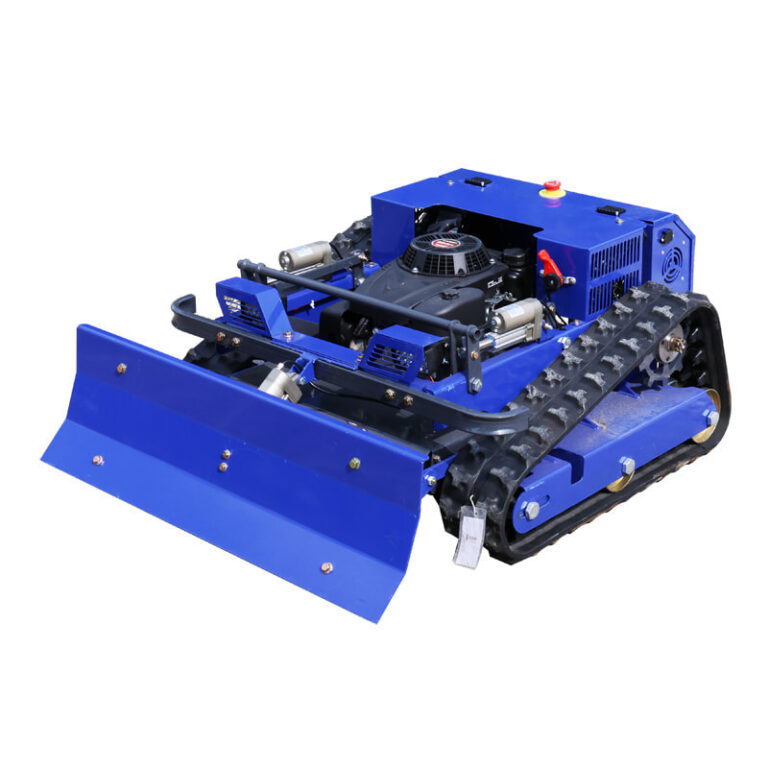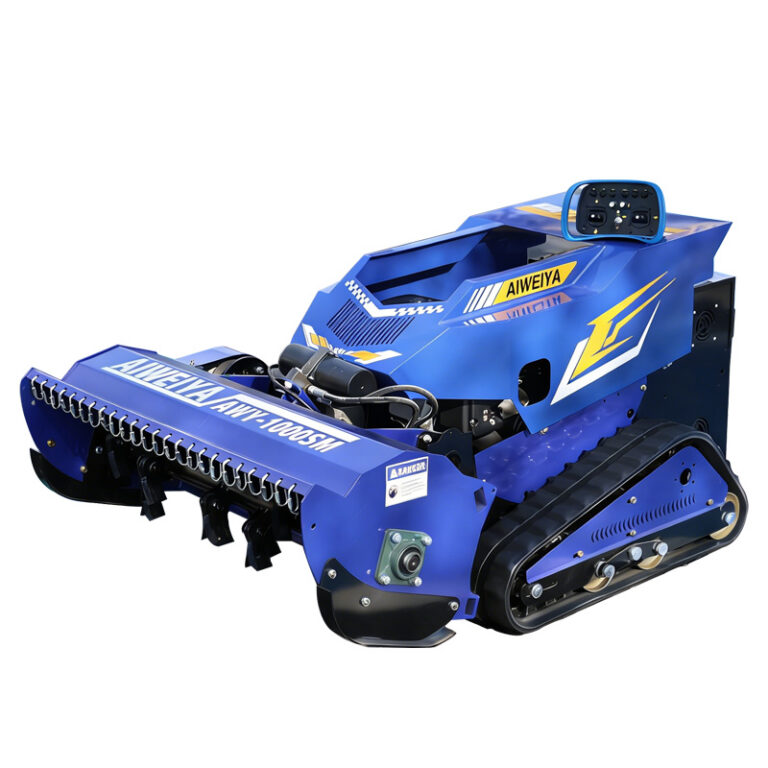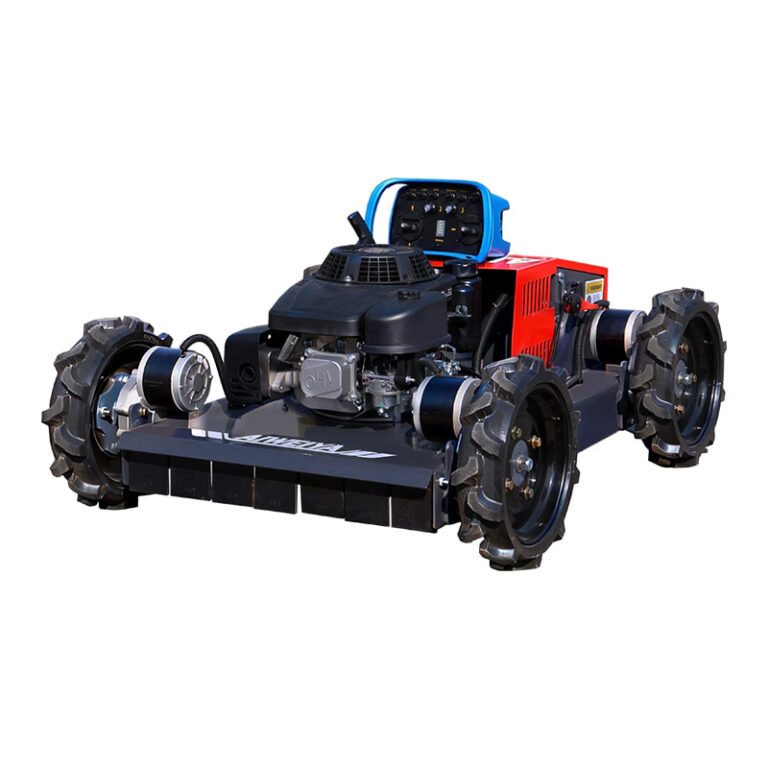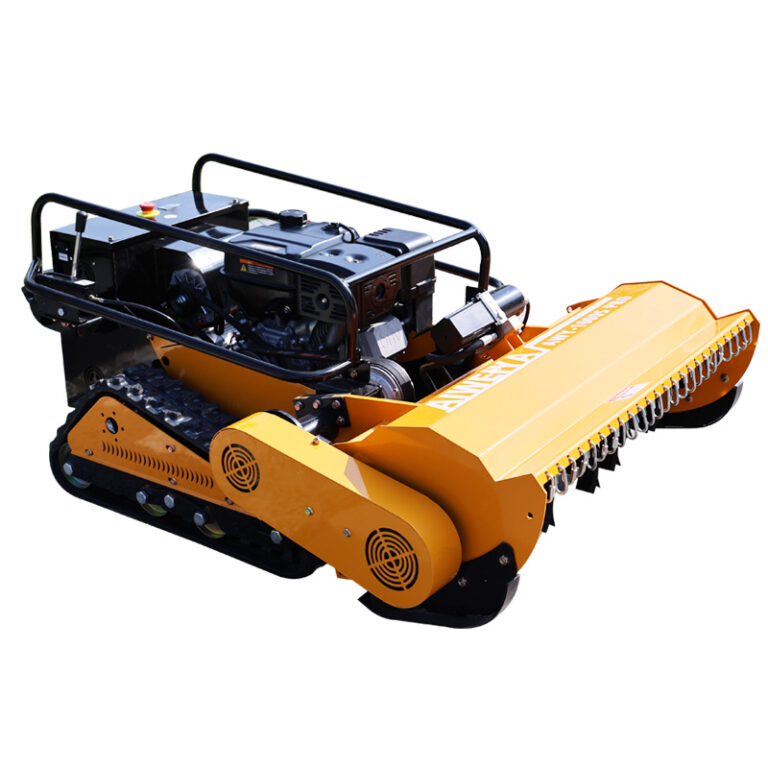
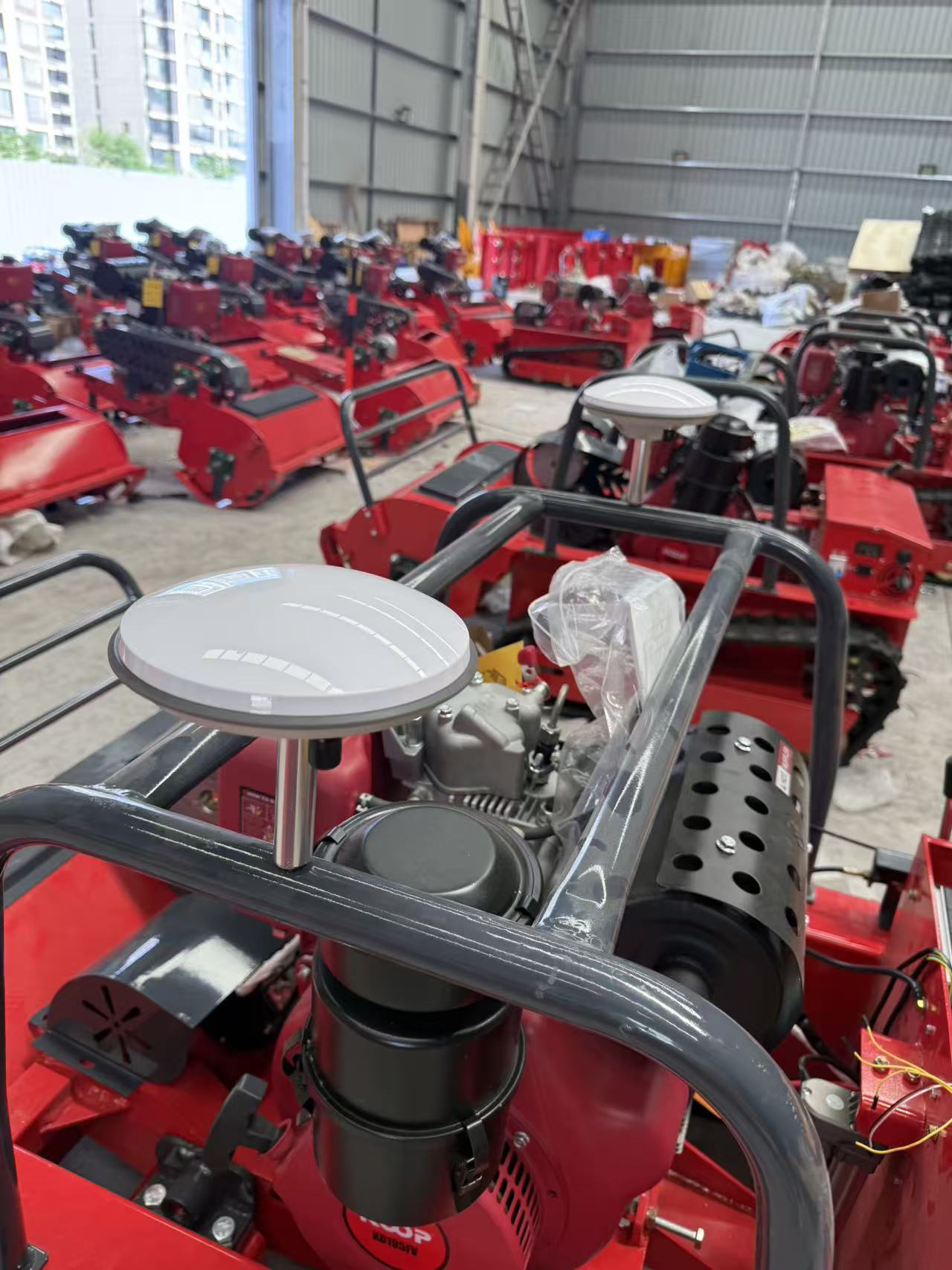
Choosing a remote control mower for commercial use requires more than comparing engine power or cutting width. Professional buyers need to consider terrain, vegetation, slope capability, drive system, cutting technology, operating range, maintenance requirements, and long-term operating costs.
A remote control mower can help professional contractors, landscapers, farmers, orchard managers, municipalities, rental companies, and vegetation management businesses handle areas that may be difficult, inefficient, or uncomfortable to mow with conventional equipment.
However, not every remote controlled mower is designed for the same application.
A compact wheeled mower may be suitable for relatively flat properties, while a tracked remote control mower may be a better choice for steep slopes, uneven terrain, and demanding vegetation. Similarly, a rotary cutting system and a flail cutting system can provide different advantages depending on the type of grass, weeds, brush, and vegetation you need to manage.
This commercial remote control mower buying guide explains the key factors you should evaluate before purchasing a machine and how to match mower specifications with your actual working conditions.
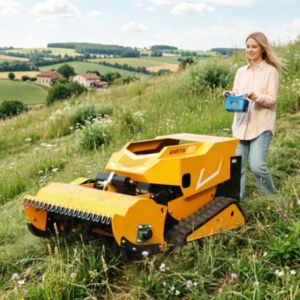
Choosing the right remote control mower starts with understanding your terrain, vegetation, and commercial application.
What Is a Remote Control Mower?
A remote control mower is a motorized mowing machine operated from a distance using a wireless remote controller rather than requiring the operator to sit directly on the machine.
Depending on the model, remote control mowers can be equipped with wheels or crawler tracks and different cutting systems, including rotary and flail configurations.
The remote operating system allows the operator to control functions such as:
- Forward and reverse movement
- Steering
- Mowing direction
- Cutting operation
- Engine functions
- Working speed
- Emergency stop
The main advantage is that the operator can remain away from the cutting deck and machine while controlling the equipment.
This can be particularly useful when mowing steep slopes, rough ground, roadside vegetation, orchards, farms, embankments, and areas with dense brush.
For commercial buyers, the important question is not simply whether a mower has remote control technology. The real question is:
Can the machine perform reliably in your specific working environment?
That is why the following specifications should be evaluated before purchasing.
1. Identify Your Main Mowing Application
Before comparing machines, define where and how you will use the mower.
Different commercial applications require different machine characteristics.
Common applications include:
- Steep slope mowing
- Farm vegetation management
- Orchard mowing
- Roadside maintenance
- Highway embankment maintenance
- Solar farm vegetation control
- Landscaping
- Brush and weed cutting
- Large property maintenance
- Municipal vegetation management
- Rental services
For example, a contractor maintaining roadside slopes may prioritize gradeability, crawler traction, stability, and cutting performance.
An orchard operator may place more importance on maneuverability, compact dimensions, and vegetation management capability.
A landscaping company working mainly on relatively flat properties may prioritize productivity, cutting width, transportability, and operating efficiency.
Therefore, start your buying process with the application rather than the machine.
2. Consider the Terrain and Slope
Terrain is one of the most important factors when choosing a commercial remote control mower.
A machine designed for flat grassland may not perform well on steep or uneven terrain.
If your work involves slopes, evaluate:
- Maximum recommended working slope
- Longitudinal gradeability
- Lateral slope capability
- Track or wheel configuration
- Center of gravity
- Ground clearance
- Traction
- Weight distribution
- Stability
For demanding slope applications, crawler tracks can provide advantages because they distribute machine weight across a larger contact area.
They can also provide additional traction on uneven or loose ground.
How to Choose a Remote Control Mower for Steep Slopes
Why Crawler Tracks Matter
Crawler systems are particularly relevant when the machine needs to operate on:
- Slopes
- Uneven terrain
- Rough grassland
- Embankments
- Orchard terrain
- Soft ground
- Areas with limited traction
The larger contact area can help improve traction and reduce the risk of wheel spin compared with some conventional wheeled configurations.
For buyers whose primary application involves steep slopes, a crawler remote control mower should be one of the first configurations to consider.
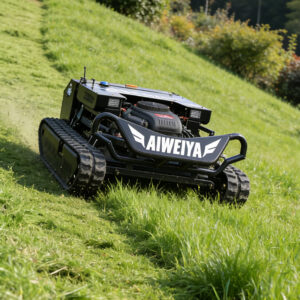
Crawler tracks provide traction and stability for demanding terrain and slope mowing
3. Choose the Right Cutting System
The cutting system determines what type of vegetation the machine can handle efficiently.
Two common configurations for commercial remote mowers are:
Rotary Cutting System
Rotary cutting systems are generally suitable for:
- Grass
- Pasture
- Lawn vegetation
- General vegetation maintenance
- Large open areas
They can be a practical choice when the primary objective is grass cutting and general vegetation management.
Flail Cutting System
Flail systems are designed for more demanding vegetation management.
They can be particularly useful for:
- Thick grass
- Weeds
- Brush
- Tall vegetation
- Rough grassland
- Vegetation containing small woody material
For contractors working in overgrown areas or roadside vegetation, a remote control flail mower may provide a better solution than a conventional grass-cutting deck.
Flail vs Rotary Remote Control Mower: Which Should You Choose?
4. Compare Cutting Width
Cutting width directly affects productivity.
A wider cutting deck can cover more ground in a single pass, which may reduce the number of passes required on large properties.
However, bigger is not always better.
A wide cutting deck can become less practical in:
- Narrow orchard rows
- Confined areas
- Uneven terrain
- Areas requiring precise maneuvering
When comparing cutting widths, consider both:
Productivity + Maneuverability
For large open areas, a wider deck may improve working efficiency.
For orchards or complicated terrain, a more compact cutting width may make the machine easier to control.
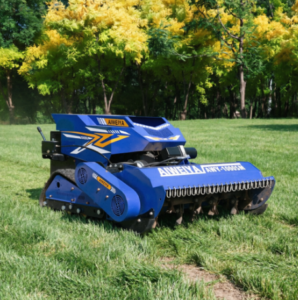
Cutting width should match the size of the working area and the maneuverability required.
5. Evaluate Engine Power
Engine power is another important specification for commercial buyers.
A higher-power engine may provide advantages when the mower needs to handle:
- Dense vegetation
- Tall grass
- Heavy brush
- Steep terrain
- Continuous commercial operation
- Larger cutting decks
However, engine power should not be evaluated by itself.
A machine’s real working performance also depends on:
- Cutting system
- Transmission
- Machine weight
- Track or wheel design
- Hydraulic system
- Cutting width
- Terrain
- Vegetation density
For example, a powerful engine paired with an unsuitable cutting system may not deliver the expected productivity.
Therefore, commercial buyers should evaluate the complete machine configuration rather than focusing on one specification.
6. Check Remote Control Range and Operation
Remote operation is one of the defining characteristics of a remote control mower.
Before purchasing, check the manufacturer’s specifications for:
- Remote control range
- Wireless connection stability
- Response time
- Emergency stop function
- Battery life
- Controller ergonomics
- Visibility between operator and machine
- Control functions
For professional applications, the remote controller should allow the operator to control the machine accurately while maintaining a safe operating distance.
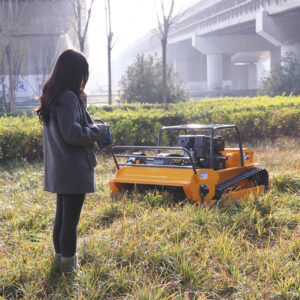
An ergonomic remote controller gives operators precise control over commercial mowing operations.
7. Look at Machine Stability
Stability is particularly important for slope mowing.
Important design factors include:
Low Center of Gravity
A lower center of gravity can contribute to improved stability on uneven terrain.
Machine Width
A wider machine can provide a larger support footprint, depending on the terrain and configuration.
Weight Distribution
Balanced weight distribution helps the machine maintain traction and stability.
Track Design
Crawler tracks can provide increased ground contact compared with conventional wheels.
Working Speed
Operating speed should be appropriate for the terrain and vegetation conditions.
For commercial slope applications, buyers should evaluate the complete machine design rather than relying on one specification.
8. Consider Productivity
Commercial buyers need to think about productivity rather than simply machine specifications.
A useful way to evaluate productivity is to consider:
Working Width × Working Speed × Terrain Conditions × Cutting Performance
A machine with a wider deck may cover more area per pass, but actual productivity can decrease if the terrain requires frequent maneuvering.
Likewise, a machine with high engine power may not necessarily be the most productive option if it is difficult to transport or maintain.
Consider your actual worksite and calculate:
- Area to be mowed
- Vegetation density
- Average slope
- Number of operating hours
- Required mowing frequency
- Number of operators
- Transportation requirements
This gives you a much better basis for selecting a machine.
9. Check Maintenance Requirements
Commercial equipment needs regular maintenance.
Before ordering a remote control mower, ask the supplier about:
- Engine maintenance
- Track or wheel maintenance
- Cutting blade or flail maintenance
- Hydraulic system maintenance
- Lubrication points
- Air filter replacement
- Belt or transmission components
- Remote controller battery
- Spare parts availability
A machine that is easy to maintain can reduce downtime over its operating life.
For commercial buyers, spare parts support can be just as important as the initial purchase price.
Remote Control Mower Maintenance Guide for Commercial Users
10. Ask About Spare Parts and After-Sales Support
When buying commercial machinery, do not evaluate the supplier only by the machine price.
Ask:
- Are spare parts available?
- How quickly can parts be shipped?
- Is technical support available?
- Are operation manuals provided?
- Can the supplier provide maintenance guidance?
- Does the manufacturer support dealers?
- Is OEM/ODM available?
- Can the supplier provide replacement components?
A reliable manufacturer should be able to provide support beyond the initial transaction.
This is especially important for distributors and contractors who depend on machine availability for their business.
11. Compare Manufacturer Capabilities
If you are purchasing one machine for your own operation, supplier support is important.
If you are purchasing multiple machines for resale or commercial deployment, manufacturer capability becomes even more important.
A professional remote mower manufacturer should ideally be able to support:
- Product customization
- OEM/ODM projects
- Bulk orders
- Spare parts
- Technical support
- Product documentation
- Packaging
- Dealer cooperation
- Export logistics
How to Find a Reliable Remote Control Mower Manufacturer in China
12. Think About Total Cost of Ownership
The cheapest machine is not necessarily the most economical machine.
Commercial buyers should consider:
Initial Purchase Price
The upfront cost of the machine.
Fuel Consumption
Fuel costs can become significant when machines operate for many hours.
Maintenance
Consider routine service and replacement parts.
Downtime
Equipment downtime can directly affect project schedules and business revenue.
Productivity
A machine that completes work faster may reduce labor and operating costs.
Service Life
Durability and long-term reliability affect the overall value of the investment.
A better purchasing approach is to evaluate:
Total Cost of Ownership = Purchase Cost + Operating Cost + Maintenance Cost + Downtime Cost
This provides a more realistic picture of the machine’s commercial value.
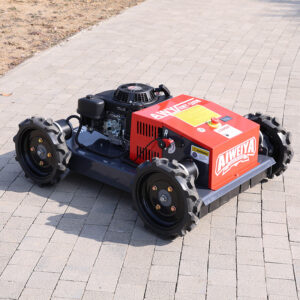
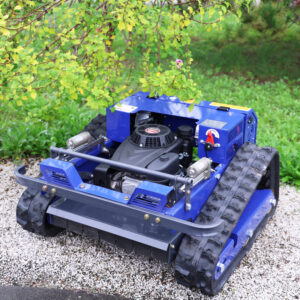
13. Crawler vs Wheel Remote Control Mower
One of the most common questions from commercial buyers is whether to choose a tracked or wheeled machine.
| Feature | Crawler Remote Mower | Wheel Remote Mower |
|---|---|---|
| Steep slopes | Excellent | Application dependent |
| Rough terrain | Excellent | Good |
| Traction | High | Good |
| Flat grassland | Good | Excellent |
| Maneuverability | Good | Excellent |
| Orchard applications | Good | Good |
| Roadside slopes | Excellent | Application dependent |
| Ground pressure | Generally lower | Depends on tires |
| Transport | Depends on model | Generally convenient |
| Best for | Difficult terrain | General commercial mowing |
The right choice depends on the application.
If your main requirement is steep-slope and rough-terrain mowing, a crawler configuration is often worth considering.
If your work is mainly on relatively flat terrain, a wheeled configuration may offer the maneuverability and efficiency you need.
Crawler vs Wheel Remote Control Mower: Which Is Better?
14. Match the Mower to Your Industry
Different industries have different requirements.
Agriculture
Farmers may use remote mowers for:
- Pasture maintenance
- Field edges
- Orchard vegetation
- Sloped farmland
- Weed management
Orchard Management
Orchard operators often need machines that can maneuver around:
- Trees
- Narrow rows
- Uneven ground
- Grass and weeds
Roadside Maintenance
Contractors may use remote mowers for:
- Roadside slopes
- Embankments
- Drainage areas
- Difficult-to-access vegetation
Solar Farms
Remote mowers can help manage vegetation around solar installations where access, terrain, and recurring maintenance are important considerations.
Landscaping
Professional landscaping companies can use remote mowers to improve productivity on large or difficult properties.
Remote Control Mower for Solar Farm Vegetation Management
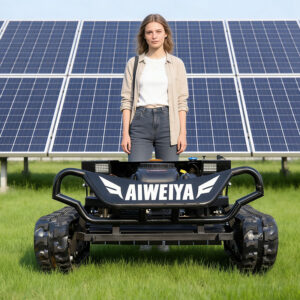
Remote control mowers can be used across agriculture, roadside maintenance, landscaping, and vegetation management.
15. Consider OEM and ODM Requirements
If you are a distributor, importer, dealer, or equipment brand, you may need more than standard machines.
OEM and ODM services can allow buyers to customize aspects such as:
- Brand identity
- Product appearance
- Labels
- Packaging
- Product configuration
- Technical specifications
- Accessories
- Documentation
When evaluating an OEM/ODM supplier, ask about:
- Minimum order quantity
- Customization options
- Development timeline
- Sample availability
- Production capacity
- Quality control
- Packaging
- Export experience
For businesses developing their own remote mower product line, working directly with a manufacturer can simplify communication and product development.
Remote Control Mower OEM and ODM Guide
16. Questions to Ask Before Buying a Remote Control Mower
Before placing an order, ask your supplier the following questions:
- What applications is this model designed for?
- What is its recommended maximum working slope?
- Is it crawler or wheel driven?
- What type of cutting system does it use?
- What is the cutting width?
- What engine options are available?
- What is the remote control range?
- What safety functions are included?
- What maintenance is required?
- Are spare parts readily available?
- Can the machine be customized?
- Do you provide OEM/ODM services?
- What is the minimum order quantity?
- What is the production lead time?
- What after-sales support is available?
The answers to these questions can help you compare suppliers on more than price.
17. Why Buy Directly From a Remote Control Mower Manufacturer?
For commercial buyers, purchasing directly from a manufacturer can provide several potential advantages.
Better Product Communication
You can communicate directly with the technical and sales team responsible for the product.
More Configuration Options
Manufacturers may provide different engines, cutting systems, drive configurations, or accessories.
OEM/ODM Support
Direct manufacturers are generally better positioned to support customized product requirements.
Spare Parts
A factory relationship can make it easier to source replacement parts.
Dealer Cooperation
Manufacturers can provide support for distributors and dealers building a local product line.
Long-Term Cooperation
For B2B buyers, a long-term supplier relationship can be more valuable than a one-time purchase.
Remote Control Mower Manufacturer vs Trading Company
18. Why Choose NUOYU for Your Remote Control Mower?
NUOYU focuses on remote-controlled mowing equipment for professional applications, including crawler, flail, and other remote mower configurations.
The product range is designed for applications such as:
- Slope mowing
- Farm and orchard vegetation management
- Roadside maintenance
- Brush and weed cutting
- Landscaping
- Commercial vegetation management
For distributors, contractors, importers, rental companies, and other professional buyers, NUOYU can provide product selection and configuration support based on the intended application.
Instead of choosing a machine based only on horsepower or price, NUOYU can help buyers evaluate the combination of:
Terrain + Vegetation + Cutting System + Drive System + Working Requirements
Remote Control Mower Buying Checklist
Before purchasing, use this quick checklist:
Application
☐ Farm
☐ Orchard
☐ Slope
☐ Roadside
☐ Solar farm
☐ Landscaping
☐ Brush and weeds
Terrain
☐ Flat
☐ Uneven
☐ Steep
☐ Soft ground
☐ Rough terrain
Machine
☐ Engine power
☐ Cutting width
☐ Cutting system
☐ Crawler or wheel
☐ Gradeability
☐ Ground clearance
☐ Machine dimensions
Operation
☐ Remote range
☐ Controller
☐ Emergency stop
☐ Battery life
☐ Operating visibility
Supplier
☐ Spare parts
☐ Technical support
☐ Warranty
☐ OEM/ODM
☐ Production capacity
☐ Export experience
Frequently Asked Questions
Are remote control mowers suitable for commercial use?
Yes. Remote control mowers can be used for professional vegetation management in applications such as agriculture, orchards, roadside maintenance, landscaping, slope mowing, and brush cutting. The appropriate machine should be selected based on terrain, vegetation, and workload.
Are crawler remote control mowers better for slopes?
Crawler configurations can provide strong traction and stability on challenging terrain. They are particularly suitable for applications involving slopes, rough ground, and areas where maintaining traction is important.
What is the difference between a rotary and flail remote mower?
Rotary systems are commonly used for grass and general vegetation, while flail systems are often preferred for thicker vegetation, weeds, brush, and demanding vegetation management applications.
How much does a commercial remote control mower cost?
The price depends on factors such as engine power, cutting system, drive configuration, cutting width, optional equipment, and order quantity. Commercial buyers should compare total operating value rather than purchase price alone.
Can I buy remote control mowers directly from a manufacturer?
Yes. Buying directly from a manufacturer can provide access to product configurations, OEM/ODM services, spare parts, technical support, and B2B cooperation.
Can remote control mowers be customized?
Depending on the manufacturer, customization may include product configuration, branding, packaging, accessories, and other OEM/ODM requirements. Buyers should discuss specific requirements with the manufacturer before ordering.
What should I consider when choosing a remote control mower supplier?
Consider product quality, manufacturing capability, application knowledge, spare parts availability, technical support, OEM/ODM capability, production lead time, and export experience—not just the initial machine price.
Final Thoughts
Choosing the right remote control mower for commercial use starts with understanding your working conditions.
The best machine for a steep roadside slope may be very different from the best machine for a flat farm or orchard.
Before purchasing, evaluate:
Application → Terrain → Cutting System → Drive System → Engine → Productivity → Maintenance → Supplier Support
For difficult slopes and rough terrain, crawler configurations may be the right choice. For general grass and vegetation management, wheeled or rotary configurations may provide the required productivity and maneuverability. For heavy brush and weeds, a flail cutting system can be a valuable option.
If you are purchasing remote control mowers for your own business, dealership, rental operation, or OEM product line, selecting the right manufacturer is equally important.
Looking for the right remote control mower for your application? Contact NUOYU to discuss your terrain, vegetation, working requirements, and preferred configuration.