Buying a remote control mower is a significant investment for commercial users. Whether you are a landscaping contractor, farmer, orchard operator, roadside maintenance company, dealer, rental business, or machinery importer, choosing the right machine requires more than comparing prices.
A professional remote controlled mower needs to match the terrain, vegetation, workload, and operating environment where it will be used.
Important factors include:
- Engine power
- Cutting width
- Cutting system
- Drive system
- Slope capability
- Traction
- Machine stability
- Remote control range
- Safety functions
- Working speed
- Maintenance requirements
- Spare parts availability
- Manufacturer support
A machine with impressive specifications on paper may not necessarily be the best solution for your application.
The goal is to find the right combination of performance, reliability, productivity, maneuverability, and long-term value.
This guide explains the key things to check before purchasing a remote control mower.
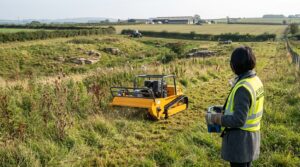
Before buying a remote control mower, compare the machine’s configuration with your actual working conditions.
1. Start With the Intended Application
Before looking at individual specifications, determine exactly where the mower will be used.
A remote control mower can be used for many different applications, including:
- Steep slope mowing
- Farm vegetation management
- Orchard mowing
- Roadside maintenance
- Highway embankments
- Solar farm vegetation control
- Landscaping
- Brush cutting
- Weed management
- Large property maintenance
- Municipal vegetation management
Each application places different demands on the machine.
For example, a contractor working on steep roadside embankments may need strong traction and slope capability.
An orchard operator may need a compact machine with good maneuverability.
A landscaping company working on large properties may prioritize cutting width and productivity.
Therefore, the first question to ask a supplier is not:
“How powerful is the mower?”
Instead ask:
“Is this configuration suitable for my working environment?”
How to Choose the Right Remote Control Mower for Your Application
2. Check the Drive System
The drive system determines how the mower moves across the ground.
The two main configurations are:
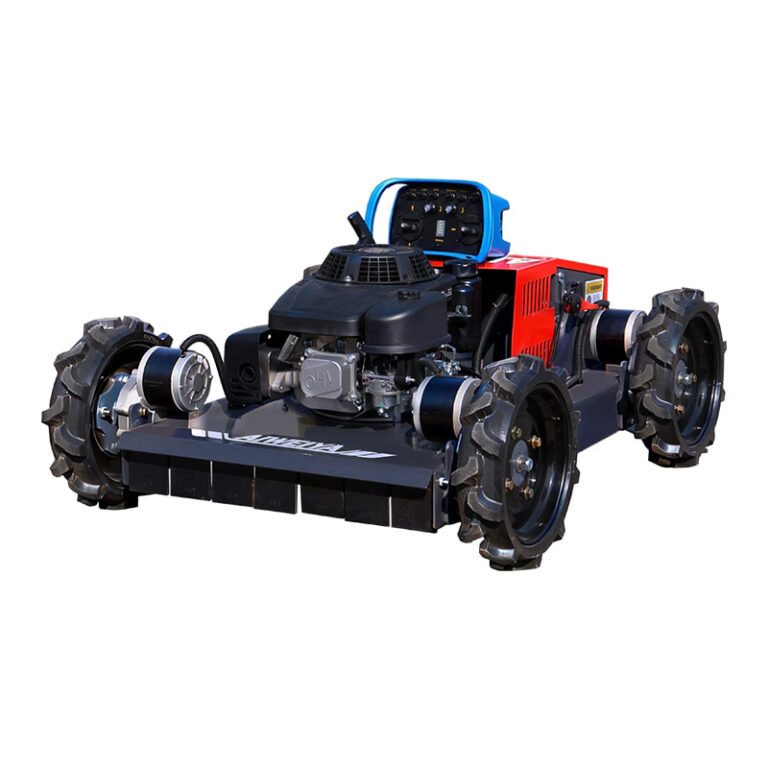
- Wheeled
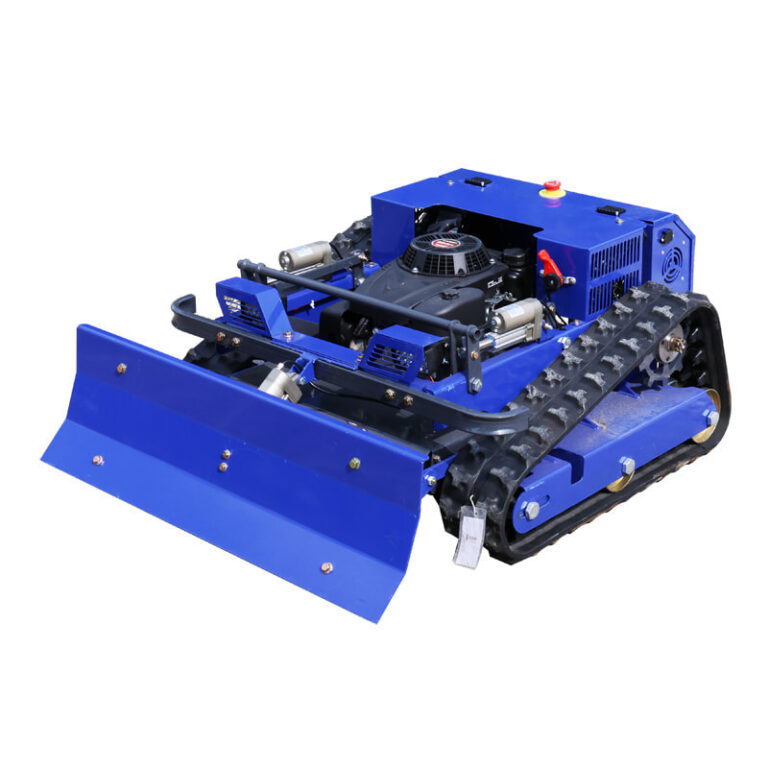
- Crawler/tracked
Your choice should depend primarily on terrain and traction requirements.
Wheeled Remote Control Mowers
Wheeled machines can be suitable for:
- Flat grassland
- Parks
- Landscaping
- Farms
- Large properties
- General vegetation management
They can offer good maneuverability on suitable terrain.
Crawler Remote Control Mowers
Tracked machines are particularly useful when working on:
- Steep slopes
- Uneven terrain
- Rough ground
- Embankments
- Soft ground
- Challenging vegetation areas
Crawler tracks can provide a large contact area with the ground and strong traction.

Choose between crawler and wheel drive according to terrain, traction, and maneuverability requirements.
3. Check Slope Capability
If you plan to mow slopes, this should be one of the first specifications you evaluate.
Ask the manufacturer about:
- Maximum recommended slope
- Longitudinal gradeability
- Lateral slope capability
- Surface conditions
- Recommended operating speed
- Traction limitations
Do not assume that a mower advertised as “suitable for slopes” can safely operate on every slope.
Actual performance may depend on:
- Grass conditions
- Soil
- Moisture
- Surface stability
- Machine configuration
- Operator experience
For professional slope mowing, always follow the manufacturer’s operating instructions and recommended limits.
How to Choose a Remote Control Mower for Steep Slopes
4. Look at Engine Power
Engine power is an important specification, but it should never be considered alone.
More demanding applications may require more power, particularly when the machine is handling:
- Dense grass
- Tall vegetation
- Thick weeds
- Brush
- Larger cutting decks
- Steep terrain
However, a high-power engine does not automatically mean higher productivity.
Performance also depends on:
- Cutting system
- Transmission
- Machine weight
- Hydraulic system
- Cutting width
- Ground conditions
- Working speed
When comparing models, look at the complete configuration rather than horsepower alone.
5. Evaluate the Cutting System
The cutting system determines what type of vegetation the mower is designed to handle.
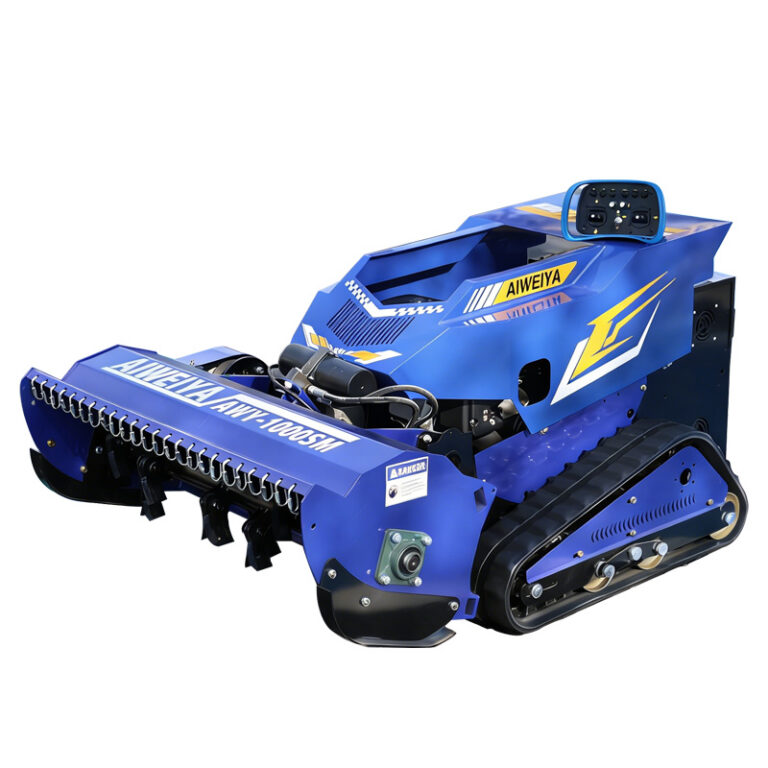
Two common systems are rotary and flail.
Rotary Mowing
Rotary systems are generally appropriate for:
- Grass
- Pasture
- General vegetation
- Large open areas
They can be a practical solution when grass cutting is the primary requirement.
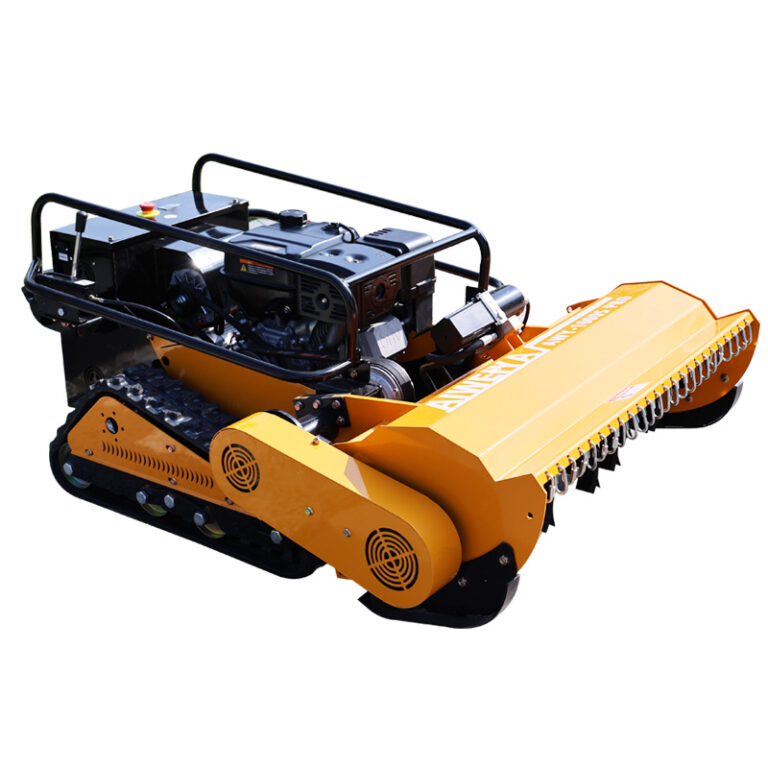
Flail Mowing
Flail systems are often preferred for more demanding vegetation.
Typical applications include:
- Tall grass
- Dense weeds
- Brush
- Rough vegetation
- Roadside vegetation
- Overgrown areas
For contractors dealing with mixed vegetation, a remote control flail mower can provide a versatile solution.
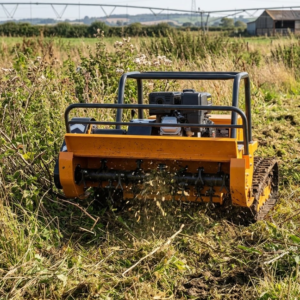
6. Compare Cutting Width
Cutting width affects how much vegetation can be cleared during each pass.
A wider cutting deck can improve productivity in large open areas.
However, a wider machine may be less convenient in:
- Narrow orchard rows
- Areas between trees
- Confined spaces
- Around obstacles
- Complicated terrain
When evaluating cutting width, consider:
Working Area + Terrain + Maneuverability + Required Productivity
For example, a large commercial field may benefit from a wider cutting system.
An orchard with narrow rows may require a more compact configuration.
The best cutting width is therefore not necessarily the largest available.
7. Check Working Speed
Working speed affects potential productivity.
However, maximum travel speed and actual mowing speed are not necessarily the same.
Actual working speed depends on:
- Vegetation density
- Cutting system
- Terrain
- Slope
- Machine stability
- Operator visibility
- Desired cutting quality
A machine operating too quickly in dense vegetation may reduce cutting performance.
On challenging slopes, slower controlled movement may also be more appropriate.
Therefore, ask the manufacturer for realistic information about working performance rather than looking only at maximum travel speed.
8. Evaluate Traction
Traction becomes especially important on:
- Slopes
- Wet grass
- Soft ground
- Uneven terrain
- Loose soil
- Rough fields
A machine can have sufficient engine power but still struggle if traction is inadequate.
Important factors include:
- Track design
- Tire design
- Machine weight
- Ground contact
- Weight distribution
- Drive system
If your primary application involves slopes or difficult terrain, traction should be one of the main criteria in your buying decision.
9. Consider Machine Stability
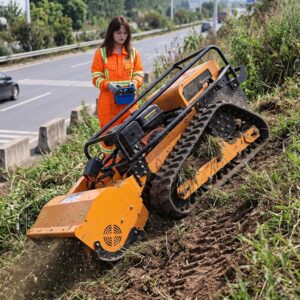
For professional mowing on uneven terrain, machine stability is critical.
Look at:
- Center of gravity
- Machine width
- Track or wheel spacing
- Machine height
- Weight distribution
- Ground clearance
- Chassis design
A low-profile design can help maintain stability on uneven terrain.
However, stability also depends on the operating environment.
Wet grass, loose soil, rocks, and steep slopes can all change machine behavior.
Therefore, buyers should combine manufacturer specifications with actual site conditions.
10. Check Remote Control Range
Remote operation is one of the major advantages of this type of equipment.
When comparing remote control systems, look at:
- Maximum control range
- Signal stability
- Response time
- Controller design
- Battery life
- Control functions
- Emergency stop
- Signal-loss protection
The stated range should be viewed as a manufacturer’s specification rather than a guaranteed distance in every environment.
Buildings, trees, terrain, interference, and other obstacles may affect wireless communication.
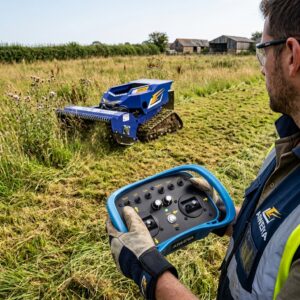
Reliable remote control allows operators to manage the machine from an appropriate position.
11. Look for Practical Safety Features
Safety should be considered before purchasing any commercial mowing machine.
Depending on the model, useful safety functions may include:
- Emergency stop
- Engine shutdown
- Signal-loss protection
- Remote-controlled cutting engagement
- Controlled operating speed
- Operator visibility
- Protective machine design
Buyers should request the manufacturer’s safety documentation and operating instructions.
Operators should also receive appropriate training before using the machine.
Remote control technology can allow operators to remain away from the cutting deck, but it does not eliminate the need for proper operating procedures.
12. Check Machine Dimensions and Weight
Machine dimensions can affect transport, storage, and application suitability.
Check:
- Overall length
- Overall width
- Overall height
- Machine weight
- Ground clearance
- Loading requirements
These specifications matter particularly for contractors who transport machines between different worksites.
A machine that fits easily on your existing trailer can simplify daily operations.
For orchard applications, machine width can also determine whether the mower can move comfortably between rows.
13. Consider Fuel and Operating Efficiency
Commercial buyers should evaluate operating costs, not just the initial purchase price.
Important factors can include:
- Fuel consumption
- Engine efficiency
- Maintenance intervals
- Cutting productivity
- Working speed
- Required labor
- Spare parts
A machine that completes a job efficiently can provide better long-term value even if its initial purchase price is higher.
This is why commercial buyers should evaluate:
Purchase Cost + Operating Cost + Maintenance Cost + Downtime
rather than purchase price alone.
Remote Control Mower Price: What Affects the Cost?
14. Evaluate Maintenance Requirements
Before purchasing, ask how frequently the machine requires maintenance.
Important areas include:
Engine
Oil, filters, cooling system, and routine servicing.
Cutting System
Blades, flails, belts, shafts, or other wear components.
Drive System
Tracks, wheels, transmission, or related components.
Hydraulic System
For machines using hydraulic components, check inspection and service requirements.
Remote Control System
Controller battery, charging, and communication components should also be considered.
A machine designed for commercial use should have a practical maintenance routine.
15. Ask About Spare Parts Availability
Spare parts support can have a major effect on business continuity.
Before ordering, ask:
- Which parts are considered wear parts?
- Are replacement cutting components available?
- Can tracks or tires be supplied?
- Are filters and belts available?
- How quickly can parts be shipped?
- Are spare parts stocked?
- Can the supplier provide parts lists?
For distributors and dealers, spare parts availability can also affect customer satisfaction.
A strong supplier relationship should continue after the machine is delivered.
16. Check Manufacturer Support
The supplier you choose is almost as important as the mower itself.
Look for a manufacturer that can provide:
- Product documentation
- Operation manuals
- Technical support
- Spare parts
- Maintenance guidance
- Warranty information
- OEM/ODM support
- Dealer support
If you are buying several machines, these services can have a significant impact on your business.
How to Find a Reliable Remote Control Mower Manufacturer in China
17. Consider OEM and ODM Options
For importers, dealers, and machinery brands, customization may be an important consideration.
OEM/ODM options may include:
- Brand name
- Product labels
- Packaging
- Color or appearance
- Accessories
- Product configurations
- Documentation
Before starting an OEM project, discuss:
- Minimum order quantity
- Customization options
- Sample requirements
- Production lead time
- Packaging
- Quality control
- After-sales support
If you are building your own remote mower product line, direct cooperation with a manufacturer can provide greater flexibility.
Remote Control Mower OEM and ODM Guide
18. Ask About Production Capacity
For B2B buyers, production capacity can be important.
If you are ordering one machine, lead time may be less critical.
If you are building inventory for a dealership or distribution network, production capacity becomes much more important.
Ask the supplier:
- What is the normal production lead time?
- What is the monthly production capacity?
- Can production scale with demand?
- How are large orders managed?
- Are spare parts available?
- Can customized products be produced consistently?
A reliable supply chain helps distributors avoid stock shortages.
19. Review Quality Control
Before placing a commercial order, ask how the manufacturer controls product quality.
Possible areas include:
- Incoming material inspection
- Component testing
- Assembly inspection
- Machine testing
- Remote control testing
- Cutting system testing
- Final inspection
- Packaging inspection
For large B2B orders, buyers can also discuss inspection requirements before shipment.
Quality control should be part of the purchasing process rather than an afterthought.
20. Compare Suppliers Using the Same Criteria
When comparing multiple remote mower manufacturers, create a standard checklist.
For example:
| Factor | Supplier A | Supplier B | Supplier C |
|---|---|---|---|
| Engine options | ✓ | ✓ | ✓ |
| Crawler models | ✓ | ✓ | — |
| Flail configuration | ✓ | ✓ | ✓ |
| Slope applications | ✓ | ✓ | ✓ |
| OEM/ODM | ✓ | — | ✓ |
| Spare parts | ✓ | ✓ | — |
| Technical support | ✓ | ✓ | ✓ |
| Production capacity | Check | Check | Check |
| Lead time | Check | Check | Check |
| Warranty | Check | Check | Check |
The exact comparison will depend on your application and supplier.
The important point is to compare manufacturers using the same criteria.
21. Don’t Choose a Mower Based Only on Price
Price is obviously important.
However, the lowest quotation may not represent the lowest overall cost.
Consider what is included in the quotation:
- Machine
- Cutting system
- Remote controller
- Accessories
- Spare parts
- Packaging
- Warranty
- Technical support
- Shipping
- Customization
Also consider machine productivity and expected service life.
For commercial users, a machine that costs slightly more but provides better productivity and support may deliver greater value over time.
22. Match the Machine to the Vegetation
Before buying, describe your vegetation to the manufacturer as accurately as possible.
Instead of saying:
“I need a mower for grass.”
Provide information such as:
“The machine will mow grass approximately 50–80 cm high, with areas of thick weeds and occasional brush.”
Useful information includes:
- Average vegetation height
- Vegetation density
- Grass species if known
- Brush presence
- Small woody growth
- Mowing frequency
- Wet or dry conditions
The more accurate your description, the easier it is for the supplier to recommend the appropriate cutting system.
23. Match the Machine to the Terrain
The same principle applies to terrain.
Tell the manufacturer:
- Average slope
- Maximum slope
- Ground condition
- Soil type
- Wet or dry conditions
- Rocks or obstacles
- Narrow passages
- Required working direction
For example:
Flat farm + grass
→ Wheeled configuration may be appropriate.
Steep slope + dense vegetation
→ Crawler + flail configuration may be worth considering.
Orchard + narrow rows
→ Compact configuration and maneuverability become more important.
Roadside slope + brush
→ Strong traction and heavy-duty cutting capability are key considerations.
24. What Should Commercial Buyers Ask the Manufacturer?
Before placing an order, ask these questions:
About the Machine
- What applications is the model designed for?
- What is the engine power?
- What is the cutting width?
- What cutting system is available?
- Is it crawler or wheel driven?
- What is the recommended slope capability?
- What is the operating speed?
- What is the remote control range?
About Maintenance
- What are the main wear parts?
- How often is maintenance required?
- Are spare parts readily available?
- Can maintenance instructions be provided?
About Business Cooperation
- Is OEM/ODM available?
- What is the MOQ?
- What is the production lead time?
- Can you support distributors?
- What after-sales support is provided?
- Can you provide product documentation?
These questions can help you identify whether a supplier is capable of supporting long-term commercial use.
25. Remote Control Mower Buying Checklist
Use this checklist when evaluating a machine.
Application
☐ Farm
☐ Orchard
☐ Slope
☐ Roadside
☐ Solar farm
☐ Landscaping
☐ Brush cutting
☐ Municipal maintenance
Terrain
☐ Flat
☐ Uneven
☐ Steep
☐ Soft
☐ Rough
Drive System
☐ Wheel
☐ Crawler
Cutting System
☐ Rotary
☐ Flail
Performance
☐ Engine power
☐ Cutting width
☐ Working speed
☐ Gradeability
☐ Traction
Remote Control
☐ Operating range
☐ Battery life
☐ Emergency stop
☐ Signal stability
☐ Controller functions
Ownership
☐ Maintenance
☐ Spare parts
☐ Warranty
☐ Technical support
☐ Transport
☐ OEM/ODM
26. Why NUOYU Is a Practical Choice for B2B Buyers
NUOYU focuses on remote-controlled mowing equipment for professional and commercial applications.
The product range includes different configurations designed for applications such as:
- Slope mowing
- Farm vegetation management
- Orchard maintenance
- Roadside vegetation control
- Brush and weed cutting
- Landscaping
- Commercial land maintenance
For B2B buyers, the goal is not simply to purchase a machine.
It is to select a configuration that matches the actual working environment.
NUOYU can help buyers evaluate requirements such as:
Terrain + Vegetation + Drive System + Cutting System + Power + Working Conditions
This approach can be useful for:
- Contractors
- Importers
- Distributors
- Dealers
- Rental companies
- Farms
- Landscaping companies
- OEM brands
Frequently Asked Questions
What should I look for when buying a remote control mower?
The main factors include application, terrain, slope capability, drive system, cutting system, engine power, cutting width, remote control range, safety functions, maintenance, spare parts, and manufacturer support.
What type of remote control mower is best for slopes?
For demanding slopes, a crawler remote control mower can be a suitable option because tracks can provide strong ground contact and traction. Always verify the specific model’s recommended operating limits.
Should I choose a crawler or wheeled remote mower?
Choose based on your terrain. Crawler machines are often considered for difficult slopes and rough terrain, while wheeled machines can be suitable for relatively flat and accessible areas.
Is a flail mower better than a rotary mower?
It depends on the vegetation. Rotary systems are commonly suitable for grass and general vegetation, while flail systems can be more appropriate for dense grass, weeds, brush, and rough vegetation.
Is higher engine power always better?
No. Engine power should be matched with the cutting system, cutting width, vegetation, terrain, and workload. The overall machine configuration is more important than horsepower alone.
How important is remote control range?
Remote control range is important, but it should be considered together with signal stability, operating environment, controller functions, emergency stop, and machine visibility.
What should I ask a remote control mower manufacturer?
Ask about machine specifications, slope capability, cutting system, engine options, spare parts, maintenance, warranty, production lead time, OEM/ODM services, technical support, and dealer cooperation.
Can I order customized remote control mowers?
Depending on the manufacturer’s capabilities, OEM and ODM customization may be available for branding, packaging, product configuration, accessories, and other requirements.
Final Thoughts
Buying a remote control mower should be treated as a complete equipment selection process rather than a simple price comparison.
Before making a decision, evaluate:
Application → Terrain → Drive System → Cutting System → Power → Productivity → Remote Control → Safety → Maintenance → Supplier Support
The right combination depends on your actual working environment.
A contractor mowing steep roadside slopes may need a tracked machine with a heavy-duty cutting system.
A farmer maintaining relatively flat grassland may prioritize productivity and cutting width.
An orchard operator may need a compact machine with precise maneuverability.
A distributor may require multiple configurations, spare parts, OEM/ODM services, and long-term supply support.
The best remote control mower is therefore not simply the machine with the highest horsepower or lowest price.
It is the machine that provides the right balance of performance, stability, cutting capability, productivity, reliability, and commercial value for your specific application.
If you are comparing remote control mowers for professional use, provide your supplier with information about your terrain, vegetation, working area, and operating requirements.
NUOYU can help you evaluate the appropriate remote mower configuration for your application.